In Short
In Irish folklore, a fairy fort belongs to the Aos Sí, the fairy people, whatever the land deeds say. Damaging one, by ploughing through it, digging into its banks, taking its stones, or cutting its thorn trees, was believed to bring illness, dead cattle, failed crops, injury, or a death in the family. The belief was taken so seriously that farmers worked around forts for centuries, and many still do. Most known ringforts in the Republic of Ireland are also protected by law, so today there are practical reasons to leave them alone as well as supernatural ones.
| The rule | Never plough, dig, build on, or take anything from a fairy fort |
|---|---|
| Worst offense | Cutting a fairy thorn growing on or near the fort |
| Punishments in the stories | Illness, dead livestock, failed crops, injury, death in the family |
| Also dangerous | Building a house on a fairy path between forts |
| Making amends | Put everything back, and stop the work |
| Walking in one | Generally fine by day, if you disturb nothing |
| The law | Recorded ringforts are protected under the National Monuments Acts |
Whose Ground Is It?
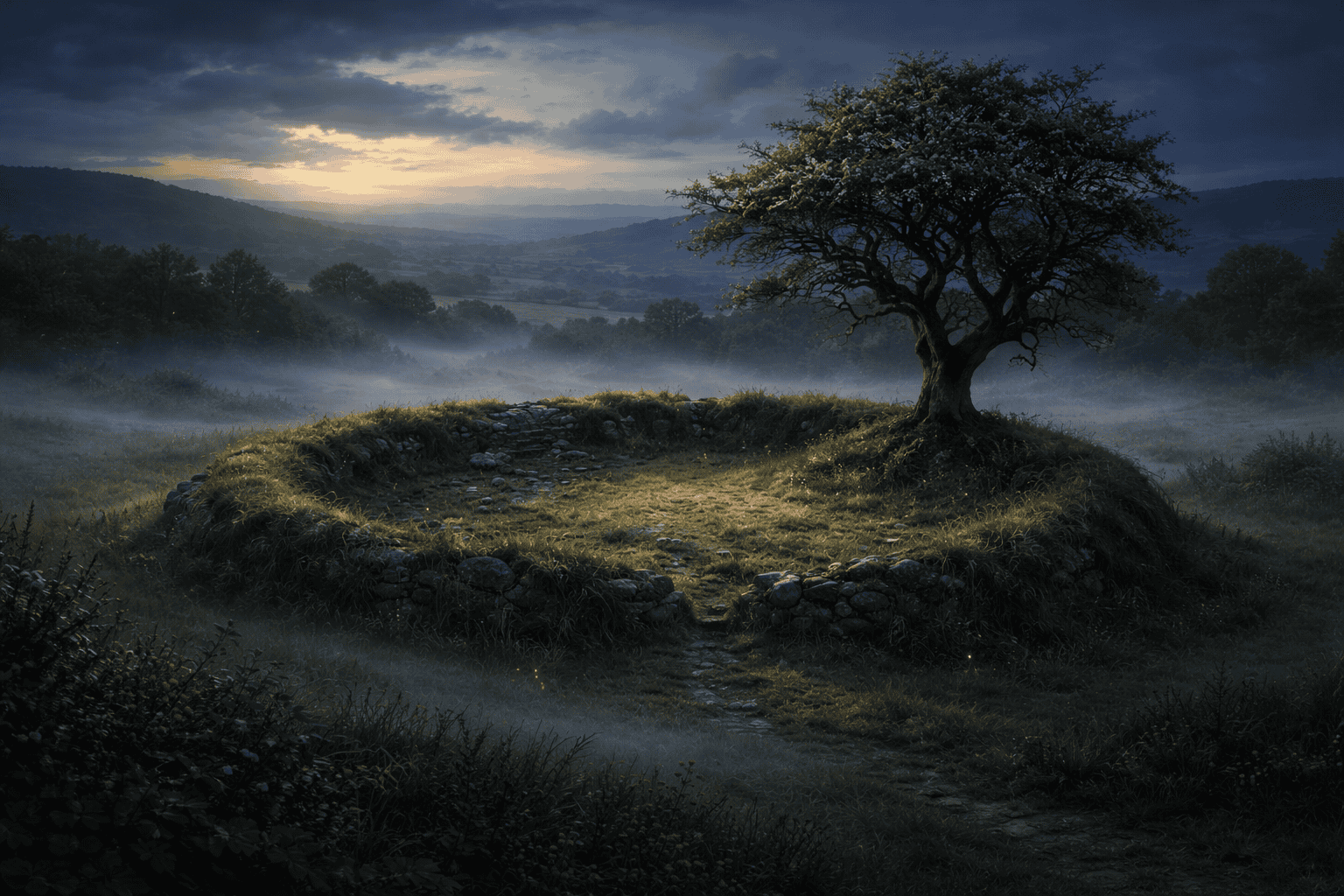
A farmer in the old stories might own a field outright, pay rent on it, and work it every day of his life. But if there was a fairy fort in the corner, the round bank ringed with hawthorn, then that corner was not really his. It belonged to the Good People, the daoine maithe, who were believed to live inside or to gather there at night. He could graze his cattle around it and cut hay up to its edge. He did not touch the fort itself.
That is the heart of the warning. Disturbing a fairy fort was not like breaking an ordinary rule. It was trespass against neighbors who were powerful, easily offended, and slow to forgive.
What Counted as Disturbing a Fort
Not every contact with a fort was forbidden. Tradition drew the line at damage. These were the offenses people most feared:
- Ploughing or leveling it. Running a plough through the bank, or flattening the fort to gain a little more land.
- Digging into it. Cutting into the banks for soil or gravel, or digging for the treasure that forts were rumored to hide.
- Taking its stones. Carting away stones from a stone fort or its walls to use in a house, byre, or wall.
- Cutting its trees. Above all, cutting a fairy thorn, even a single branch for firewood.
- Building on it. Putting a house, shed, or road across the fort, or across the paths the fairies used between forts.
What Happened to Those Who Did
The folklore of every county is full of cautionary tales, and they follow a familiar pattern. Someone ignores the warning, often boasting that he does not believe in fairies, and damages a fort. Soon after, things start to go wrong.
The punishments in the stories range from the petty to the fatal. The man who cut a thorn on a fort might cut his hand or break his leg. The farmer who ploughed through one might find his cattle sickening or his crops failing, year after year. A family who used the fort’s stones in their new house might find the house unlucky, full of strange noises at night, and never prosperous. In the gravest stories, a child falls ill and dies, or the man who did the damage is struck down himself. Similar accounts were collected in great numbers by Lady Gregory in the west of Ireland in the early twentieth century, and by the schoolchildren of the Schools’ Collection in the 1930s.
A common detail is that the worker who is hired to do the job refuses, and the owner has to do it himself, or bring in outsiders who do not know the stories. The locals, watching from a safe distance, are rarely surprised by what follows.
Fairy Paths
The danger did not stop at the fort’s bank. The fairies were believed to travel between their forts along invisible paths, especially on the great festival nights of Samhain and Bealtaine. A house built across one of those paths was in their way, and could expect trouble: illness, bad luck, and noises in the night.
People had practical remedies. The corner of a house that stood in the way might be knocked off to let the host pass. In other cases, the front and back doors were built exactly opposite each other and left open on certain nights, so that the fairies could pass straight through the house without being blocked.
Asking Permission Before Building
Because nobody could see the fairy paths, a careful builder tested the ground first. One custom, recorded in many parts of Ireland, was to mark out the site of a new house with stones or sods at the corners and leave them overnight. If they were still in place in the morning, it was safe to build. If they had been scattered, the site was on fairy ground, and the family would look for somewhere else.
Can You Make Amends?
If the damage was already done, the folklore offers a few remedies, though none is guaranteed. The first step was to stop the work immediately. Stones taken from the fort were carried back and put where they had been. Soil was returned to the bank. Some people left offerings of milk or bread at the fort, or said prayers there. The stories suggest that the fairies were most offended by pride, so an honest admission of the wrong, and a real effort to put it right, was the best hope.
A Belief That Still Shapes the Landscape
The warning is not only a thing of the past. Many Irish farmers still plough around a fort rather than through it, and builders and road engineers have changed their plans rather than disturb one. The best-known modern example involves a tree rather than a fort: the Latoon fairy bush in County Clare, which the storyteller Eddie Lenihan campaigned to save from a motorway in 1999, and which the road was eventually built to avoid.
The belief has also had a lasting benefit that its holders never intended. Because so many people refused to touch the forts, tens of thousands of early medieval settlement sites survived into modern times, in the middle of intensively farmed land. Archaeologists often say they owe the fairies a debt.
The Legal Reason to Leave Them Alone
Today, there is a practical reason as well. In the Republic of Ireland, most known ringforts are listed in the Record of Monuments and Places and protected under the National Monuments Acts. Anyone planning work at or near a recorded monument must notify the government two months in advance, and damaging one without permission is a criminal offense. Our guide to fairy forts explains the law in more detail.
Is It Bad Luck to Walk Into a Fairy Fort?
Not in most traditions. The folklore warns against damaging a fort, not against visiting one. Many people would avoid being inside a fort at night, and some would never sleep or lie down in one, for fear of waking up in the fairy world. But walking through a fort by day, respectfully, and without taking anything away, was generally considered safe. What the fairies objected to was damage, not company.
Sources and Further Reading
- Lady Augusta Gregory, Visions and Beliefs in the West of Ireland, G. P. Putnam’s Sons (1920).
- Seán Ó Súilleabháin, A Handbook of Irish Folklore, Educational Company of Ireland (1942).
- Eddie Lenihan and Carolyn Eve Green, Meeting the Other Crowd: The Fairy Stories of Hidden Ireland, Tarcher (2004).
- Matthew Stout, The Irish Ringfort, Four Courts Press (1997).
- The Schools’ Collection, National Folklore Collection, University College Dublin (1937 to 1939), on dúchas.ie.