In Short
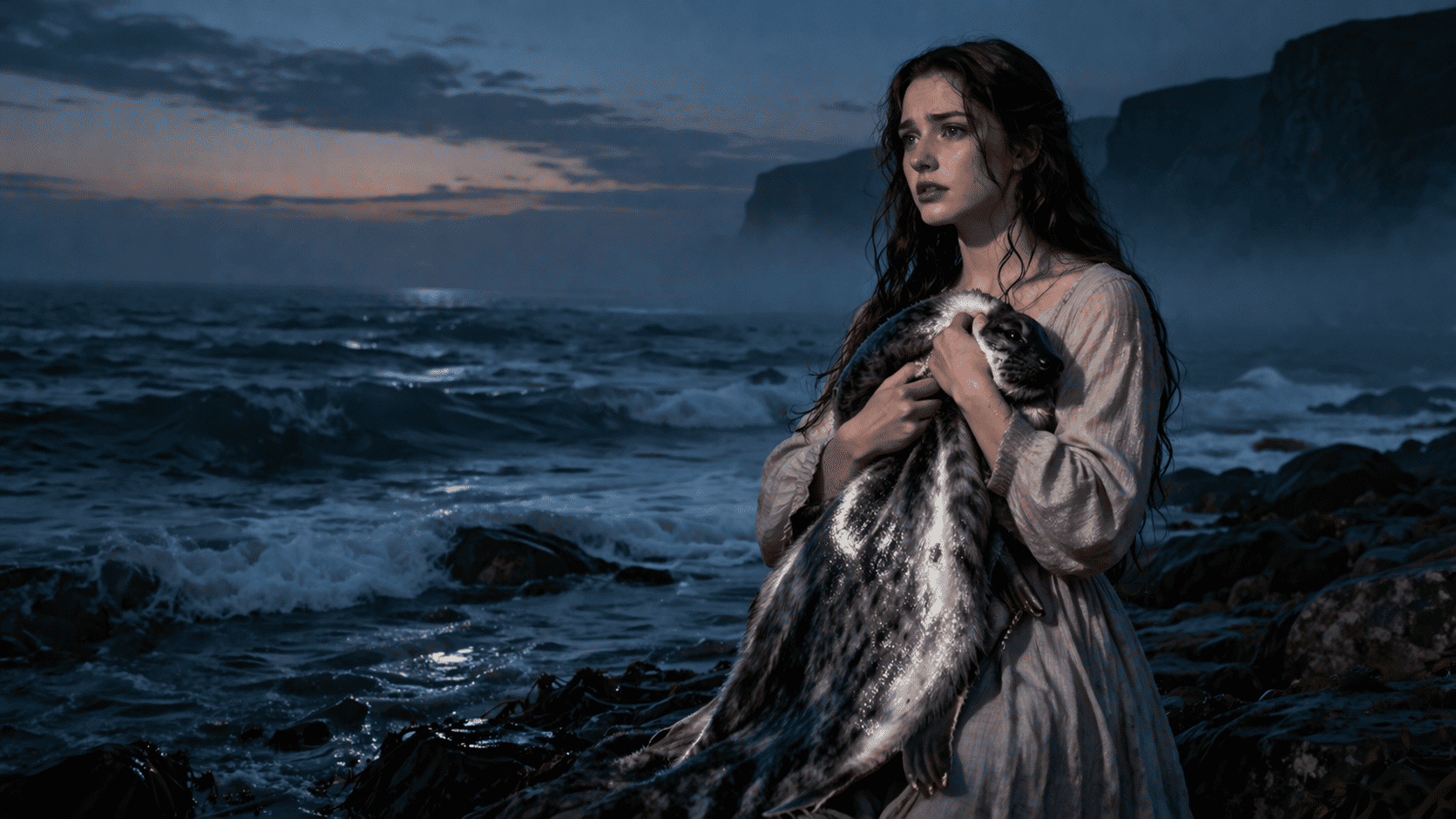
Selkies (pronounced SELL-keez) are seal people: beings who live as seals in the sea but can shed their skins and walk on land in human form. In the best-known story, a man hides a seal woman’s skin, marries her, and raises a family with her, until she finds the skin and returns to the sea. The word selkie comes from Orkney and Shetland in Scotland, but seal-folk legends were told all along the west coast of Ireland too, where some families, like the Conneelys of Connemara, were said to be descended from seals.
| Name | Selkie, from Scots selch, “seal”; in Irish, the seal is rón |
|---|---|
| Pronunciation | SELL-kee |
| What they are | Seals who can take off their skins and become human |
| The key | The sealskin: whoever holds it holds the selkie |
| Classic tale | The seal wife, whose hidden skin keeps her on land |
| Where | Orkney, Shetland, the Hebrides, and the west of Ireland |
| Seal families | The Conneelys of Connemara; the MacCodrums of North Uist |
| Irish cousin | The merrow, whose magic cap works like the sealskin |
What Are Selkies?
On a moonlit night, a fisherman walking the shore hears laughter from the rocks. He creeps closer and sees a group of young people dancing on the sand, and beside them, a heap of sealskins. He picks one up and hides it under his coat. When the dancers see him, they snatch up their skins, dive into the sea, and swim away as seals, all except one young woman, who searches desperately for the skin that he is holding. Without it, she cannot go home.
That is the beginning of the most famous selkie story, told in countless versions around the coasts of northern Europe. Selkies are seals who can take off their skins and become human, and the whole of their legend turns on that skin. As long as a selkie has it, she can return to the sea. Whoever takes it, and hides it, can keep her on land.
Where the Name Comes From
The word selkie comes from the Scots dialects of Orkney and Shetland, where selch or selkie simply means a seal. The legends are richest there and in the Hebrides, and much of what is written about selkies comes from those islands.
But the belief was never only Scottish. Along the west coast of Ireland, from Kerry to Donegal, people told the same kinds of stories about seals, calling them by the ordinary Irish word rón. Seals were thought to be more than animals: people under enchantment, or a sea race of their own, or even the souls of the drowned.
The Seal Wife
The classic selkie tale follows a pattern found from Ireland to Iceland. A man steals a seal woman’s skin and hides it, in the thatch, under a stone, or in a locked chest. Unable to return to the sea, she goes home with him and becomes his wife. She is a good wife and a loving mother, and the family is often said to be lucky and prosperous. But she is never quite at home. She spends long hours gazing at the sea, and sometimes a great seal is seen watching the shore.
Then one day, often thanks to one of her children, she finds the hidden skin. She puts it on, says goodbye or slips away without a word, and returns to the sea. In some versions, she is seen afterward near the shore, watching her children, and the family’s fishing is always good. In others, she never comes back.
Seal Families of Ireland and Scotland
If a seal woman could marry a fisherman and bear his children, then there had to be people descended from seals. Several families claimed exactly that.
- The Conneelys of Connemara. In the west of Ireland, the Conneely family was said to be descended from seals, and it was thought that no Conneely should ever harm one.
- The MacCodrums of North Uist. In the Hebrides, the MacCodrums were known as Clann ‘ic Codrum nan ròn, “the MacCodrums of the seals,” from a seal wife in their ancestry.
Descendants of seal marriages were sometimes said to have a mark of their origin, such as a web of skin between the fingers, or a special gift with the sea.
Selkie Men
Not all selkies are women. In Orkney and Shetland especially, male selkies were said to come ashore as handsome men who seduced lonely women, particularly the wives of fishermen away at sea. Orkney tradition held that a woman who wanted a selkie lover could summon one by shedding seven tears into the sea at high tide. The Shetland ballad “The Great Silkie of Sule Skerry” tells of a seal man who fathers a child with a human woman and later returns to claim his son, foretelling that both he and the boy will be killed by her future husband, a hunter.
Selkies and Merrows
Ireland’s other great sea folk, the merrows, have a strikingly similar story. A merrow woman wears a magic red cap instead of a sealskin, and a fisherman who steals the cap can marry her, until she finds it and returns to the sea. The two traditions are clearly related. The difference is mostly in the creature: the merrow is a mermaid with a fish’s tail, while the selkie is a seal who becomes fully human on land.
Why the Seal Legends Took Hold
Anyone who has watched seals on an Irish or Scottish shore will understand how the stories began. Seals have large, dark, almost human eyes. They watch people from the water with obvious curiosity, and some of their calls sound strangely like human voices. They haul out on rocks near the shore and seem to live half in one world and half in another.
The stories also carried the realities of coastal life. Fishermen drowned and never came home. Wives and husbands left for good. Children grew up with a parent who seemed to belong somewhere else. The seal wife, who loves her family but cannot stay, gave shape to losses that many coastal families knew well.
Selkies in Popular Culture
Selkies have become some of the best-loved figures of Celtic folklore on screen and in print. John Sayles’s 1994 film The Secret of Roan Inish, based on Rosalie K. Fry’s novel Secret of the Ron Mor Skerry and moved from Scotland to the coast of County Donegal, tells of a girl whose family has seal blood. Cartoon Saloon’s 2014 animated film Song of the Sea, from the Kilkenny studio behind The Secret of Kells, follows a young selkie girl in Ireland. Selkie stories also appear in songs, poems, and novels by writers across Ireland and Britain.
Are Selkies Irish or Scottish?
Both. The word selkie is Scottish, from Orkney and Shetland, and the most detailed selkie traditions were recorded there. But the seal-folk belief is shared by the whole Gaelic and northern world, and the west of Ireland has its own seal families, seal wives, and stories told in Irish. In Ireland, the same tale is also told of the merrow.
Sources and Further Reading
- David Thomson, The People of the Sea: A Journey in Search of the Seal Legend, Turnstile Press (1954).
- Ernest W. Marwick, The Folklore of Orkney and Shetland, Batsford (1975).
- Francis James Child, ed., The English and Scottish Popular Ballads, “The Great Silkie of Sule Skerry” (Child 113), Houghton Mifflin (1882 to 1898).
- Thomas Crofton Croker, Fairy Legends and Traditions of the South of Ireland, part 2, John Murray (1828).
- Katharine Briggs, An Encyclopedia of Fairies, Pantheon Books (1976).