In Short
No, Saint Patrick did not banish the snakes from Ireland, because there were never any snakes there to banish. Ireland was cut off by rising seas after the last Ice Age, before snakes could reach it, and Roman and early medieval writers remarked on its lack of snakes centuries before and after Patrick lived. Patrick never mentions snakes in his own writings. The legend first appears in a biography of Patrick written around 1185, more than 700 years after his death.
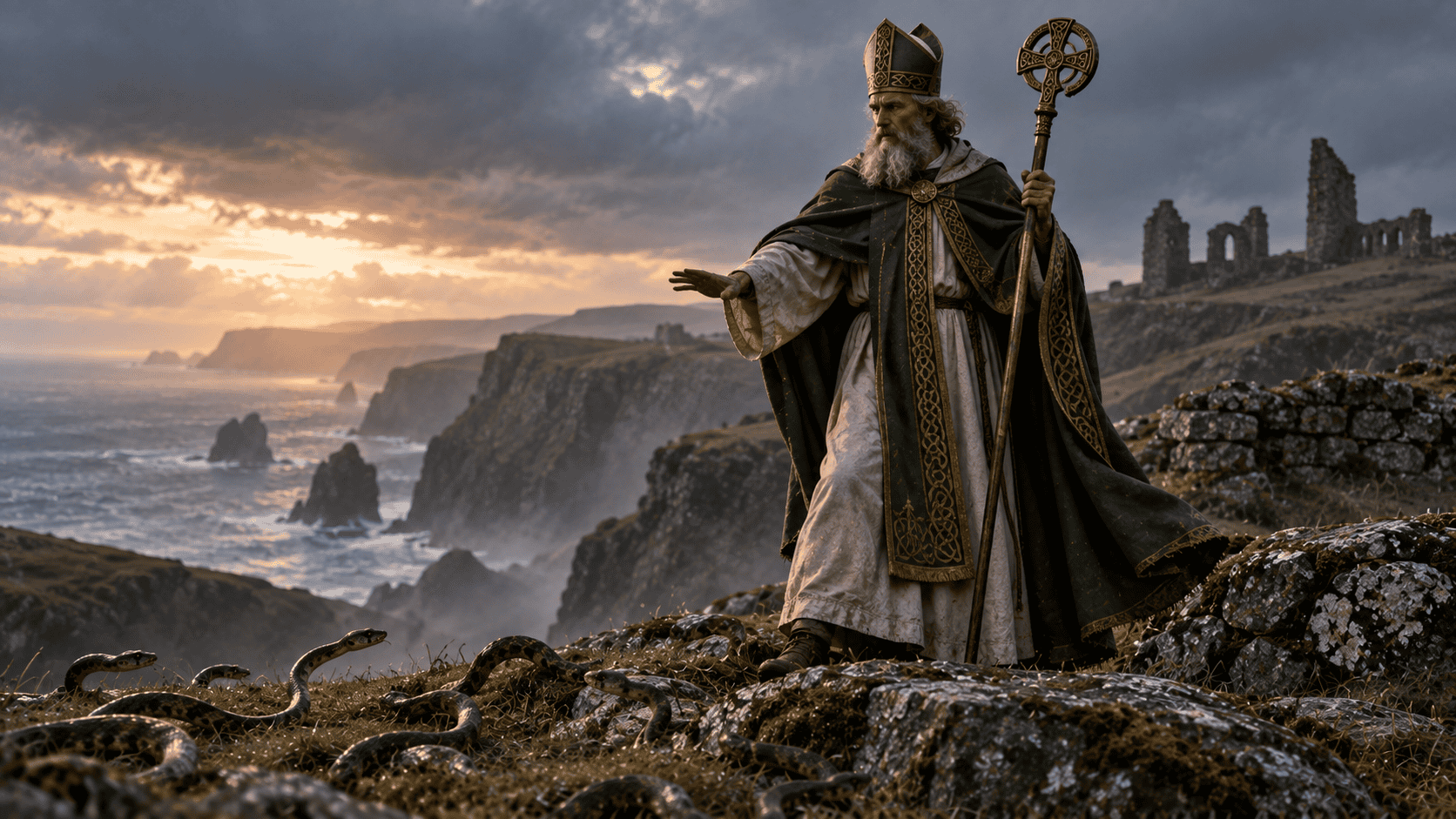
| The legend | Patrick drove every snake in Ireland into the sea |
|---|---|
| Is it true? | No. Ireland has no native snakes and never had any after the last Ice Age |
| Why no snakes | The land bridge to Britain flooded before snakes could cross it |
| Noticed by | Solinus in the third century, and Bede in 731 |
| Patrick’s own writings | The Confessio and the Letter to Coroticus never mention snakes |
| First written version | Jocelin of Furness, Life of Patrick, around 1185 |
| Early doubter | Gerald of Wales, around 1188 |
| Place linked to it | Croagh Patrick, County Mayo |
| Only native reptile | The common, or viviparous, lizard |
Did Saint Patrick Really Banish the Snakes?
Every March, somebody retells it: the saint standing on a mountain in the west of Ireland, staff in hand, while every snake in the country slithers past him and throws itself into the sea. It is one of the best-known stories about Ireland’s patron saint, and one of the best-known facts about Ireland is that there are no snakes there. It seems to fit perfectly.
The trouble is that the two facts have nothing to do with each other. Ireland had no snakes before Patrick arrived in the fifth century, and writers had been saying so for hundreds of years. Patrick himself never claimed to have seen one. The legend came later, and it tells us a great deal about how the Middle Ages remembered its saints, even if it tells us nothing about Irish wildlife.
Ireland Never Had Snakes
The real reason lies in the last Ice Age. For tens of thousands of years, Ireland was buried under ice or frozen as tundra, far too cold for reptiles. When the ice began to retreat, around 10,000 years ago, animals moved north again from the warmer south of Europe. Snakes were among the slowest to spread.
At the time, Britain and Ireland were still joined to the continent by land. But the melting ice was raising the sea, and the land bridge between Ireland and Britain disappeared first, around 8,500 years ago. Britain stayed connected to mainland Europe for roughly another 2,000 years, long enough for three species of snake to reach it: the adder, the grass snake, and the smooth snake. None of them made it across to Ireland before the Irish Sea closed the way.
Nigel Monaghan, a former keeper of natural history at the National Museum of Ireland, has searched the country’s fossil and museum records and put it plainly: there has never been any sign of snakes in Ireland, and so there was nothing for Saint Patrick to banish. Ireland shares this with New Zealand, Iceland, Greenland, and Antarctica, none of which has any native snakes either.
Writers Noticed Long Before Patrick
Ireland’s lack of snakes was famous long before anyone connected it to a saint. In the third century, the Roman writer Gaius Julius Solinus noted that there were no snakes in Ireland, in the same breath as he remarked that its birds were few and its people warlike. That was about two hundred years before Patrick arrived.
The English monk Bede, finishing his Ecclesiastical History of the English People in 731, went further. No reptiles are found in Ireland, he wrote, and no snake can live there. Snakes brought over from Britain, he claimed, die as soon as they breathe the Irish air. He even reported that scrapings from the pages of books brought out of Ireland, stirred into water, had cured people of snakebite. Bede was writing some three centuries after Patrick, and he says nothing about the saint having anything to do with it.
What Patrick Wrote Himself
Two texts survive that are accepted as Patrick’s own work: his Confessio, a short account of his life and mission, and a letter condemning a British warlord named Coroticus, whose men had killed and enslaved some of Patrick’s converts. Patrick tells how he was captured by raiders as a teenager, herded animals as a slave in Ireland for six years, escaped, and later returned as a missionary. He describes hardship, danger, and dreams. He never mentions a snake.
The earliest biographies of Patrick, known as Lives, written in the seventh century by Muirchú and Tírechán, don’t mention snakes either. Tírechán does record the story that Patrick spent forty days fasting on a mountain in Connacht, following the example of Moses on Mount Sinai, and that he was harassed there by birds. A ninth-century Irish Life of Patrick, the Bethu Phátraic, turns those birds into a flock of black demons, which Patrick drives away by ringing his bell. The shape of the later legend is starting to appear: a saint, a mountain, and a swarm of evil creatures driven out. But the creatures are birds, not snakes.
Where the Snake Story Came From
Saints and snakes were already a familiar pairing in Irish writing. In Adomnán’s Life of Columba, written around the year 700, Columba blesses the island of Iona so that the venom of snakes will harm no person or animal there. But the first writer to credit Patrick with banishing the snakes of Ireland was Jocelin of Furness, a Cistercian monk from the north of England.
Around 1185, Jocelin wrote a new Life of Patrick, commissioned by the Anglo-Norman lord John de Courcy, who had recently conquered much of Ulster and was promoting Patrick’s cult at Downpatrick. In Jocelin’s version, Patrick gathers all the venomous creatures of the island together, drives them to a high headland, and sends them over the cliff into the ocean.
Not everyone was convinced, even then. Gerald of Wales, writing his Topography of Ireland at almost the same time, reported the story but added that it was more likely that Ireland had never produced venomous creatures at all, from the earliest ages, long before Christianity arrived. More than eight hundred years ago, a medieval writer had already reached the same conclusion as modern science.
Were the Snakes a Metaphor?
A popular modern explanation is that the snakes were never meant literally, and that they stand for paganism, or for the druids, whom Patrick drove out when he brought Christianity to Ireland. There is something to this. In Christian symbolism, the serpent is the tempter of Genesis and a figure of the devil, and stories of saints defeating serpents and dragons were common across medieval Europe, as a way of showing the triumph of the faith over evil.
But the specific idea that Patrick’s snakes meant the druids is a modern reading, not something the medieval sources say. Jocelin presents the banishment as a real miracle, and his readers seem to have taken it that way. What the story does show is how a snake-free island and a famous saint drew together over the centuries, until the one seemed to explain the other.
The Serpent of Croagh Patrick
The legend is tied above all to Croagh Patrick, the cone-shaped mountain above Clew Bay in County Mayo, where Patrick is said to have spent his forty days. A later folk legend adds a single great serpent, a demonic female creature known as Corra or Caorthannach, who tormented the saint on the mountain. Patrick banished her into a lake below, Lough na Corra, or into a hollow from which the lake burst out.
The mountain is still Ireland’s best-known pilgrimage site. On Reek Sunday, the last Sunday in July, thousands of pilgrims climb it, many of them barefoot, to the small chapel on the summit.
The Snake Legend in Popular Culture
The snakes have become one of the fixtures of St. Patrick’s Day, especially outside Ireland, where they appear in cartoons, parade floats, and jokes about Patrick’s other achievements. They even have a modern twist. In 2013, the New York Times reported that during the boom years of the Celtic Tiger, exotic pet snakes became something of a status symbol in Ireland, and when the economy collapsed after 2008, animal sanctuaries took in many that had been abandoned by owners who could no longer afford them.
Are There Any Snakes in Ireland Today?
Not in the wild. Ireland has only one native land reptile, the common or viviparous lizard, a small brown lizard unusual for giving birth to live young rather than laying eggs. The Burren in County Clare is home to the slow worm, which looks very like a snake but is actually a legless lizard, and was introduced to Ireland in the twentieth century. Sea turtles sometimes visit Irish waters. The only snakes in Ireland are pets and zoo animals, and they were brought there by people, not driven out by a saint.
Sources and Further Reading
- Ludwig Bieler, trans., The Works of St. Patrick, Ancient Christian Writers 17, Newman Press (1953).
- Ludwig Bieler, ed. and trans., The Patrician Texts in the Book of Armagh, Dublin Institute for Advanced Studies (1979).
- Bede, The Ecclesiastical History of the English People, ed. Judith McClure and Roger Collins, Oxford University Press (1994).
- Jocelin of Furness, “The Life of St. Patrick,” in The Most Ancient Lives of Saint Patrick, ed. James O’Leary (1904).
- Gerald of Wales, The History and Topography of Ireland, trans. John J. O’Meara, Penguin (1982).