In Short
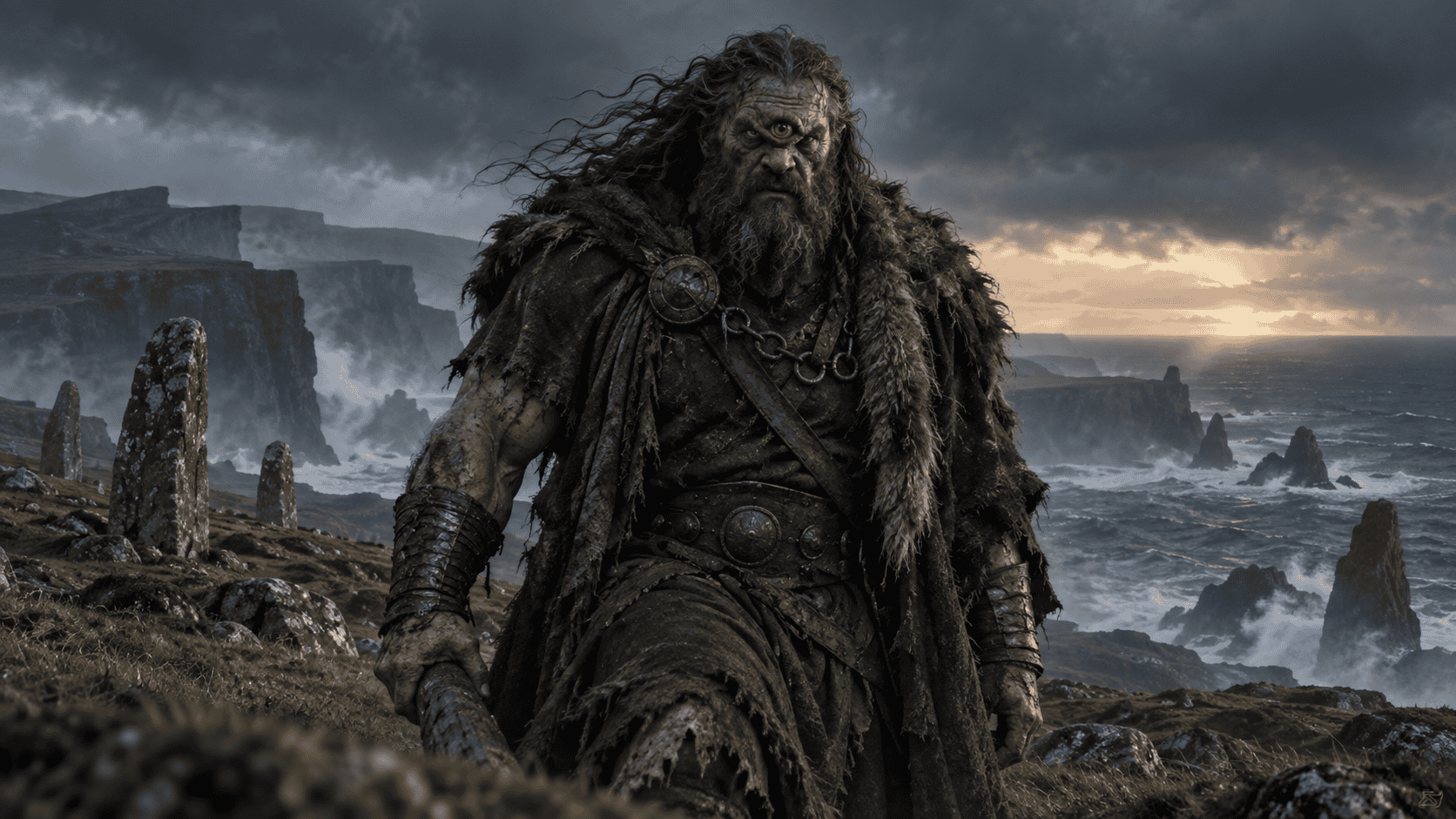
Balor (pronounced BAL-ur) is the monstrous king of the Fomorians in Irish mythology, remembered as Balor of the Evil Eye. His eye was so poisonous that an army that looked into it could not fight back, and it took four men to raise its lid. A prophecy said he would be killed by his own grandson, so, in the folk version of his story, he locked his only daughter in a tower on Tory Island. It did not work. Her son was Lugh, who killed Balor at the Second Battle of Mag Tuired with a sling stone that drove the eye out through the back of his head, where it destroyed the Fomorian army behind him.
| Name | Balor; also Balar, Bolar |
|---|---|
| Pronunciation | BAL-ur |
| Titles | Balor of the Piercing Eye (Birugderc); in later Irish, Balór na Súile Nimhe, “Balor of the Poisonous Eye” |
| People | The Fomorians |
| Home | Tory Island, County Donegal, in folk tradition |
| Daughter | Ethniu, mother of Lugh |
| Wife | Cethlenn, in some later accounts |
| Killed | Nuada, king of the Tuatha Dé Danann |
| Killed by | His grandson Lugh, at the Second Battle of Mag Tuired |
| Main source | Cath Maige Tuired, “The Second Battle of Mag Tuired” |
Who Is Balor?
Four warriors stand beside a giant on a battlefield in Connacht. Between them they hold a polished ring set into the lid of his eye. They pull it up. Across the field, a whole army sees what is beneath, and the fight goes out of it: thousands of warriors stand helpless while a handful of enemies cut them down.
That is Balor, the most feared of the Fomorians, the dark enemies of the gods in Irish mythology. He is the great villain of the Mythological Cycle, the one-eyed tyrant whose poisonous gaze could destroy an army, and whose own grandson was fated to kill him. Every child in Ireland who heard the old stories knew his name.
Who Were the Fomorians?
To understand Balor, it helps to know his people. The Fomorians, in Irish Fomóire, were a race of powerful, often monstrous beings who appear throughout the legendary history of Ireland as the enemies of every people who tried to settle there. In the Lebor Gabála Érenn, the Book of Invasions, they fight Partholón’s people and oppress Nemed’s from their tower on Tory Island. Later, they force the Tuatha Dé Danann to pay them a crushing tribute.
The meaning of their name is debated. It may mean “those from under the sea,” or “under-spirits,” or something like “phantoms from below.” They are usually described as coming from the sea or from the islands off the coast, and they often stand for the forces of chaos, darkness, and blight against which the gods struggled. Yet they were not simply monsters. The Tuatha Dé married into them: Bres, who became king of the Tuatha Dé, was half Fomorian, and so was Lugh himself.
How Balor Got His Evil Eye
Cath Maige Tuired, the medieval Irish tale of the great battle between the gods and the Fomorians, gives a clear explanation. When Balor was young, his father’s druids were brewing a magic potion. The boy came and looked in through the window, and the fumes of the brew rose up and entered his eye, and the poisonous power of the potion settled in it.
From then on, the eye was deadly. It was kept closed and never opened except on a battlefield. When it was opened, four men raised its lid by means of a polished ring set into it, and any army that looked at it, however many thousands strong, could offer no resistance.
Later folklore made the eye even more terrible. In one account, it was kept covered with seven cloaks to keep it cool, and as they were removed one by one, the ferns withered, the grass turned red, the trees began to smoke, and at the seventh, the whole land caught fire. In nineteenth-century folk tales, Balor was said to look through a glass that let him destroy a person with a single glance.
The Prophecy and the Tower on Tory Island
The most famous story about Balor is not in the medieval manuscripts but in the folklore of County Donegal, recorded in the nineteenth century by the scholar John O’Donovan. It tells how a druid warned Balor that he would be killed by his own grandson. Balor had only one child, a daughter named Ethniu, so he locked her away in a tower on Tory Island, off the Donegal coast, guarded by women, where no man could ever see her.
Balor was also a thief. He stole the Glas Gaibhnenn, a magical cow whose milk never ran dry, from its owner on the mainland, and carried her off to Tory. The owner, called Mac Cinnfhaelaidh in the folk tale, who takes the place of Lugh’s father, Cian, in the medieval texts, swore to get her back. With the help of a druidess named Biróg, he was carried across to Tory, disguised as a woman, and reached Ethniu in her tower. In time, she gave birth to three sons.
When Balor found out, he ordered the three babies drowned. They were wrapped in a sheet and thrown into the sea, but one of them fell free and was rescued. That child grew up to be Lugh. The other two, in some tellings, became the first seals.
In the same folk tale, Balor took his revenge on the father, cutting off his head on a great white stone on the mainland. The place is still called Cloghaneely, in Irish Cloich Chionnaola, “Cionnaola’s Stone,” and the stone, streaked with red, was pointed out for generations as the place where his blood was spilled.
Balor at the Second Battle of Mag Tuired
In Cath Maige Tuired, the war between the Tuatha Dé and the Fomorians comes to a head on a plain near Lough Arrow in County Sligo. The medieval text calls Balor “grandson of Nét” and “Balor of the Piercing Eye.” In the battle, he killed Nuada, the silver-handed king of the Tuatha Dé, and Macha, one of the war goddesses.
Then Lugh came against him. As the lid of the eye was raised, Lugh fired a stone from his sling that struck the eye and drove it out through the back of Balor’s head. The eye’s gaze now fell on the Fomorian host behind him, and they were destroyed. It was the turning point of the battle, and the prophecy was fulfilled: Balor had been killed by his grandson.
Other Endings
Like many figures in Irish myth, Balor has more than one death. A version found in medieval sources from at least the twelfth century says he survived the loss of his eye and fled south, with Lugh in pursuit, all the way to Mizen Head in County Cork. There, Lugh cut off his head and set it on a great rock, which shattered. The headland’s Irish name, Carn Uí Néit, “the cairn of Nét’s grandson,” was explained by the story.
A later local legend from County Sligo says that when Balor fell, he landed face down with his eye still open, and its deadly beam burned a hole deep into the ground. The hole filled with water and became Loch na Súl, “the Lake of the Eye.”
Balor’s Wife, Cethlenn
Some later writers, including the seventeenth-century historian Roderick O’Flaherty, name Balor’s wife as Cethlenn, a prophetess and warrior of the Fomorians. In the Lebor Gabála Érenn, she wounds the Dagda at the Second Battle of Mag Tuired, and he later dies of the wound. The town of Enniskillen, in County Fermanagh, is traditionally said to take its name from her: in Irish, Inis Ceithleann, “Cethlenn’s island.”
What Did Balor Mean?
Nineteenth-century scholars often read the story of Balor and Lugh as a myth about nature: the old, harsh sun of drought and blight, or the darkness of winter, overcome by a young god of light. That reading is now largely set aside, and the idea that Lugh’s name means “light” is itself doubtful.
What is clear is that Balor belongs to a very old and widespread pattern of story. A tyrant is warned that his grandson will kill him, imprisons his only daughter to prevent it, and is killed anyway. The same pattern appears in the Greek story of Acrisius, his daughter Danaë, and her son Perseus. The monstrous one-eyed giant also recalls the Cyclops of Greek myth, and in Welsh tradition, the giant Ysbaddaden, whose eyelids had to be propped open with forks. Stories like these warn that fate cannot be escaped, and that a king who tries to cheat it only brings it closer.
Balor in Popular Culture
Balor has become one of the best-known villains of Celtic myth. He appears in comics, including Marvel’s Thor stories, in fantasy novels, and in many video games, and his name has been borrowed for the balor, a fiery demon in the Dungeons and Dragons role-playing game. Tory Island still points visitors to Dún Bhalair, “Balor’s Fort,” a rocky headland on its eastern end.
Was Balor a God?
Not quite, at least not in the surviving stories. The Fomorians are presented as a hostile race rather than as gods, and Balor is their champion and king. Some scholars have suggested that the Fomorians represent older or darker powers that the gods of the Tuatha Dé had to defeat, much as the Greek gods defeated the Titans. Balor, in that sense, is less a god than the great enemy of the gods.
Sources and Further Reading
- Elizabeth A. Gray, ed. and trans., Cath Maige Tuired: The Second Battle of Mag Tuired, Irish Texts Society (1982).
- John O’Donovan, ed. and trans., Annala Rioghachta Eireann: Annals of the Kingdom of Ireland by the Four Masters, vol. 1, Hodges and Smith (1848 to 1851), notes on Balor and Tory Island.
- R. A. S. Macalister, ed. and trans., Lebor Gabála Érenn: The Book of the Taking of Ireland, Irish Texts Society (1938 to 1956).
- Roderick O’Flaherty, Ogygia (1685), trans. James Hely (1793).
- Dáithí Ó hÓgáin, Myth, Legend and Romance: An Encyclopaedia of the Irish Folk Tradition, Ryan Publishing (1990).