In Short
Stingy Jack is the hero (or villain) of the Irish legend most often linked to the jack-o’-lantern. In the best-known modern version, he is a mean, hard-drinking blacksmith who tricks the Devil twice, first by trapping him as a coin in his pocket and then by stranding him up a tree. When Jack dies, heaven will not have him, and the Devil, bound by his promise, will not take him either. The Devil throws him a burning coal from hell, Jack sets it inside a hollowed turnip to light his way, and he wanders the earth forever as “Jack of the Lantern.” The phrase itself is older than the Irish story in print, but the legend became its best-known explanation. In Ireland, turnip lanterns were carved at Halloween, and when Irish emigrants reached America, the pumpkin took the turnip’s place.
| Also known as | Jack of the Lantern, Jack o’ the Lantern |
|---|---|
| Who he was | Often a blacksmith; a cobbler in some versions |
| His punishment | Barred from heaven and hell, wandering with a coal in a turnip |
| Tale type | The Smith and the Devil (ATU 330) |
| Early Irish print version | Dublin Penny Journal, 16 January 1836 |
| Name first recorded | 1650s, for the will-o’-the-wisp |
| Used for carved pumpkins | Nineteenth-century American English |
| Famous Irish example | The Ghost Turnip from Donegal, about 1900 |
Who Was Stingy Jack?
Stingy Jack is a character from Irish folklore, a man so cunning and so mean that he outwitted the Devil and ended up welcome nowhere after death. In many Irish versions he is a blacksmith, though some tellings make him a cobbler, and he is always a drinker who never pays his share. His nickname comes from that stinginess, and his fate became the best-known explanation for the word jack-o’-lantern, although the word itself is older.
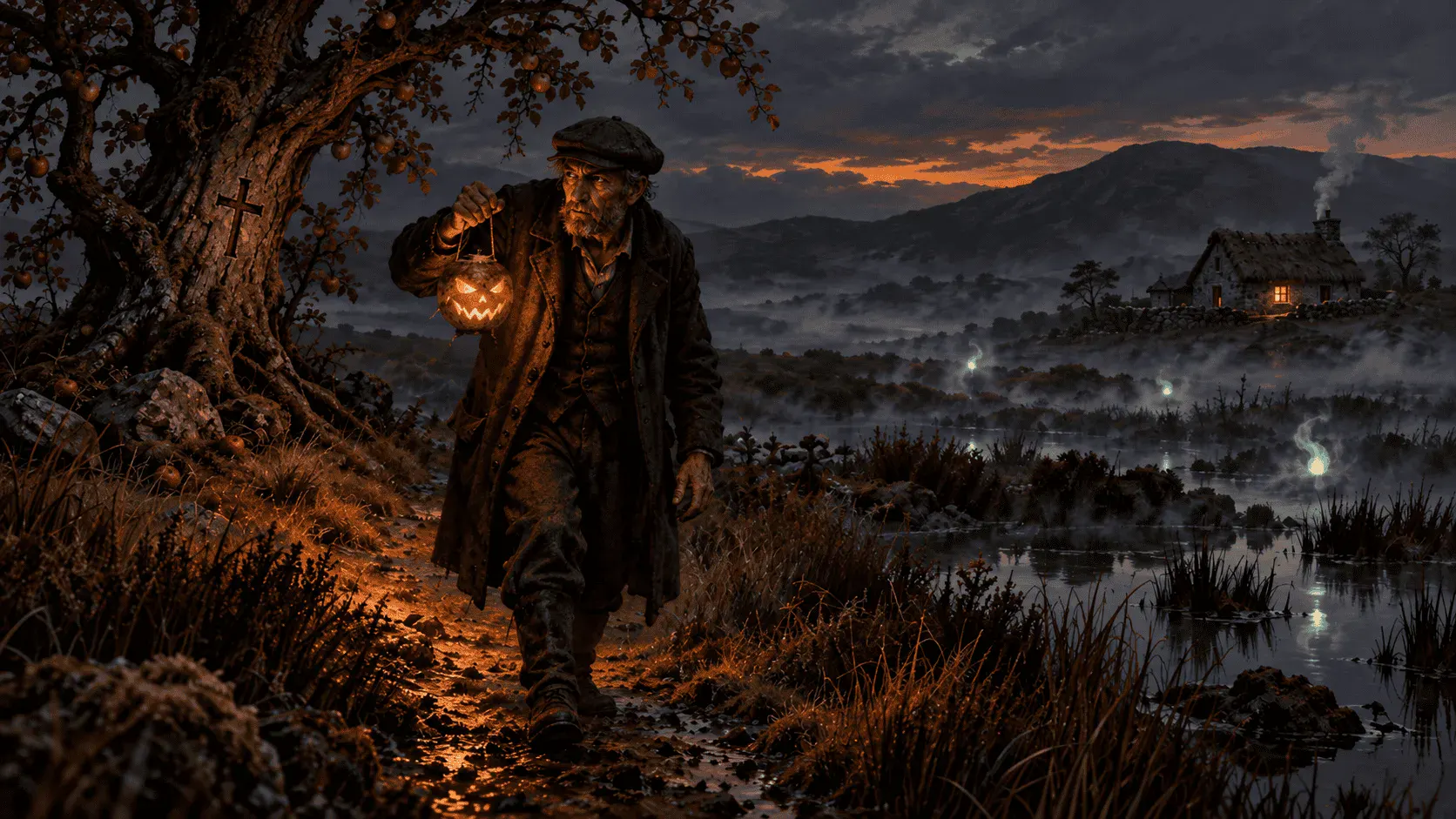
The legend explains one of the strangest sights in old Ireland: the pale, flickering lights that hovered over bogs and marshes at night. People said that this was Jack, still wandering with his lantern, looking for somewhere to rest. On Halloween, when the dead and the fairy people were thought to be abroad, families carved faces into turnips and set them in windows and doorways, and in many retellings the lanterns are said to keep Jack, and spirits like him, away.
The Story of Stingy Jack
The legend has many versions, but the one most often told today runs in three parts. It is a story about a bargain, and like most bargains with the Devil, it does not end the way the man who made it expected.
The Devil in His Pocket
One night, Jack invited the Devil to have a drink with him. When it came time to pay, Jack had no intention of spending his own money, as usual, so he talked the Devil into turning himself into a coin to settle the bill. The moment the Devil changed, Jack slipped the coin into his pocket, next to a small silver cross. Trapped by the cross, the Devil could not change back. Jack let him go only after the Devil promised to leave him alone for a year, and never to claim his soul.
The Devil Up a Tree
A year later, the Devil came back. This time, Jack asked him to climb an apple tree and fetch him a piece of fruit before they left. Once the Devil was up in the branches, Jack carved a cross into the trunk, and the Devil was stuck again. Jack made him promise to stay away for another ten years before he scratched the cross off and let him down.
Barred From Heaven and Hell
Jack died before the ten years were up. At the gates of heaven, he was turned away for his drinking, his lying, and his meanness. At the gates of hell, the Devil kept his word and refused to take him. Jack asked how he was to find his way in the dark, so the Devil threw him a burning coal from the fires of hell. Jack put the coal inside a turnip he had hollowed out, and with that small lantern, he has wandered the earth ever since. That is why, in the story, he is called Jack of the Lantern, or Jack-o’-Lantern. The phrase was already in use before the legend appeared in print, as the sections below explain, but the tale gave it a face and a history.
Other Irish Versions of the Tale
Older Irish tellings often follow a different path to the same ending. In one, a stingy blacksmith does a rare kindness for an old man by the roadside, who turns out to be an angel or a saint. As a reward, Jack is granted three wishes, and instead of asking for salvation, he wishes that anyone who sits in his chair, takes a branch from his tree, or touches his tools will stick fast. He uses the wishes to trap the Devil’s messengers, and he finds himself shut out of heaven for wasting the gift and out of hell for the trouble he caused.
One of the earliest Irish versions in print appeared in the Dublin Penny Journal on 16 January 1836, under the title “Jack o’ the Lantern.” It is told as a memory of the writer’s uncle, a kindly but very superstitious man, who explained the lights over a shaking bog as Jack on his endless wanderings. The writer, who preferred a scientific answer, called the lights ignis fatuus, a gas rising from rotting plants. The story shows how the legend worked in Ireland: as an explanation for something people really saw.
An Ancient Story: The Smith and the Devil
Folklorists classify the legend of Stingy Jack as a version of “The Smith and the Devil,” tale type 330 in the international Aarne-Thompson-Uther index of folktales. In this family of stories, a blacksmith makes a deal with the Devil or another evil power, then uses trickery to escape his side of the bargain. Versions have been recorded across Europe and beyond.
It may be one of the oldest stories still told. In 2016, Sara Graça da Silva of the New University of Lisbon and Jamshid Tehrani of Durham University used methods borrowed from biology to trace how folktales spread among Indo-European languages. Their study, published in Royal Society Open Science, estimated that the tale type of “The Smith and the Devil” may be around 6,000 years old, which would place its roots in the Bronze Age. That is an estimate for the basic plot, not for any particular telling. The Irish Jack, with his drink, his silver cross, and his turnip, is a much later local dress for that ancient plot.
Jack and the Will-o’-the-Wisp
The word jack-o’-lantern is older than the carved pumpkin, and even older than the Irish legend in print. In seventeenth-century England, “Jack” was a common name for any ordinary man, and a “Jack with the lantern” was a man carrying a light at night, such as a watchman. The Oxford English Dictionary records the name from the 1650s as another term for the ignis fatuus, or will-o’-the-wisp, the ghostly lights seen over marshes and bogs.
Those lights are now often attributed to gases from rotting plants that ignite, although no single explanation covers every report, and for centuries they were thought to be spirits, fairies, or lost souls, and they had many names across Britain and Ireland. Stingy Jack’s story attached a face and a history to them. A light moving over the bog at night was no longer just a light. It was a man who had cheated the Devil and was paying for it forever.
Why the Irish Carved Turnips
Long before pumpkins, Irish families carved Halloween lanterns from turnips, and sometimes from potatoes, beets, or mangels. They hollowed out the vegetable, cut eyes and a mouth into it, and put a candle or a glowing ember inside. The lanterns were set in windows or by the door, or carried through the dark lanes on Halloween night. Their purposes overlapped. They lit the way on a dark night, and the National Museum of Ireland records that they were used to frighten people on Halloween. In many places, they were also said to keep away Stingy Jack and the other spirits who were thought to roam on the eve of Samhain, when the boundary with the Otherworld grew thin.
A practical reason helped too. A metal lantern cost money, but a turnip was cheap and easy to find at the end of the harvest. The most famous surviving example is the Ghost Turnip, a lantern with a frightening carved face that came from County Donegal and dates to around the turn of the twentieth century. Rois Ní Braonáin, a schoolteacher near Fintown, gave it to the National Museum of Ireland in 1943, noting that the custom was no longer practiced in the area but was still remembered. The original was close to falling apart, so the museum made a plaster cast, which is held at its Country Life museum in County Mayo.
Ireland was not alone. Carved turnip and mangel lanterns were also part of Halloween in Scotland and parts of England and Wales. In parts of Somerset, children still carry mangel lanterns on Punkie Night, held on the last Thursday of October.
From Turnips to Pumpkins
When Irish and Scottish emigrants crossed the Atlantic in the nineteenth century, especially in the great wave of Irish emigration during and after the Famine of the 1840s, they brought their Halloween customs with them. In North America, they found the pumpkin, a plant native to the Americas. It was larger than a turnip, far easier to hollow out, and plentiful in the autumn, and it soon replaced the turnip as the lantern of choice.
The name followed the vegetable, though exactly how is still debated. The phrase appears in American writing by the 1830s, in Nathaniel Hawthorne’s Twice-Told Tales, but there it describes a glowing gem, not a pumpkin. At first, carved pumpkins belonged to the harvest season in general. The poet John Greenleaf Whittier mentioned pumpkins carved with faces in his 1850 poem “The Pumpkin,” without any mention of Halloween, and an 1867 issue of Harper’s Weekly pictured a carved pumpkin as a children’s prank. As Irish Halloween customs spread through American cities, the two came together, and by the end of the nineteenth century, the glowing pumpkin face had become the best-known symbol of Halloween.
What the Jack-o’-Lantern Means Today
Most people who carve a pumpkin each October have never heard of Stingy Jack, but the custom still carries traces of his story. The lantern is lit on the night when, in Irish belief, spirits walk abroad, and its frightening face is the same warning the old turnips gave: stay away from this house. Some Irish families and heritage groups still carve a turnip each Halloween to keep the older tradition alive.
Common Questions
These are some of the questions people ask most often about Stingy Jack and the origin of the jack-o’-lantern.
Is Stingy Jack a Real Irish Legend?
Yes. Versions of the tale were told in Ireland and printed there by the 1830s, and the story belongs to a much older family of folktales about a smith who outwits the Devil. The name “Stingy Jack” and the exact details of the coin and the tree vary from teller to teller, and the version most people know today has been polished by many retellings, especially in America.
Why Is It Called a Jack-o’-Lantern?
The phrase began in seventeenth-century England, where a “Jack with the lantern” was a man carrying a light at night, and by the 1650s the name was also used for the will-o’-the-wisp, the mysterious lights seen over marshes. Irish folklore linked those lights to Stingy Jack, the wandering soul with his coal in a turnip. In America, the name later passed to the carved pumpkin, though exactly how is still debated.
Did the Irish Carve Pumpkins?
Not originally. In Ireland, Halloween lanterns were made from turnips, potatoes, or beets, since pumpkins are native to the Americas and were not grown in Ireland at the time. Irish emigrants switched to pumpkins in North America, and pumpkins became common in Ireland only much later, as American Halloween customs crossed back over the Atlantic.
Sources and Further Reading
- “An Irish Story Produces a Halloween Icon,” Rare Books and Special Collections, University of Notre Dame (2024), on “Jack o’ the Lantern,” Dublin Penny Journal, 16 January 1836.
- Jessica Traynor, “The Story of Jack-o’-Lantern,” The Irish Times (29 October 2019).
- Sara Graça da Silva and Jamshid J. Tehrani, “Comparative Phylogenetic Analyses Uncover the Ancient Roots of Indo-European Folktales,” Royal Society Open Science (2016). Summary: “Phylogenetic Analyses Suggest Fairy Tales Are Much Older Than Thought,” Phys.org (20 January 2016).
- “When People Carved Turnips Instead of Pumpkins for Halloween,” Smithsonian magazine.
- “Jack o’ lantern,” Online Etymology Dictionary.
- “The History of ‘Jack-o’-Lantern’,” Merriam-Webster.
- “Ghost Turnip” (F1943.350), National Museum of Ireland, Irish Folklife Collection.
- Kevin Danaher, The Year in Ireland: Irish Calendar Customs, Mercier Press (1972).