In Short
Lady Gregory (born Isabella Augusta Persse, 1852 to 1932) was an Anglo-Irish writer from County Galway who retold Ireland’s ancient myths for ordinary readers and collected the fairy beliefs of country people around her home at Coole Park. Her Cuchulain of Muirthemne (1902) and Gods and Fighting Men (1904) brought the old sagas back into Irish culture, and in 1904 she founded the Abbey Theatre with W. B. Yeats.
| Full Name | Isabella Augusta Persse, later Lady Gregory |
|---|---|
| Born | March 15, 1852, Roxborough, County Galway |
| Died | May 22, 1932, at Coole, aged 80 |
| Home | Coole Park, near Gort, County Galway |
| Best Known Myth Books | Cuchulain of Muirthemne (1902), Gods and Fighting Men (1904) |
| Folklore Collection | Visions and Beliefs in the West of Ireland (1920) |
| Theater | Cofounder and director of the Abbey Theatre (1904) |
Picture a widow sitting by the fire in a ward of the Gort workhouse, listening as two old women argue over which of two rival poets from their childhood was the better. She is there to listen, and the scene will later appear in one of her books.
That widow was Lady Gregory, and her habit of listening changed how the world reads Irish myth. Her retellings carried the stories of heroes, gods and the fairy host to a wide public, told in a voice that sounded like the west of Ireland itself.
Who Was Lady Gregory?
Lady Gregory was born Isabella Augusta Persse on March 15, 1852, at Roxborough, near Kilchreest in south County Galway. She was the youngest daughter of an Anglo-Irish landlord.
Even as a girl she loved stories, and a nanny filled her head with tales of Irish heroes. Few would have guessed, though, that this quiet daughter of the gentry would one day become one of the most important figures in the history of Irish mythology.
Marriage and Coole Park
In 1880 she married a near neighbor, Sir William Gregory of Coole. She was 27 and he was in his early sixties, a retired politician who had served as a member of Parliament and as governor of Ceylon (now Sri Lanka). Their only son, Robert, was born in 1881.
Marriage opened up London society, travel and the arts to her. It also gave her Coole Park, the estate near Gort that would later become the meeting place of a whole literary movement.
A Widow Finds Her Voice
Sir William died on March 6, 1892, just before Lady Gregory’s 40th birthday. She had published a little while he was alive, including a pamphlet called Arabi and His Household in 1882, but her serious literary career began after his death. Before long her attention turned to the people living around her.
She set out to learn Irish, first from some of her own tenants and then by spending time on the Aran Islands. That decision mattered enormously. It meant she could hear the old stories and beliefs in the language they had been carried in for centuries.
The Irish Revival and the Meeting with Yeats
Lady Gregory came of age as a writer during the Irish Literary Revival, a flowering of Irish writing between roughly 1880 and 1930 that was closely tied to Irish nationalism. Its writers retold ancient heroic legends, drew on folklore and celebrated the simple dignity of the Irish peasant.
The key friendship of her life began in the mid-1890s. The Coole Park timeline records a first brief meeting with the young poet W. B. Yeats in London, while Britannica dates their meeting to 1896. In 1897 they met again, and Yeats spent that summer at Coole.
During that stay the two talked about plays, poetry and folklore, and each sharpened the other’s ideas. Yeats became her lifelong friend, and she became his patron and collaborator. Coole turned into a creative retreat where Revival writers came to rest, plan and work.
Retelling the Great Sagas
Lady Gregory’s most lasting gift to Irish myth was a pair of books that took scattered medieval tales and shaped them into flowing, readable stories. She did not invent the material. Instead, she retold existing medieval tales, arranging them and putting them into her own distinctive English.
Cuchulain of Muirthemne (1902)
Her first great retelling was Cuchulain of Muirthemne, subtitled The Story of the Men of the Red Branch of Ulster. John Murray of London published it in 1902, with a preface by Yeats. It told the life of Cú Chulainn, the greatest of the Red Branch warriors, and retold the Irish epic known as the Táin Bó Cúailnge.
In other words, she gave readers the heart of the Ulster Cycle in a single book. She dedicated it to the people of Kiltartan, telling them, “it is of you I was thinking” when she began gathering the stories.
Yeats was dazzled. In his preface he praised it as the best book to come out of Ireland in his time, and he later drew on it as a source for his own plays. The book stayed in print throughout her lifetime.
Gods and Fighting Men (1904)
Two years later came Gods and Fighting Men, subtitled The Story of the Tuatha De Danaan and of the Fianna of Ireland. Again Yeats wrote the preface, saying it was worthy to sit beside her earlier book.
The book has two halves. Part One, “The Gods,” begins with the arrival of the Tuatha Dé Danann in Ireland, moves on to the coming of the Gaels, and ends with the Fate of the Children of Lir. Part Two, “The Fianna,” turns to Finn and his warrior band, ending with Oisín and Saint Patrick.
Taken together, it covered the Mythological Cycle and the Fenian Cycle. Add the Ulster tales of her first book, and her two volumes spanned three of the great story traditions of early Ireland.
The Kiltartan Voice
What made these books feel so alive was their language. Lady Gregory wrote them in a dialect she called Kiltartan, named after the area around Kiltartan in County Galway, close to Coole.
Kiltartan was a hybrid of English and Irish, an English shaped by the rhythms and sentence patterns of the Irish spoken by her neighbors. Instead of the stiff Victorian style of earlier translators, readers met heroes who spoke the way people on the roads of Galway actually talked.
Yeats later wrote that, with Cuchulain of Muirthemne, she suddenly “became the founder of Irish dialect literature.” That style proved hugely influential, giving the Revival one of its most recognizable voices.
Collecting the Fairy Faith
Alongside the ancient sagas, Lady Gregory collected living belief. For years she listened to country people on the coast, on the islands and in the Gort workhouse, recording what they said about the fairies, healers, ghosts and the strange happenings of everyday life.
Poets and Dreamers (1903)
An early fruit of this work was Poets and Dreamers: Studies and Translations from the Irish, published in Dublin in 1903. It opens with the poet Raftery, whose wandering, homeless life she compared to that of the old bards, and includes chapters with titles such as “Herb-Healing” and “Workhouse Dreams.”
It was in this book that she described sitting in the Gort workhouse, listening to old women debate rival poets. Those voices, rather than learned commentary, are the real subject of the book.
Visions and Beliefs in the West of Ireland (1920)
Her folklore collection Visions and Beliefs in the West of Ireland appeared in two volumes in 1920. Lady Gregory collected and arranged the material, and Yeats added two essays and notes. Her own preface is dated Coole, February 1916.
In her introduction to the sea stories, she explains that she began gathering on the coast and later traveled to the Aran Islands of Inishmore, Inishmaan and Inisheer. Yeats sometimes sat with her while the stories were told, so the book is partly a record of their shared fieldwork.
The first series moves through sea stories, seers and healers, the evil eye, and people “away” with the fairies. One long section is devoted to Biddy Early, the famous Clare wise woman whom some called a healer and others a witch.
The Sidhe in Her Pages
Running through the whole collection are the Sidhe, the aos sí or fairy people of Irish tradition. Her preface opens by noting that “The Sidhe cannot make themselves visible to all.”
She goes on to describe them as shape-changers who pass by in a cloud of dust, as many as the blades of grass. Because she recorded these beliefs in the words of the people who held them, her collection remains a valuable window into rural Irish folklore at the turn of the twentieth century.
| Book | Year | What It Covers |
|---|---|---|
| Cuchulain of Muirthemne | 1902 | The Ulster Cycle and the Táin, told in Kiltartan English |
| Poets and Dreamers | 1903 | Raftery, ballads, herb lore and workhouse stories |
| Gods and Fighting Men | 1904 | The Tuatha Dé Danann and the Fianna |
| The Kiltartan Poetry Book | 1918 | Translations of Irish poems and legends |
| Visions and Beliefs in the West of Ireland | 1920 | Fairy belief, healers and the supernatural, with notes by Yeats |
The Abbey Theatre
Lady Gregory’s work with myth fed directly into the theater. In 1897 she, Yeats and their Galway neighbor Edward Martyn drew up plans for what became the Irish Literary Theatre, which staged its first plays in Dublin in 1899 and paved the way for the Abbey. In 1904 the two of them founded the Abbey Theatre as a national theater for Ireland.
The Abbey opened on December 27, 1904, with premieres that included Yeats’s On Baile’s Strand, a Cú Chulainn play, and Lady Gregory’s comedy Spreading the News. Its founding aim was “to bring upon the stage the deeper emotions of Ireland.”
Director and Playwright
She became a director of the Abbey in 1904, and her skill at calming quarrels among its strong-willed founders helped keep it alive. She was still guiding it in 1907, when fellow director J. M. Synge’s The Playboy of the Western World caused riots in the audience.
She also wrote or translated nearly 40 plays. Among the best loved were The Rising of the Moon (1907) and The Workhouse Ward (1908), and in 1913 she told the company’s story in Our Irish Theatre.
Why Lady Gregory Matters
Lady Gregory’s importance lies in reach. The Dictionary of Irish Biography says her versions played “a crucial role in popularising the Irish sagas and winning for them an international audience.” Their admirers reportedly included Mark Twain and Theodore Roosevelt.
She also helped make myth part of modern Irish identity. Yeats built plays on her Cú Chulainn, and the Abbey staged the stories she loved. A modern reviewer in the Dublin Review of Books notes that many eminent Celtic scholars were first drawn to the field by popular editions like hers.
Criticism and Reassessment
Her retellings are not perfect, and modern readers should know their limits. She retold rather than translated line by line, and she shaped the stories for a public audience rather than for scholars.
Softened Heroes
The same Dublin Review of Books review points out that some material appears to have been “omitted silently.” In her Fenian tales, much of the violence of Finn’s early years is gone.
The reason, the reviewer suggests, is that heroes had to be clean enough to serve as role models for Irish youth. In practice, that meant some of the earthiness of the originals was trimmed away.
The Kiltartanese Debate
Her dialect has its critics too. Some readers have found “Kiltartanese,” as it is sometimes called, to be twee. Others, including the same reviewer, see it as a creative blending of two cultures.
Either way, it is worth remembering that Kiltartan was a literary style built from real speech, not a word-for-word transcript of how anyone talked. She shaped it to carry old stories, and readers still disagree about how well it wears.
Coole Park Today
Lady Gregory spent her last years at Coole. Her son Robert was killed in action in January 1918, during the First World War, and she died at Coole on May 22, 1932, aged 80.
Her daughter-in-law had already sold the estate to the Irish state in 1927. The house itself was taken down in 1941, but the land survived, becoming Coole Park Nature Reserve in 1983. The National Parks and Wildlife Service has managed it since 1987, and a visitor center opened in 1992.
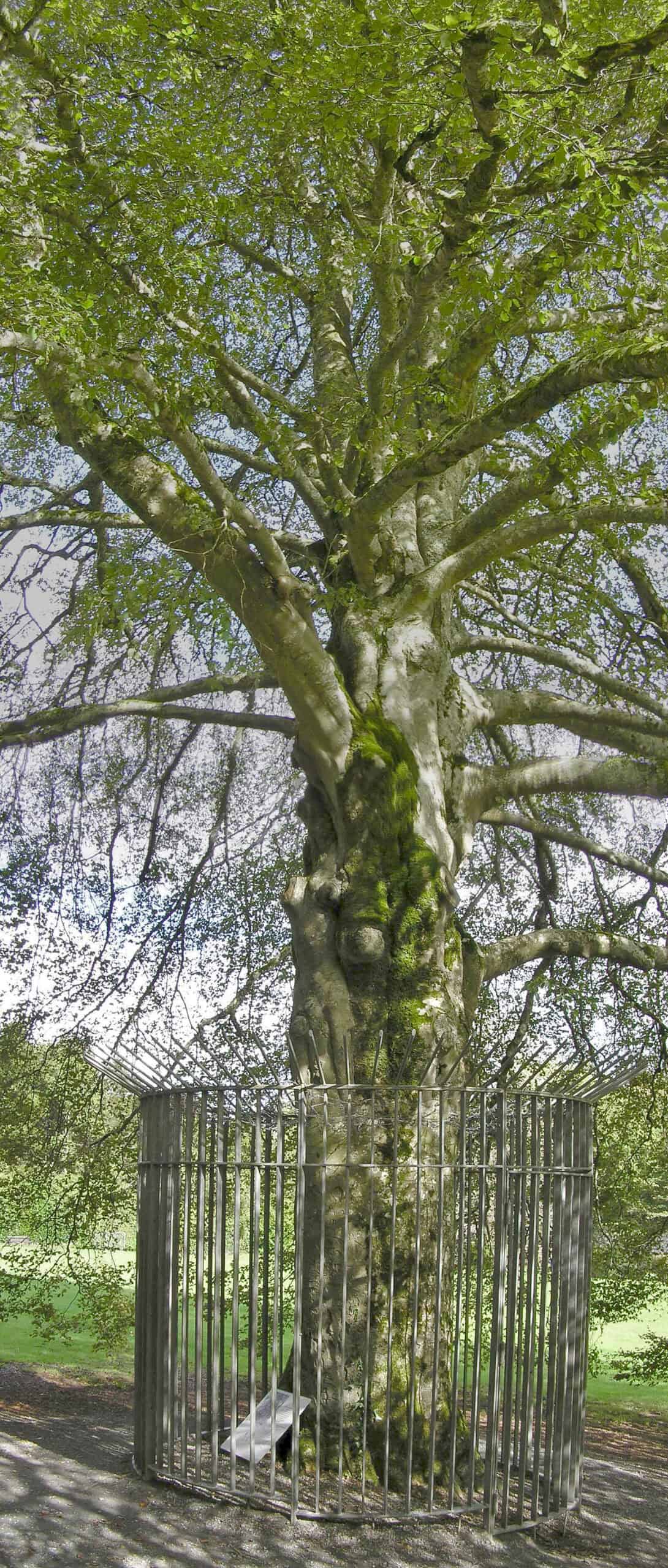
Visitors can still walk her woods and see the great copper beech inscribed by Yeats, George Bernard Shaw, Sean O’Casey and Lady Gregory herself. She once wrote of the estate’s trees, “The generations of trees have been my care, my comforters.”
Common Questions
Here are short answers to some of the questions readers most often ask about Lady Gregory. Each one draws on the sources listed at the end of this article.
Did Lady Gregory Speak Irish?
Yes. She was not raised speaking it, but after her husband’s death she learned Irish from some of her tenants and then on the Aran Islands. This allowed her to work with Irish texts and to hear stories directly from native speakers.
What Is the Kiltartan Dialect?
Kiltartan is the name Lady Gregory gave to the English she wrote her retellings in. It mixes English vocabulary with the rhythms and sentence patterns of Irish, as spoken by people around Kiltartan, near Coole in County Galway.
What Did Lady Gregory and Yeats Do Together?
They collected folklore together, with Yeats sometimes present while country people told their stories, and he added essays and notes to Visions and Beliefs in the West of Ireland. They also founded the Abbey Theatre in 1904, and he wrote prefaces for both of her great saga books.
Which Lady Gregory Book Should I Read First?
For the heroic tales, start with Cuchulain of Muirthemne, which covers Cú Chulainn and the Ulster Cycle. For gods and the Fianna, try Gods and Fighting Men. If fairy belief interests you most, Visions and Beliefs in the West of Ireland is the place to begin.
Sources and Further Reading
These are the sources opened and read for this article.
- Encyclopaedia Britannica, Augusta, Lady Gregory, Encyclopaedia Britannica.
- Coole Park, Lady Gregory of Coole, Coole Park Visitor Centre.
- Coole Park, History Timeline, Coole Park Visitor Centre.
- Dublin City Libraries, Happy Birthday Lady Gregory, Dublin City Council.
- Abbey Theatre, History, Abbey Theatre.
- Poetry Foundation, Lady Gregory, Poetry Foundation.
- Dictionary of Irish Biography, Gregory, (Isabella) Augusta, Royal Irish Academy.
- Dictionary of Irish Biography, Gregory, Sir William Henry, Royal Irish Academy.
- History of Parliament, William Gregory, History of Parliament Trust.
- Encyclopaedia Britannica, Irish Literary Renaissance, Encyclopaedia Britannica.
- Women in World History, Gregory, Augusta (1852 to 1932), Encyclopedia.com.
- Grolier Club, A Celtic Theatre, Grolier Club exhibition.
- National Library of Ireland, The Kiltartan Poetry Book (Cuala Press, 1918), NLI catalogue.
- Lady Gregory, Cuchulain of Muirthemne (1902), Internet Sacred Text Archive.
- Lady Gregory, Dedication to Cuchulain of Muirthemne, Internet Sacred Text Archive.
- Lady Gregory, Gods and Fighting Men (1904), Internet Sacred Text Archive.
- Lady Gregory, Gods and Fighting Men, with a preface by W. B. Yeats, Project Gutenberg.
- Lady Gregory, Poets and Dreamers: Studies and Translations from the Irish (1903), Project Gutenberg.
- Lady Gregory and W. B. Yeats, Visions and Beliefs in the West of Ireland, First Series (1920), Project Gutenberg.
- Grolier Club, Cuchulain of Muirthemne, First Edition, Grolier Club exhibition.
- Grolier Club, Preface to Cuchulain of Muirthemne, Grolier Club exhibition.
- New York Public Library, Cuchulain of Muirthemne, NYPL exhibition.
- University of Otago Library, Cuchulain of Muirthemne, University of Otago.
- Síle Ní Mhurchú, The Keening Waves, Dublin Review of Books.
Image credit: The Autograph Tree at Coole Park, photograph by Thpohl (2005), public domain, via Wikimedia Commons.