In Short
“Celtic gods” is an umbrella for the deities of every Celtic-speaking people, from Gaul and Roman Britain to Wales and Ireland. The Irish gods are one branch of that family: the Tuatha Dé Danann (TOO-uh-ha day DAN-un), known from medieval Irish manuscripts. The continental gods, such as Taranis, Esus, and Cernunnos, are known mostly from Roman-era inscriptions, carvings, and Greek and Latin writers. A few names are genuinely related across the divide, most securely Lugus and Lugh, Nodens and Nuada, Brigantia and Brigid, but most “Celtic gods” have no Irish story at all.
| Continental evidence | Inscriptions, statues, Caesar, Lucan |
|---|---|
| Irish evidence | Medieval manuscripts, 8th to 17th centuries |
| Welsh evidence | The Mabinogi, composed about 1060 to 1200 |
| Irish divine family | Tuatha Dé Danann |
| Securest cognates | Lugus/Lugh, Nodens/Nuada, Brigantia/Brigid |
| Not attested in Ireland | Cernunnos, Epona, Taranis, Esus |
| Key Irish text | Lebor Gabála Érenn (11th century) |
| Cernunnos named | Once, on the Pillar of the Boatmen, Paris |
Two Kinds of Evidence, Two Kinds of Gods
In March 1710, workmen digging a crypt beneath Notre-Dame de Paris struck carved stone blocks. Raised by the boatmen of the Parisii tribe during the reign of the emperor Tiberius (AD 14 to 37), the pillar showed Roman gods alongside strangers labeled in Latin letters: Esus hacking at a tree, a bull named Tarvos Trigaranus with three cranes, and an antlered god whose name survives as [C]ernunnos. That carving is still the only inscription anywhere that names Cernunnos.
Nobody carved Lugh’s name on an altar in Ireland. Instead, Irish monks wrote down long, vivid stories about Lugh, the Dagda, and the Morrígan, centuries after Ireland became Christian. Continental Celtic gods are mostly names without stories; Irish gods are stories without temples. The real question is always which kind of evidence survives.
The Continental Celtic Gods
The gods of Gaul (roughly modern France, Belgium, and parts of Switzerland and Germany) are known from three sources: votive inscriptions, sculpture, and the remarks of Greek and Roman writers who were often hostile and rarely interested in theology. Nearly all of it is Roman-period, so we see these gods through Roman eyes.
What Caesar and Lucan Said
Julius Caesar, writing about his Gallic campaigns in the 50s BC, never gave the Gauls’ own divine names. In Book 6 of his Gallic War, he says they worshiped Mercury above all as “inventor of all arts” and guide of travelers and trade, and after him Apollo, Mars, Jupiter, and Minerva. He adds that the Gauls claimed descent from Dis Pater, which is why they counted time by nights rather than days. This Roman renaming, called interpretatio romana, makes matching his list to native names guesswork.
The poet Lucan, writing his Pharsalia in the early 60s AD, supplied three native names. In Book 1 he mentions Teutates, “dread Esus with his savage altars,” and Taranis, as gods appeased with human blood. A later commentary, the Berne Scholia, adds lurid details of drowning, hanging, and burning that scholars treat with caution.
The Main Gaulish and Continental Deities
Each of these gods is attested by name or securely by image.
- Lugus: Known chiefly from plural dedications to the Lugoves in Spain and Switzerland, and possibly from place names such as Lugdunum (Lyon). Many scholars equate him with Caesar’s Mercury, though Bernhard Maier and others have questioned that link.
- Taranis: A thunder god whose name means “thunderer,” recorded in about a dozen inscriptions and equated with Jupiter. An altar at Chester dated AD 154 names Jupiter Tanarus.
- Teutates: His name comes from Proto-Celtic *teutā, “tribe,” the same root as Irish túath. He was often paired with Mars.
- Esus: Shown cutting a tree on the Pillar of the Boatmen and on a monument at Trier.
- Cernunnos: The antlered god, linked to at least twenty-five images, mostly around Paris and Reims, but named only once.
- Epona: A horse goddess carried across the Roman Empire by cavalry units, with over 260 known inscriptions and images. She even had a festival in the Roman calendar, on December 18.
- Sucellus: The “good striker,” a god with a long-handled mallet and a pot, often paired with the goddess Nantosuelta.
- Belenus: Named in about fifty inscriptions, most from Aquileia in northeastern Italy, and identified with Apollo as a healer.
Gods of Roman Britain
Britain under Rome produced its own altars. Nodens was worshiped at a late fourth-century healing temple at Lydney Park in Gloucestershire, excavated by Mortimer and Tessa Wheeler in 1928 and 1929; J. R. R. Tolkien wrote the appendix on the name “Nodens” in their 1932 report. Brigantia, goddess of the Brigantes tribe of northern Britain, appears on about eight inscriptions, and a relief from Birrens in southern Scotland shows her armed and crowned like Minerva.
The Welsh Gods of the Mabinogion
Wales sits between the two traditions. Its gods survive, as in Ireland, in medieval prose, chiefly the Four Branches of the Mabinogi, composed somewhere between about 1060 and 1200 and preserved in the White Book of Rhydderch (about 1350) and the Red Book of Hergest (about 1400). No Welsh text calls them gods, but scholars read several as remembered deities.
Rhiannon, the otherworldly bride of the First Branch, is often compared with Epona because of her association with horses, though Ronald Hutton argues she is a later literary creation. Manawydan son of Llŷr, hero of the Third Branch, shares his patronymic with the Irish Manannán mac Lir. Lleu Llaw Gyffes, “Lleu of the Skillful Hand,” appears in the Fourth Branch among the Children of Dôn, a family of magicians. Lludd Llaw Eraint, “Lludd of the Silver Hand,” was originally called Nudd, and both names descend from Nodens.
The Irish Gods: the Tuatha Dé Danann
The Irish gods form a single family, the Tuath Dé or “tribe of the gods,” later called the Tuatha Dé Danann. Their great narratives include Cath Maige Tuired (The Second Battle of Moytura), in which Lugh, Nuada, the Dagda, and the Morrígan defeat the Fomorians, and the Lebor Gabála Érenn, the “Book of the Taking of Ireland.”
The core figures are the Dagda (DAG-da), the “good god,” a father figure with a club and cauldron; Lugh (LOO), the Samildánach or master of every art; the Morrígan (MOR-ee-gan), a goddess of war, prophecy, and sovereignty; Nuada (NOO-uh-da), the king who lost his arm and wore one of silver; Brigid, whom the ninth-century glossary Sanas Cormaic calls the goddess of poets; and Manannán mac Lir, lord of the sea and the Otherworld.
Danu, often called their mother goddess, needs a caveat. The name Danu never appears in any medieval Irish text. Scholars reconstructed it from the genitive Danann in Tuatha Dé Danann. The sources do name a Danand, and Sanas Cormaic calls a goddess Anu the mother of the Irish gods, but the confident “Danu, Celtic mother goddess” of modern books and neopagan writing is largely a modern construction.
Which Gods Are Related? A Table of Cognates
Shared names suggest shared inheritance from an older Celtic religion, but a shared name does not prove a shared god. Medieval writers also borrowed from each other. The table below lists only equivalences that scholars broadly accept on linguistic grounds, and it marks the debated ones as such.
| Continental or British | Welsh | Irish | Status |
|---|---|---|---|
| Lugus | Lleu | Lugh | Names accepted as cognate; a single pan-Celtic god is still debated |
| Nodens | Nudd / Lludd | Nuada | Widely accepted |
| Brigantia | None | Brigid | Names cognate (“high one”); goddesses treated as distinct |
| Gobannus | Gofannon | Goibniu | Names cognate (from “smith”) |
| Maponos, Matrona | Mabon son of Modron | Mac ind Óc (Aengus) | Welsh link accepted; Irish link debated |
| Ogmios | None | Ogma | Debated on phonetic grounds |
| None | Manawydan son of Llŷr | Manannán mac Lir | Closely parallel; possibly borrowed |
| Sucellus | None | Dagda | Comparison only; Jan de Vries called it superficial |
| Cathubodua | None | Badb | Speculative; one inscription |
Even the securest links involve names, not myths. Nothing on a Gaulish altar tells us that Lugus fought a one-eyed giant, as Lugh does in Cath Maige Tuired.
How Monks Turned Irish Gods into Kings
The Irish gods reached us through Christian scribes, and those scribes had to decide what the old gods had been. In the late seventh century, Tírechán’s account of Saint Patrick describes the daughters of King Lóegaire meeting the saint at a well and wondering if he and his companions were “men of the síde, or of the gods of the earth.” The hymn attributed to Fiacc says the Irish worshiped the síde before Patrick came.
The most influential answer was euhemerism, the idea, named after the fourth-century BC Greek writer Euhemerus, that gods were once human beings. The eleventh-century Lebor Gabála Érenn made the Tuatha Dé Danann the fifth of six peoples to invade Ireland, fitted into biblical chronology, and even hedged on their nature: the truth was not known “whether they were of heaven or of earth.” The Annals of the Four Masters, compiled in the 1630s, gave the Dagda and Lugh reign dates as kings of Ireland, with Lugh ruling from 1870 to 1830 BC. That is why Irish gods appear as kings and ancestors rather than objects of worship. It also explains their afterlife in folklore: once the Milesians, the ancestors of the Irish, took the land, the defeated Tuatha Dé retreated into the fairy mounds and became the aos sí.
Celtic Gods Often Wrongly Called Irish
Popular lists of “Irish gods” regularly include deities that have no Irish attestation at all. The three most common offenders are worth knowing.
Cernunnos has no Irish name, story, or inscription. Attempts to connect him to the Ulster hero Conall Cernach rest on a similar-sounding word, and readings of antlered figures on Irish high crosses are contested. Epona was a Gaulish and Roman cavalry goddess with no Irish cult; the Irish figure sometimes paired with her, Macha, is a separate literary tradition. Taranis is unknown in Irish sources, although his name shares a root with the Old Irish word torann, “thunder.” The same caution applies to Esus, Belenus, and Sucellus. A link between Belenus and the festival of Bealtaine has been proposed but remains speculative.
How to Tell Which Tradition a God Belongs To
Four quick checks will sort most names.
- Check the evidence: If the god is known from Roman-era altars, statues, or classical authors, the god is continental or Romano-British, not Irish.
- Check the stories: If the god acts in an Irish saga or the Lebor Gabála Érenn, the god is Irish, and usually one of the Tuatha Dé Danann.
- Check the spelling: Irish names follow Irish spelling, such as Lugh, Nuada, and Brigid; Latinized endings such as -us, -os, and -a point to Gaul or Roman Britain.
- Check the source date: Claims sourced only to modern neopagan books should be treated as modern additions.
Within the Gaelic world, “Irish” often includes shared Scottish and Manx tradition: Sanas Cormaic already ties Manannán to the Isle of Man, and Brigid survives in Scotland as Bride.
Common Questions
These are the questions readers most often ask when the two labels get tangled.
Are Irish Gods Celtic Gods?
Yes. The Irish gods are Celtic gods in the linguistic sense, because Irish is a Celtic language. Not every Celtic god is Irish, however, and most continental deities were never worshiped in Ireland as far as the evidence shows.
Who Is the Chief Celtic God?
No single chief god spans the Celtic world. Caesar named “Mercury” as the most honored Gaulish god, often identified with Lugus, while Irish tradition gives the role of father figure to the Dagda and of king to Nuada.
Sources and Further Reading
- Julius Caesar, Commentarii de Bello Gallico, Book 6, chapters 17 and 18 (50s BC).
- Lucan, Pharsalia (De Bello Civili), Book 1, lines 444 to 446 (about AD 61 to 65).
- Bernhard Maier, Dictionary of Celtic Religion and Culture, Boydell Press (1997).
- Miranda Green, Dictionary of Celtic Myth and Legend, Thames and Hudson (1992).
- Mark Williams, Ireland’s Immortals: A History of the Gods of Irish Myth, Princeton University Press (2016).
- Ronald Hutton, Pagan Britain, Yale University Press (2013).
- R. A. S. Macalister (ed. and trans.), Lebor Gabála Érenn, Irish Texts Society (1938 to 1956).
- John T. Koch (ed.), Celtic Culture: A Historical Encyclopedia, ABC-CLIO (2006).
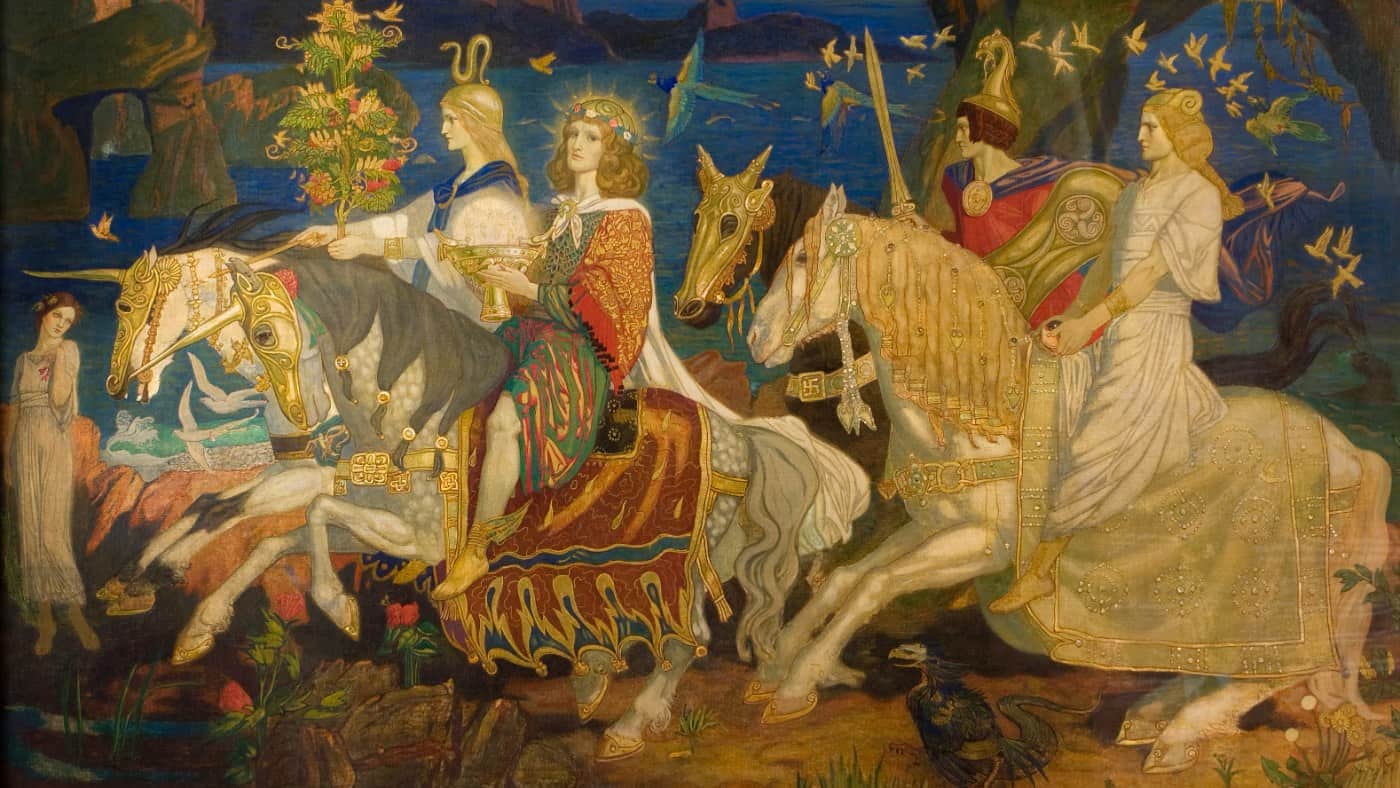
- Image credit: John Duncan, The Riders of the Sidhe (1911), public domain, via Wikimedia Commons.