In Short
Grace O’Malley, known in legend as Granuaile (GRON-ya-wail), was a real sea captain from Mayo who lived from around 1530 to around 1603. English State Papers show her raiding, her fight with Sir Richard Bingham, and her 1593 suit at the court of Elizabeth I. So yes, she was a pirate, but no record quoted here calls her a queen. The best-known tales, including Howth Castle, the handkerchief, and the cropped hair, come from tradition, and the earliest printing found for several dates from the 1790s.
| Irish Name | Gráinne Ní Mháille |
|---|---|
| Legend Names | Granuaile, Gráinne Mhaol |
| Lived | Around 1530 to around 1603 |
| Home Waters | Clew Bay and the lordship of Umhall, County Mayo |
| Strongholds | Clare Island and Rockfleet (Carrigahowley) |
| Main Evidence | English State Papers, including her 1593 petition |
The gates were shut. That is how the story begins: A sea captain from the far west walks up to Howth Castle at the dinner hour, wanting a meal, and finds the door closed against her. Soon after, she seizes the young heir of the house, carries him aboard, and sails for Mayo.
The family pays to get him back, and for years afterward, the gates of Howth stand open at dinner. It is a perfect tale, and it may have nothing to do with her. Grace O’Malley is a figure of legend who can be checked against the paperwork.
Who Was Grace O’Malley?
Grace O’Malley was a Gaelic noblewoman who made her living from the sea along the Mayo coast in the second half of the sixteenth century. She was born into the O’Malley family of Umhall, the daughter of the chieftain Owen Dubhdara O’Malley. Unlike the figures of Irish mythology, she left a paper trail.
Around 1546 she married Dónal an Chogaidh O’Flaherty, a match made for politics. After his death, Gaelic law barred her from inheriting O’Flaherty land, so she went back to Umhall and settled on Clare Island. Around 1566 she married Richard Burke, known as Richard-in-Iron, whose castle at Rockfleet was less exposed than Clare Island.
Her Names and How to Say Them
Her Irish name is Gráinne Ní Mháille, and Grace O’Malley is the English form. Gráinne Mhaol and Granuaile are the names of folklore, and Granuaile is said roughly GRON-ya-wail. English clerks wrote Grany O’Mayle, Grany Ne Male, and Ghrayn Ny Vayle, among other spellings. She also carried the nickname Gráinne na gCearbhach, “Gráinne of the Gamblers.”
Dates That Refuse to Settle
Most reference works give her life as around 1530 to around 1603. Her birthplace is just as loose. Sources tie her family to the lordship of Umhall (the later barony of Murrisk), but the biographies checked here name no exact spot.
The last official notice of her dates from 1601, when an English captain reported a galley that “belongs to Grace O’Malley.” She is believed to have died around 1603, probably at Rockfleet, although neither the year nor the place is certain.
What the Documents Show
The solid core of her story comes from her enemies and her own petitions. Nearly everything we can check about her sits in the English State Papers, so this Irish heroine is known mostly through the files of the government she fought.
Sidney’s Letter
Sir Henry Sidney toured Connacht as Lord Deputy in 1576, and she came to him at Galway, offering three galleys and 200 fighting men. Sources differ on the year, with some dating the offer to 1577. Sidney recalled it in a letter to Walsingham in 1583, describing a famous “feminine sea captain called Grany Imallye.” His verdict: “This was a notorious woman in all the coasts of Ireland.”
Bingham’s Campaign
Sir Richard Bingham became governor of Connacht in 1584. She was arrested in 1586, and in her own later account he “caused a new pair of gallows to be made” for her. Only her son-in-law Richard Burke saved her.
Her son Owen was killed, her son Tibbot was held hostage for a year in Ballymote Castle, and in 1592 her lands were plundered and her fleet impounded. In August 1593 Bingham called her “a notable traitress and nurse of all rebellions in the province for forty years.”
The 1593 Petition and the 18 Articles
In July 1593 she petitioned Elizabeth I directly, pleading age and poverty and asking for maintenance. It was also a way around Bingham, who had arrested Tibbot for treason and was holding her brother. She reached England that summer, and the court sent her 18 interrogatories, known as the “Articles of Interrogatory,” probing her family and connections. Her answers survive with Lord Burghley’s notes in the margin.
The queen’s letter to Bingham of 6 September 1593 tells the outcome. It says she “departeth with great thankfulness,” promising on oath to “fight in our quarrel with all the world.” Tibbot and her brother could go free on bonds, and her sons were to provide for her. All of it hung on one condition: She must cease rebellion against the crown.
Bingham did not hurry. He let the prisoners go only in late November or early December, and two further petitions in 1595 have no recorded reply.
Greenwich or Windsor?
Nearly every account, her biographer’s included, sets the great scene at Greenwich Palace in early September. The queen’s letter, however, names no place. A day-by-day calendar of the court has Elizabeth at Oatlands and then Windsor from late June into early September, with no stay at Greenwich.
That calendar puts the sea captain at Windsor with the queen around 6 September, although it cites no eyewitness to the meeting. So the date holds, while the famous Greenwich setting may be wrong.
The Silence of the Annals
The Gaelic record is strangely quiet. The Annals of the Four Masters, compiled about 30 years after her death, do not mention her name. The annalists did notice her husband, calling Richard Burke “a plundering, warlike, unquiet, and rebellious man.”
Later Irish historians, with fixed ideas of how Gaelic women should be portrayed, largely wrote her out. Folklore kept her alive instead.
Was She Really a Pirate Queen?
She was certainly a pirate, by the standards of her time and by her own implied admission. Her answers of 1593 suggest piracy was her only means of survival, and she lived by “maintenance by land and sea.” Her clan was known for both piracy and fishing, and she raided ships bound for English-held Galway.
She also took tolls at sea in exchange for safe passage, a kind of protection racket under sail. Piracy was endemic on the Irish coast, so her trade was not unusual. A seafaring career of over forty years, led by a woman, was.
The word “queen” is another matter. Her contemporaries called her a sea captain, a notorious woman, and a traitress, and none of the records quoted here gives her a royal title. “Queen” describes her reputation, not her rank.
What Folk Memory Added
The stories below live in Irish folklore and popular print, and many of them have no support in the records. The table sorts the main claims by the earliest evidence found for this article, so older tellings may still exist.
| Story | Status | Earliest Evidence |
|---|---|---|
| Audience with Elizabeth | Documented, place uncertain | Court correspondence, 1593 |
| Howth heir abduction | Tradition, likely borrowed | Printed 1793, with a fifteenth-century parallel |
| Handkerchief in the fire | Tradition | Printed 1793 |
| Cropped hair | Tradition, probably a misreading | Date not established |
| Birth at sea and pirate attack | Tradition, with one claimed document for the attack | Latin document cited by her biographer |
| Naming of Hen’s Castle | Disproved by the annals | Name recorded under 1233 |
The Howth Castle Place Setting
The earliest telling found for this article is a piece in the Dublin magazine Anthologia Hibernica for July 1793. There she finds the gates shut “for the family was at dinner,” takes the child, and sails to Carrick a Owly. For many years afterward, the gates and doors of Howth were thrown open at dinner.
Today’s version adds a place laid for the unexpected guest, a custom the castle says still continues. Tradition has her sailing home from Elizabeth around 1575, but she did not visit the queen until 1593, when the castle says no heir was the right age. It prefers 1576, when it says she was in Dublin.
The bigger problem is older. Duald MacFirbis, writing about 60 years after her time, tells the same tale of Richard Burke, a MacWilliam who ruled from 1469 to 1479: He carried off the lord of Howth, whose ransom was to keep his door open at dinner.
A study of 1905 to 1906 concluded that the story moved to Grace from him. Against that, one modern article reports that records at Howth Castle name Grace, a claim we could not check.
The Cable Tied to Her Bed
The same 1793 article reports a hole “now shown” in the wall at Carrick a Owly, the castle better known as Rockfleet, “through which a cable was run from a vessel, and fastened to her bed.” The idea was to give her early warning of an attack.
A travel book of about 1841 moved it to her Clare Island castle, with the cable tied to her bedpost. This is a story attached to a hole in a wall, not a record of her habits.
The Handkerchief and the Dagger
The 1793 article also has the handkerchief. Offered a pocket handkerchief at court, she uses it and throws it in the fire, then does the same with a second, declaring that “in her country they were much cleanlier” than to pocket what came from their nostrils.
A reader’s letter of 1794 adds that Elizabeth offered to make her a countess and she replied that both were princesses and equals. A hidden dagger appears in modern retellings, but neither magazine piece mentions it, and no early source turned up.
Tradition also says the two women spoke in Latin, although her biographer argues she understood and spoke English. The dialogue belongs to storytellers.
The Cropped Hair
The most famous name story says that as a girl she begged to sail to Spain with her father, was told her long hair would catch in the ropes, and cut it off, earning the name Gráinne Mhaol, since “maol” means bald.
It may be a misunderstanding. One explanation holds that local speech pronounced Máille close to “Maolya,” and the story grew from the sound. The 1793 article describes her hair as gathered on her crown with a bodkin, hardly the look of a bald woman.
The Birth at Sea
Folklore says her youngest son, Tibbot, was born aboard ship in 1567, and that the next day corsairs attacked. She rises from childbed and turns the fight, shouting, in one fable, “take this load from unconsecrated hands!”
This one has the best claim to a factual root. Anne Chambers, her biographer, says she found a Latin document confirming the attack.
Hen’s Castle
On Lough Corrib stands Caisleán na Circe, the Hen’s Castle. Tradition says she defended it so bravely after her husband’s death that it took its name from her. Irish annals, however, already name the Hen’s Castle under the year 1233, about three centuries before she was born.
Local legend offers a stranger origin: A cock and a hen built the castle in a single night. An 1888 collection adds midnight boats that vanish at cockcrow, a sign that the fairies have taken a child and left a changeling in the cradle. It also lodges “Graina Uaile” and the heir of Howth there, showing how a famous name draws in other stories.
Rockfleet and Clare Island
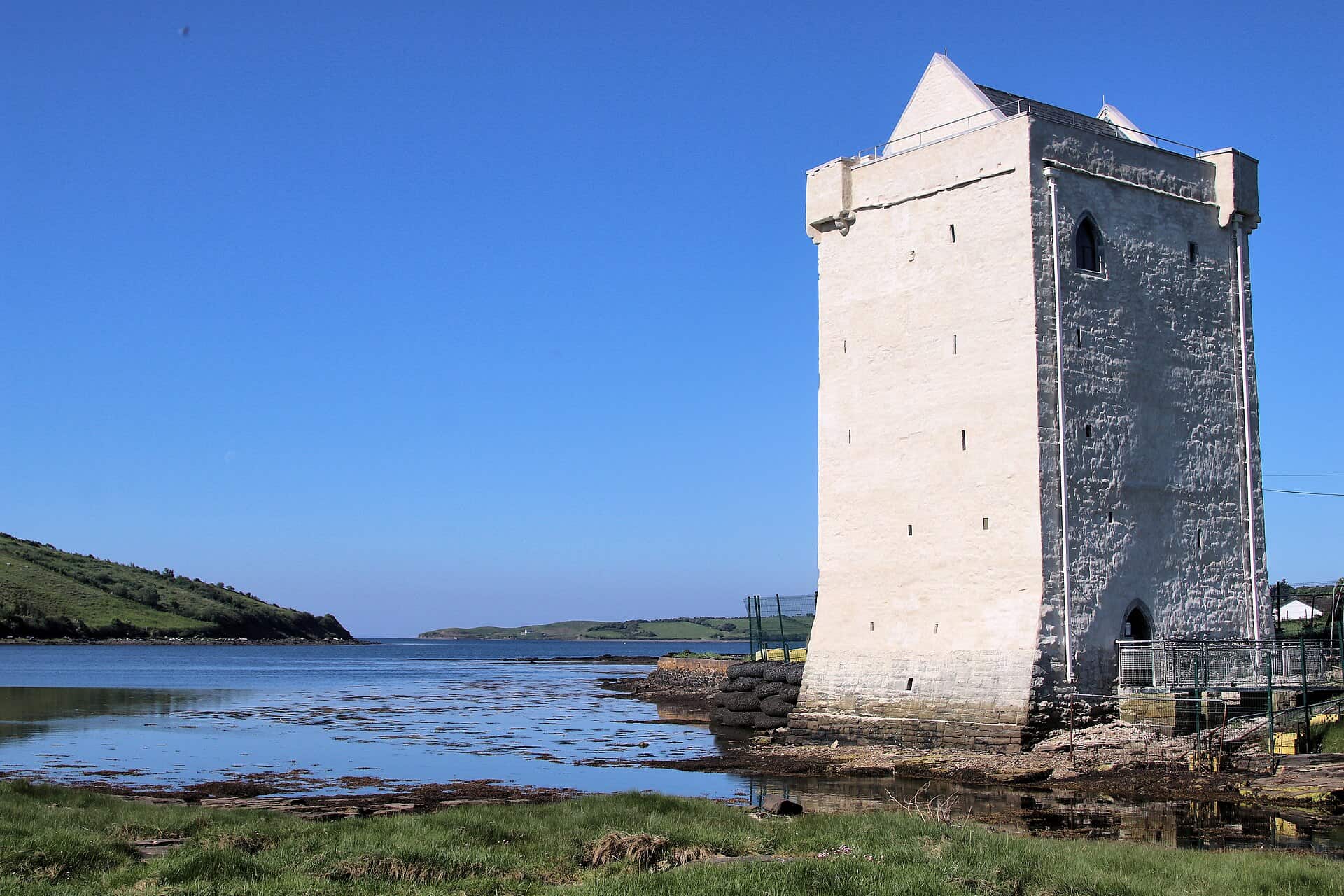
Rockfleet, a tower of the fifteenth or sixteenth century, belonged to the Burkes and became her base through her second marriage. Captain William Martin tried to besiege it in 1579 and nearly ended up her prisoner.
Rockfleet also has a marriage legend. Tradition says she wed Richard Burke for one year, after which either could say “I dismiss you” and end the union. She is then said to have locked him out and kept the castle. One heritage account calls this unlikely, since the pair stayed married until he died, although her biographer’s timeline has them parting and reuniting.
Clare Island keeps her family’s castle, three stories tall near the harbor, and a medieval church with some of Ireland’s finest frescoes. Beside a canopied tomb, believed to be hers, a plaque bears the O’Malley motto, Terra Mariq Potens, “Powerful by Land and Sea.”
Granuaile as a Name for Ireland
Her strangest afterlife is political. Her name became a code name for Ireland itself, “one of the endearing names” used during the Penal times. An 1831 collection of Irish verse notes that it “has been frequently used by our Bards, to designate Ireland.”
The idea of the land as a woman runs deep in Ireland, and the Cycle of the Kings shows it in the sovereignty goddess a rightful king must win. Granuaile gave that old figure a historical face: Ireland robbed of its land but still unbowed.
The clearest case is Óró Sé Do Bheatha Abhaile, once a Jacobite song of Bonnie Prince Charlie. Patrick Pearse wrote new words that put Granuaile in the prince’s place, and it became a rallying call before the 1916 Easter Rising.
The Pirate Queen Today
Modern interest owes a great deal to Anne Chambers, whose 1979 biography is now in its eleventh edition. Shaun Davey’s concert work Granuaile took her name to the concert stage. The Boublil and Schönberg musical The Pirate Queen reached Broadway in 2007.
The Granuaile Visitor Centre in Louisburgh tells her story, and the town of Newport unveiled a statue in her honor in January 2024. Irish Lights sails the ship Granuaile, which tends the country’s offshore buoys. For a woman who once took tolls from passing ships, that is a pleasing irony.
Common Questions
These are the questions readers most often ask about Grace O’Malley and how much of her legend is true.
Did Grace O’Malley Really Meet Queen Elizabeth I?
Yes. She came to court in September 1593, after petitioning Elizabeth that summer. Most accounts say Greenwich, but a day-by-day calendar of the court puts her with the queen at Windsor, so the place is uncertain. The famous lines spoken in the room come from tradition.
Why Is She Called Granuaile?
Granuaile is thought to come from Gráinne Mhaol, meaning “Bald Grace.” Tradition links it to her cropped hair, while another explanation points to a local pronunciation of her surname.
Did She Kidnap the Heir of Howth?
Probably not. No early record found supports it, and a nearly identical story is told of a fifteenth-century MacWilliam. One modern article says Howth Castle’s records name her, and the castle says a place is still laid, but the reason is unproven.
Where Is Grace O’Malley Buried?
Tradition places her in the O’Malley tomb in the ruined abbey on Clare Island. That is the common belief, not a proven fact.
Sources and Further Reading
These are the sources opened and read for this article.
- Meeting Grace O’Malley, Ireland’s Pirate Queen, The National Archives (UK).
- The Extraordinary Life of Grace O’Malley, Royal Museums Greenwich.
- Emmett O’Byrne, O’Malley, Gráinne (Grace) (“Granuaile”), Dictionary of Irish Biography.
- Cecil Papers: September 1593, Calendar of the Cecil Papers in Hatfield House, vol. 4, ed. R. A. Roberts (1892), British History Online.
- Marion E. Colthorpe, The Elizabethan Court Day by Day: 1593, Folgerpedia, Folger Shakespeare Library.
- Theresa D. Murray, Gráinne Mhaol, Pirate Queen of Connacht: Behind the Legend, History Ireland, vol. 13, no. 2 (2005).
- “O’Malley, Grace,” Dictionary of National Biography, 1885 to 1900, Wikisource.
- Anne Chambers, Extract, Time Line, and When the Sea Queen Met the Virgin Queen, graceomalley.com.
- Rosemary Raughter, O’Malley, Grace (c. 1530 to 1603), Women in World History, Encyclopedia.com.
- Monica A. Brennan, Granuaile (Grace O’Malley), Encyclopedia of Irish History and Culture, Encyclopedia.com.
- H. T. Knox, Grace O’Malley, Journal of the Galway Archaeological and Historical Society, vol. 4, no. 2 (1905 to 1906), pp. 65 to 72, Internet Archive.
- Anthologia Hibernica, vol. 2 (July 1793), pp. 1 to 2, Boston Public Library scan, Internet Archive.
- Anthologia Hibernica, vol. 3 (May 1794), pp. 340 to 341, Boston Public Library scan, Internet Archive.
- Annals of Connacht, entry 1233.4, CELT.
- Annals of the Four Masters, entry M1233.4, CELT.
- Annals of the Four Masters, entry M1583.20, CELT.
- Annals of the Four Masters, Ask About Ireland.
- J. Stirling Coyne and N. P. Willis, The Scenery and Antiquities of Ireland (about 1841), Library Ireland.
- John Healy, Grania Uaile (Grace O’Malley) and the Abduction of the Heir of Howth, Irish Essays (1908), Library Ireland.
- John Johnson Marshall, Popular Rhymes and Sayings of Ireland (1924), Library Ireland.
- Lady Wilde, The Hen’s Castle, Ancient Legends, Mystic Charms, and Superstitions of Ireland (1888), Library Ireland.
- James Hardiman, Irish Minstrelsy, vol. 2, notes (1831), Wikisource.
- Legends, Howth Castle.
- The Pirate Queen of Mayo’s Monuments, Heritage Ireland.
- Castlekirk Castle, Heritage Ireland.
- Óró Sé Do Bheatha Abhaile, RTÉ (2019).
- Why It’s Time to Celebrate Grace O’Malley, Ireland’s Pirate Queen, RTÉ (2026).
- Town of “Two Graces” Unveils Statue of Pirate Queen Grace O’Malley, RTÉ (2024).
- Grace O’Malley Statue Unveiled in Co Mayo’s “Town of Two Graces”, IrishCentral (2024).
- Granuaile as Symbol of Irish Nationalism, Ireland Calling.
- Ronan O’Connell, On the Trail of Ireland’s Legendary Pirate Queen, National Geographic (2021).
- Granuaile Ship Tours at Seafest 2016, Commissioners of Irish Lights.
- Granuaile Visitor Centre, Discover Ireland.
- The Pirate Queen, Internet Broadway Database.
- Catherine Curzon, Grace O’Malley, the Fearless 16th-Century Irish Pirate Queen Who Stood Up to the English, Mental Floss.
- Granuaile, Ask About Ireland.
- Grace O’Malley, Wikipedia, used only to find references. No claim here rests on it.
Image credit: Rockfleet Castle, photograph by Pfiffy (2025), CC0 1.0, via Wikimedia Commons.