In Short
The cú sídhe (pronounced koo SHEE, “fairy hound”) is a monstrous fairy dog, as large as a young bullock, with enormous paws and a long tail coiled over its back. It belongs mainly to the folklore of the Scottish Highlands and Islands, where it is called the cù sìth and was said to guard the fairy dwellings. It barks only three times, with long gaps between, and anyone who hears it must reach safety before the third bark, or be overtaken and destroyed. Ireland’s own fairy hounds are Bran and Sceólang, the magical dogs of Fionn mac Cumhaill.
| Name | Cú sídhe; Irish cú sí; Scottish Gaelic cù sìth |
|---|---|
| Meaning | “Fairy hound” |
| Pronunciation | koo SHEE |
| Size | As large as a two-year-old bullock |
| Color | Usually described as dark green |
| Tail | Long, coiled on its back, or flat and plaited |
| Footprints | As large as a man’s outspread hand |
| The danger | It barks three times; reach safety before the third |
| Main source | John Gregorson Campbell, 1900 |
What Is the Cú Sídhe?
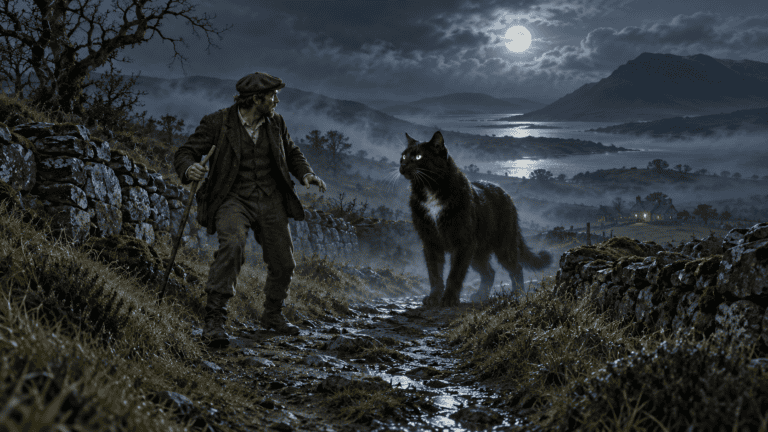
A man is crossing the moor on the island of Tiree after dark when he hears it: a single deep bark, far off, louder than any dog he knows. He starts walking faster. After a long silence, it comes again, closer this time. Now he is running, because he knows the old warning. The fairy hound barks three times, and whoever hears the third bark in the open is lost.
That is the cú sídhe, the fairy hound. Its name joins cú, “hound,” with sídhe, the fairy people, the same word that appears in the banshee, the bean sídhe or “fairy woman.” Like the fairy cat, it belongs to the hidden world of the fairies, and like the banshee, it was a creature people feared to hear.
A Creature of the Scottish Highlands
Most of what is known about the fairy hound comes from Scotland, and above all from John Gregorson Campbell, the parish minister of Tiree, in the Inner Hebrides, who spent decades collecting the folklore of the islands and western Highlands. His Superstitions of the Highlands and Islands of Scotland, published in 1900, remains the main source.
The Irish spelling, cú sídhe, appears in modern books and games, but there is little evidence of a separate Irish tradition of the same creature. Ireland has fairy hounds of its own, as we will see, but the green, calf-sized hound with the three barks is a Scottish figure.
What It Looks Like
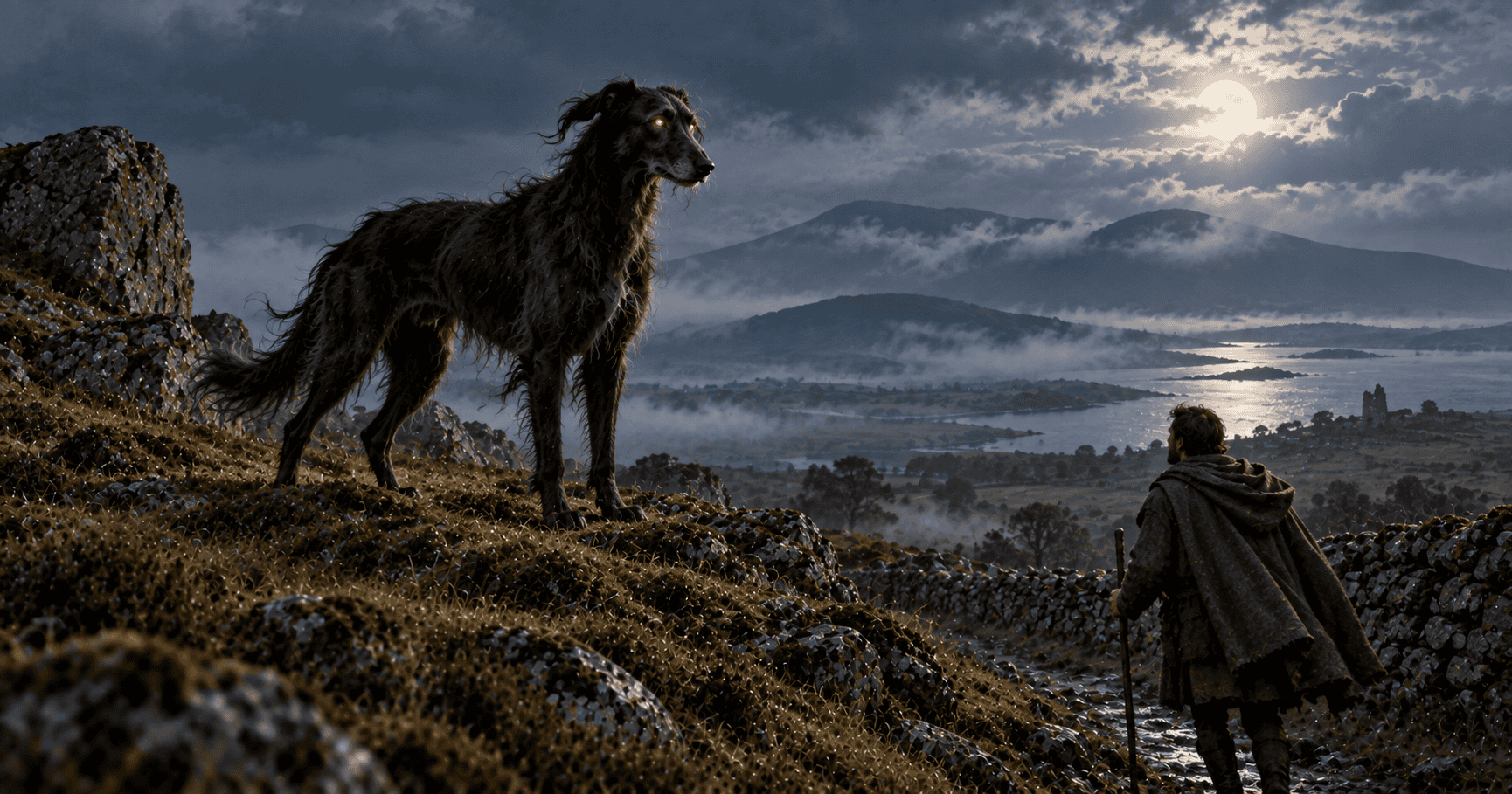
Campbell described the fairy dog as being as large as a two-year-old stirk, a young bullock. Some had a long tail rolled up in a coil on the back, others a tail that was flat and plaited. Its footprints, found in mud or snow, were as large as the spread of a man’s hand.
Its color is usually given as dark green, a color long associated with the fairies in Gaelic tradition, though some accounts describe it differently. People disagreed about how it moved. Some said it ran in total silence. Others said it made a noise like a galloping horse.
The Three Barks
The most famous thing about the fairy hound is its bark. It barks only three times, Campbell wrote, and there is a considerable interval between each. At the third bark, anyone who hears it is overtaken and destroyed, unless they have reached a place of safety by then. The barks were said to carry for miles, even to boats far out at sea.
The rule gives the story its terror, but it also gives the listener a chance. The long pauses between barks are a warning, and a person who heard the first one knew to run for home at once. That is exactly the kind of practical advice a folk belief could give: when you hear something strange on the moor at night, do not wait to find out what it is.
The Fairies’ Watchdog
The cú sídhe was not usually a wandering monster. It belonged to the fairies. In Highland tradition, the fairies kept hounds as watchdogs for their dwellings, and sometimes the dogs went out with the fairy women on their errands or roamed alone, making their lairs in the clefts of rocks. A fairy hound on the moor, in other words, was a sign that the Otherworld was close by.
That link explains why it was so feared. Like the Aos Sí it served, it belonged to a world with its own rules, and meeting it meant stepping into that world’s territory.
The Fairy Dog’s Tooth
Not every story about the fairy hound is frightening. The folklorist Alexander Macgregor recorded a tale from the Isle of Lewis about a farmer whose potatoes kept disappearing, though he could never catch the thief. One day he found a fairy dog’s tooth stuck in one of the potatoes. The tooth was kept in the family and treasured as a charm, and it was dipped in water to cure sick cattle.
Ireland’s Fairy Hounds
Irish tradition has its own famous fairy hounds, and they are very different in character. Bran and Sceólang, the great hounds of Fionn mac Cumhaill, were said to be his own cousins. His aunt Tuiren was turned into a hound by a jealous Otherworld woman while she was pregnant, and her two pups were born as dogs, with human intelligence. They were Fionn’s most loyal companions, and in the story of Sadhbh, it was their refusal to harm a fawn that revealed she was an enchanted woman.
Irish folklore is also full of spectral black dogs, seen on lonely roads at night and often taken as omens. These are not usually called fairy hounds, but they share the same sense that a strange dog on the road after dark might not be a dog at all.
Fairy Hounds Across the Celtic World
Supernatural hounds appear across the Celtic lands. In Wales, the Cŵn Annwn, the hounds of the Otherworld, were white with red ears and hunted through the sky, and hearing them was an omen of death. England has its black dogs, such as Black Shuck of East Anglia. These traditions developed separately, but they share the idea of a great hound that belongs to another world and whose voice brings fear.
The Cú Sídhe in Popular Culture
The fairy hound has become a regular in modern fantasy, games, and illustration, usually as a huge, shaggy green dog. It turns up in role-playing games, fantasy novels, and video games, often alongside the cat sídhe, and it is a popular choice for artists drawing Celtic monsters.
Is the Cú Sídhe a Death Omen?
Not in the way the banshee is. The banshee warns of a death that is coming, while the fairy hound itself is the danger: its third bark means you are caught. Some modern writers describe it as a hound that carries souls to the Otherworld, but that idea is hard to find in the older sources, which present it as a guard dog of the fairies and a terror to anyone caught out on the moor.
Sources and Further Reading
- John Gregorson Campbell, Superstitions of the Highlands and Islands of Scotland, James MacLehose and Sons (1900).
- Alexander Macgregor, Highland Superstitions, Eneas Mackay (1901).
- Katharine Briggs, An Encyclopedia of Fairies, Pantheon Books (1976).
- James MacKillop, A Dictionary of Celtic Mythology, Oxford University Press (1998).