In Short
Irish ghost stories are tales of the dead who return to the living, usually because something was left undone: a debt unpaid, a wrong unrighted, a body buried in the wrong place. The usual Irish word for a ghost is taibhse (TIVE-sheh), and folk belief kept ghosts separate from the fairies, though the two worlds touched, above all at Samhain. The tradition runs from the medieval Echtra Nerai through the collections of Patrick Kennedy, Lady Wilde, and Jeremiah Curtin to haunted houses such as Leap Castle and Loftus Hall.
| Irish words | Taibhse, sprid, tais |
|---|---|
| Why the dead return | Unfinished duty, debt, longing, or anger |
| Peak season | Samhain and All Souls (October 31 to November 2) |
| Key collections | Kennedy (1866), Wilde (1887), Curtin (1895) |
| Most-named haunted sites | Leap Castle, Offaly; Loftus Hall, Wexford |
| Signature motif | The card player with a cloven hoof |
| Related figures | Banshee, Dullahan, cóiste bodhar, Sluagh |
| Literary heirs | Sheridan Le Fanu, Bram Stoker, W. B. Yeats |
A Debt of Threepence
In 1846, a road worker named Tom Connors borrowed threepence for tobacco from a fellow laborer on the road between Slea Head and Ventry, in County Kerry, promising to repay it on the next pay day. Before pay day came, the lender fell ill. One morning, near a bridge, Connors saw the man walking toward him and reached into his pocket for the coins. The man stepped onto a ditch, crossed a bog and a field, and vanished behind a small mound. Two workmen then told Connors that his friend had died just before they left home. Connors gave the threepence to poor people and asked them to pray for the dead man.
Jeremiah Curtin heard that story near Ventry and published it in Tales of the Fairies and of the Ghost World (1895). It holds most of what makes an Irish ghost story Irish: a small obligation, a sudden death, a quiet apparition, and a settlement made through charity and prayer.
Ghosts and Fairies: Two Different Otherworlds
In Irish tradition, a ghost and a fairy are different beings. The aos sí (eess SHEE) are a separate race, living in the mounds and forts and keeping their own society. A ghost was once a living person, someone a neighbor might have owed money to, which is why Irish ghost stories so often name a parish, a family, and a road.
The Irish language has several words for the returning dead. Niall Ó Dónaill’s standard dictionary, Foclóir Gaeilge-Béarla (1977), defines taibhse as a ghost, apparition, or specter, and sprid as a sprite, spirit, or ghost. Tais also means an apparition. Spiorad is the religious word for spirit, as in An Spiorad Naomh, the Holy Spirit, and it is not the everyday word for a haunting.
Where the Dead Meet the Fairy Host
The border between the two worlds leaked. In Fairy and Folk Tales of the Irish Peasantry (1888), W. B. Yeats wrote that the fairies sometimes carried off a soul as it left the body, and that one countryman claimed to have seen the long-dead people of his village sitting inside a fairy rath. Lady Wilde recorded the island belief that beautiful young people who died had been “carried off by the fairies.” Because the fairies were already thought to steal the living, a sudden young death could be read as an abduction.
The overlap was strongest at Samhain. In Ancient Legends, Mystic Charms, and Superstitions of Ireland (1887), Lady Wilde’s islanders warn that on November Eve “the souls of the dead have power over all things,” and that the dead join the fairies in their revels. In her tale of Hugh King, a fisherman out that night recognizes the fairy dancers as his own dead friends.
Why the Dead Came Back
Irish tradition rarely presents a ghost as random. Yeats summed up the folk view: ghosts “live in a state intermediary between this life and the next,” held there by longing, by an unfulfilled duty, or by anger against the living.
The first reason was debt. A soul was thought to carry its earthly obligations with it, so an unpaid debt could hold it back. That is why Tom Connors gave his threepence away: the money could no longer reach the lender, but charity and prayer could settle the account for him. Patrick Kennedy’s Legendary Fictions of the Irish Celts (1866) tells the same idea on a grander scale in “The Ghosts and the Game of Football,” where three generations of grasping landlords haunt a castle until a poor widow’s son repays every tenant they cheated. With the debts cleared, the ghosts vanish.
The second reason was the soul’s need for prayer. Catholic teaching held that souls in Purgatory could be helped by the prayers and Masses of the living, so a ghost might return to ask for them. In Curtin’s comic tale of Tom Daly and the nut-eating ghost, a widow hopes to ask a graveyard “ghost” whether her husband is suffering, so she can have Masses said for him.
The third reason was a wrong burial. Lady Wilde recorded that the dead “will not rest peaceably unless laid with their forefathers and their own people.” The same unease hung over the cillíní, burial grounds for unbaptized infants and others refused consecrated ground, which folklore linked with strange lights and voices.
The fourth reason was grief. Yeats noted the warning that mourning a friend too long keeps the dead from rest, so the living could cause a haunting simply by refusing to let go.
The Returning Dead in Folk Custom
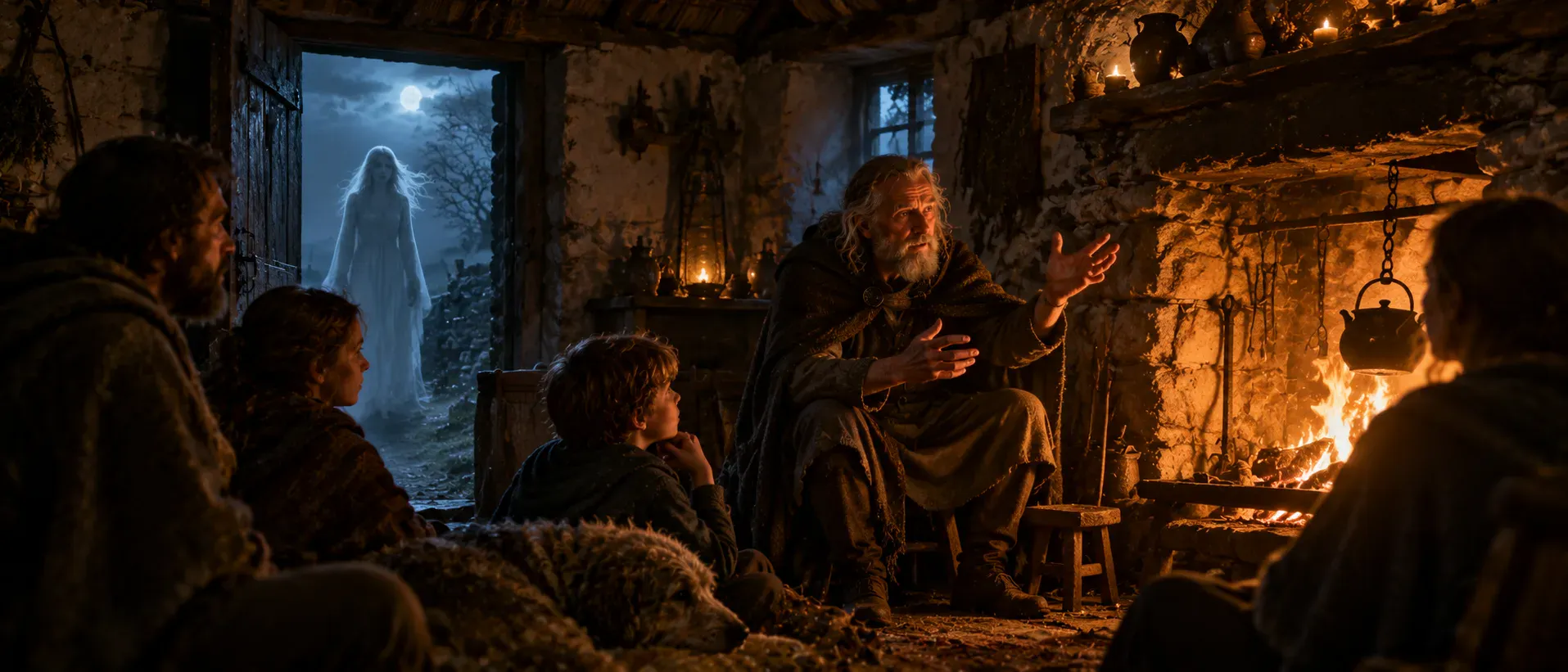
Around Samhain and All Souls’ Day, many households left the door unlatched, kept the fire in, and set out food or water so that dead relatives could visit their old home. The Samhain page covers these customs in detail.
The wake had its own protections. Lady Wilde describes an island rule that no funeral cry could be raised for three hours after a death, because the noise would “hinder the soul from speaking to God.”
A Tour of Haunted Ireland
The legends below are the ones most often told about specific Irish places. Several now support local tourism, and the details vary from telling to telling.
Loftus Hall, County Wexford
Loftus Hall stands on the Hook Peninsula, on the site of an older Redmond family house. The legend concerns Charles Tottenham, who married Anne Loftus, and his daughter, also named Anne. On a stormy night, usually placed in the 1770s, a stranger was taken in. During a game of cards, Anne dropped a card, bent to pick it up, and saw that the stranger had a cloven hoof. When she cried out, he vanished through the ceiling, leaving a hole that could never be properly mended. Anne never recovered and was kept in the Tapestry Room until her death.
The present house is largely a Victorian rebuild carried out between 1872 and 1884. It ran as a ghost-tour attraction from 2012 until 2020 and has since been sold.
Leap Castle, County Offaly
Leap Castle was an O’Carroll stronghold, and its most famous story comes from the family feud that followed the death of Mulrooney O’Carroll in 1532. According to tradition, one brother, a priest, was saying Mass for the family in the castle chapel when a rival brother burst in and killed him at the altar. The room has been called the Bloody Chapel ever since.
The castle’s second legend is much younger. Mildred Darby, a Gothic novelist who married into the Darby family of Leap and wrote as Andrew Merry, held séances in the castle and described an “elemental” in The Occult Review in December 1908: a grey, sheep-sized, human-shaped thing with hollow eyes and a sickening smell. That creature entered the record through her account, not through older folk tradition. The castle was burned in 1922 and has been restored since 1991 by the musician Sean Ryan and his family.
Charles Fort, Kinsale, County Cork
Charles Fort, a star-shaped fortress completed in 1682, has the White Lady. The commander, a man named Warrender, had a daughter who married a young officer, in some tellings Sir Trevor Ashurst. On the wedding night, the bride saw a flower growing below the walls, and a sentry offered to climb down for it if the bridegroom would hold his post. The bridegroom fell asleep on watch, and the commander shot the sleeping sentry before seeing who it was. The bride threw herself from the battlements, and her father is said to have taken his own life that night. Her figure in a wedding dress is said to walk the ramparts at dusk.
The Hellfire Club, Montpelier Hill, County Dublin
William Conolly, Speaker of the Irish House of Commons, built a hunting lodge on Montpelier Hill in 1725, reportedly with stones from a prehistoric cairn; tradition says the Devil blew the roof off in revenge. The Irish Hell Fire Club, founded by Richard Parsons, first Earl of Rosse, is said to have used the lodge from about 1735 until his death in 1741. In the best-known legend, a player drops a card and sees that one of the company has cloven hooves. A second tells of a huge black cat found in the lodge, which a priest destroyed with holy water.
The card game is nearly identical to the one told at Loftus Hall, which shows how a strong motif could travel from house to house.
Folk Ghosts from the Collections
Curtin’s Kerry tales include “John Reardon and the Sister Ghosts,” in which three sisters, bound by a murder over their father’s fortune, cannot rest until a fearless man overcomes them; when he digs up the hidden treasure, they turn into three doves and fly away. Kennedy recorded “The Queen’s County Ghost,” about a squire so wicked in life that he went on smashing dishes and tormenting his old coachman after death, appearing as a black dog, a boar, or a bull.
Motifs That Make a Ghost Story Irish
The same building blocks return again and again, each revealing what the storytellers feared.
The card game with the Devil appears at both Loftus Hall and the Hellfire Club. Cards were an idle, risky pastime, so the Devil belonged at the table, and the dropped card forces the player to look beneath it and see the truth. The stranger at the door is the same fear from another angle: Irish hospitality required a household to take in a traveler on a bad night, and the stories test that duty by making the guest something other than human.
The ghost bound until released is the most common shape of all. The soul is tied to a place or task and freed by a payment, a prayer, a Mass, or a brave act, as in the repaid debts of Kennedy’s football tale or the treasure dug up in Curtin’s sister ghosts. Grief that holds the dead back reverses the pattern: here the living are the problem, and the cure is to mourn and then let go.
The fairy path completes the set. A house built across a fairy path was said to suffer noises at night, sickness, and bad luck, and the usual remedy was to knock off the offending corner or leave the front and back doors open so the traffic could pass. Those visitors were fairies, not ghosts, but the two often blurred on the same dark road.
Neighbors of the Ghost: Death Figures in Irish Lore
Several supernatural figures sit close to ghost lore without being ghosts. Most are omens of death rather than the dead returning. The banshee, the bean sí, wails for the dying of certain families. The Dullahan, the headless horseman, rides out to call a name. The cóiste bodhar (KOHSH-tyuh BOW-er), the silent death coach, comes to a door to collect a soul. The Sluagh, shared with Scottish Gaelic tradition, is a host of unforgiven dead sweeping through the air.
Why Ireland’s Ghost-Story Tradition Is So Rich
The restless dead appear early in Irish literature. One of the earliest examples is Echtra Nerai, the Adventure of Nera, a medieval Ulster Cycle tale set on Samhain at Cruachan, in which Nera carries a hanged corpse on his back to find it a drink.
Several forces kept the tradition alive. The seanchaí, the traditional storyteller, held an honored place at the fireside, and long winter evenings gave stories room to grow. The Great Famine, which began in 1845, left mass graves and emptied villages; Curtin’s Tom Connors tale is set in 1846. The decline of the Anglo-Irish Big House, and the burning of houses and barracks during the revolutionary years, left ruins that became natural homes for legends; Leap Castle and Charles Fort both burned in 1922.
The collectors mattered too. In 1914, the clergyman St. John D. Seymour and Harry L. Neligan published True Irish Ghost Stories after appealing for accounts in the newspapers. Seán Ó Súilleabháin’s A Handbook of Irish Folklore (1942) later guided the Irish Folklore Commission’s collectors in recording beliefs about the dead.
Irish Ghost Stories in Popular Culture
Ireland gave the English-language ghost story some of its masters. Joseph Sheridan Le Fanu, a Dubliner, published “Strange Event in the Life of Schalken the Painter” in the Dublin University Magazine in 1839 and the collection Ghost Stories and Tales of Mystery in 1851. His In a Glass Darkly (1872) contains “Mr Justice Harbottle,” a true ghost story, alongside “Green Tea” and “Carmilla,” which is a vampire tale rather than a ghost story.
Bram Stoker, also from Dublin, is famous for the vampire novel Dracula (1897), but he also wrote the haunted-house story “The Judge’s House” (1891), set in England. W. B. Yeats returned to the Big House in his play Purgatory, first staged at the Abbey Theatre in August 1938, in which an old man sees his dead mother’s ghost in the window of a ruined mansion. The horror film The Lodgers (2017) was shot at Loftus Hall.
Common Questions
These are the questions readers most often ask about Irish ghost stories.
What Is the Most Haunted Place in Ireland?
No place can be proven the most haunted, but Leap Castle in County Offaly and Loftus Hall in County Wexford are the two most often named. Leap Castle’s reputation rests on the Bloody Chapel and Mildred Darby’s 1908 account of an elemental; Loftus Hall’s rests on the legend of the card-playing stranger with a cloven hoof.
What Is the Irish Word for Ghost?
The usual word is taibhse (TIVE-sheh). Sprid also means a ghost or spirit, and tais means an apparition, while spiorad means spirit in the religious sense.
Are Irish Ghosts the Same as Fairies?
No. A ghost is the spirit of a dead person, while the fairies, the aos sí, are a separate race. Folk belief did hold that the fairies sometimes took the souls of the dead, and that the dead danced with the fairies on November Eve.
Sources and Further Reading
- Jeremiah Curtin, Tales of the Fairies and of the Ghost World, Little, Brown (Boston, 1895).
- Patrick Kennedy, Legendary Fictions of the Irish Celts, Macmillan (London, 1866).
- Lady Wilde, Ancient Legends, Mystic Charms, and Superstitions of Ireland, Ward and Downey (London, 1887).
- W. B. Yeats, ed., Fairy and Folk Tales of the Irish Peasantry, Walter Scott (London, 1888).
- St. John D. Seymour and Harry L. Neligan, True Irish Ghost Stories, Hodges Figgis (Dublin, 1914).
- Seán Ó Súilleabháin, A Handbook of Irish Folklore, Educational Company of Ireland (Dublin, 1942).
- Niall Ó Dónaill, ed., Foclóir Gaeilge-Béarla, An Gúm (Dublin, 1977).
- Joseph Sheridan Le Fanu, In a Glass Darkly, Richard Bentley and Son (London, 1872).