In Short
Lugh (pronounced LOO) is the young, radiant hero-god of Irish mythology, known as Lugh Lámfhota, “of the Long Arm,” and Lugh Samildánach, “skilled in all the arts.” Half Tuatha Dé Danann and half Fomorian, he came to Tara as a stranger and won his way in by being master of every craft at once. He led the Tuatha Dé Danann to victory over the Fomorians at the Second Battle of Mag Tuired, where he killed his own grandfather, Balor of the Evil Eye, with a stone from his sling. He founded the harvest festival of Lughnasa in honor of his foster-mother, and he was the father of the Ulster hero Cú Chulainn.
| Name | Lugh; Old Irish Lug; modern Irish Lú |
|---|---|
| Pronunciation | LOO |
| Titles | Lámfhota, “of the Long Arm”; Samildánach, “skilled in all the arts” |
| Parents | Cian of the Tuatha Dé and Ethniu, daughter of Balor |
| Foster-mother | Tailtiu, queen of the Fir Bolg |
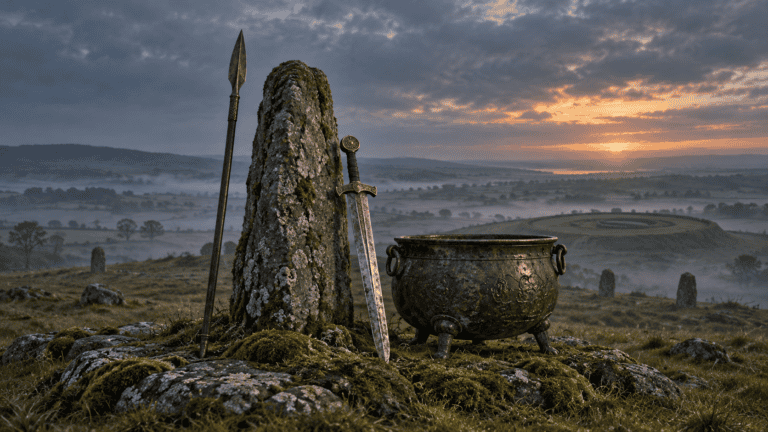
| Weapons | A spear, one of the Four Treasures; a sling |
| Great deed | Killing Balor at the Second Battle of Mag Tuired |
| Festival | Lughnasa, at the start of August |
| Son | Cú Chulainn |
| Relatives abroad | The Gaulish god Lugus; the Welsh Lleu Llaw Gyffes |
Who Is Lugh?
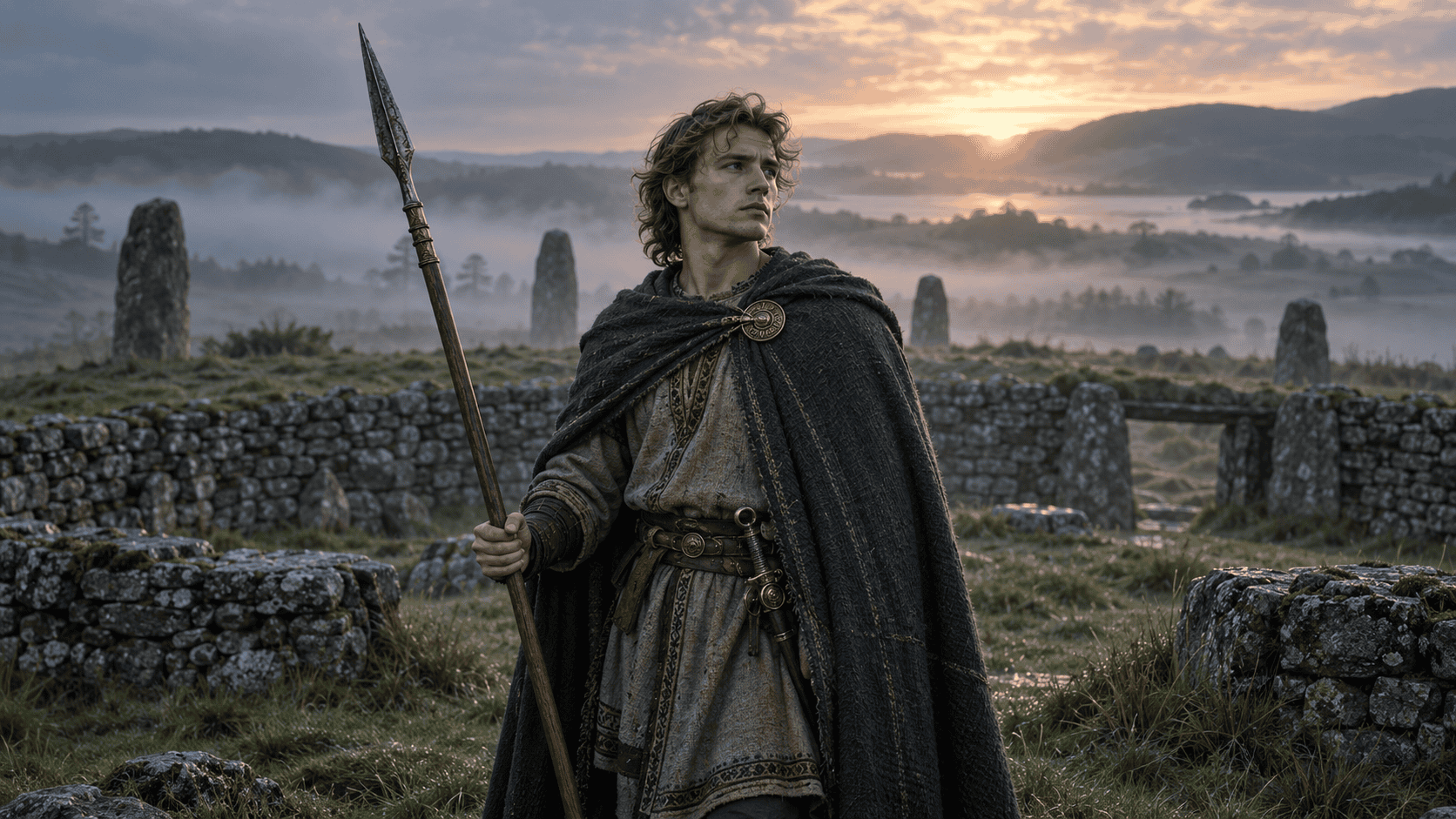
A young stranger arrives at the gates of Tara, where the king of the gods is holding a feast. The doorkeeper stops him: nobody enters Tara without a skill. The young man says he is a carpenter. They have one. A smith? They have one. A champion, a harper, a poet, a sorcerer, a physician? They have all of those. Then, says the stranger, go and ask the king whether he has anyone who can do all of them at once.
That young man is Lugh, and the scene is one of the most famous in Irish mythology. He is the brilliant, many-talented god of the Tuatha Dé Danann: a warrior, craftsman, poet, and king, whose genius lies in mastering everything. If the Dagda is the great father god, Lugh is the shining young champion, the one who arrives when the gods most need him.
What His Names Mean
His name in Old Irish is Lug, written Lugh in older spellings and Lú in modern Irish, and it is pronounced “loo.” Its origin is uncertain. It was once explained as coming from a word for “light,” which suited his bright, youthful character, but most scholars now doubt that link, and the meaning of the name is still debated.
His two great titles are clearer. Lámfhota means “of the long arm” or “long hand,” probably a reference to his skill with the spear and sling, which strike from far away. Samildánach means “skilled in all the arts together,” the title he earned at the gates of Tara.
Born of Two Peoples
Lugh belonged to both sides of the great war of Irish mythology. His father, Cian, was of the Tuatha Dé Danann, a son of the physician god Dian Cécht. His mother, Ethniu, was the daughter of Balor, the one-eyed king of the Fomorians, the Tuatha Dé’s bitterest enemies.
The medieval texts treat the marriage as a dynastic alliance between the two peoples. But a folk version, recorded in County Donegal in the nineteenth century, tells a darker tale. A prophecy had warned Balor that he would be killed by his own grandson, so he locked his only daughter in a tower on Tory Island, where no man could reach her. Cian found a way in, and Ethniu gave birth to three sons. Balor had the babies thrown into the sea, but one was saved and raised in secret. That child was Lugh, and the prophecy was waiting for him.
Lugh’s Foster-Mother, Tailtiu
According to the Lebor Gabála Érenn, Lugh was fostered by Tailtiu, a queen of the Fir Bolg, the people the Tuatha Dé had defeated. In early Ireland, children of noble families were often raised by foster-parents, and the bond between a foster-child and his foster-mother was deep. Tailtiu cleared the forests of a great plain in County Meath to make it ready for farming, and the work killed her. Lugh held funeral games in her honor at the place named after her, Tailtiu, now Teltown, and this was said to be the origin of the great summer festival that bears his name.
Lugh at the Gates of Tara
The fullest account of Lugh comes from Cath Maige Tuired, “The Second Battle of Mag Tuired,” a medieval Irish text compiled from older material. At the time the story begins, the Tuatha Dé Danann were under the heel of the Fomorians, paying them heavy tribute, and their king, Nuada, held court at Tara.
When Lugh arrived, the doorkeeper asked what art he practiced, since no one without an art could enter. Lugh named one skill after another, and each time the doorkeeper told him they already had someone: a wright, a smith, a champion, a harper, a hero, a poet and historian, a sorcerer, a physician, a cupbearer, and a brazier. At last, Lugh told him to ask the king whether any one person in Tara could do all of those things. Nobody could, and Lugh was let in.
Inside, he proved his claim. He beat everyone at fidchell, a board game like chess. The champion Ogma hurled an enormous flagstone that it would take eighty oxen to move out through the wall of the hall, and Lugh threw it straight back into place. Then he took up a harp and played the three strains of music: the sleep strain, so that the king and his court slept until the next day; the sorrowful strain, so that they wept; and the joyful strain, so that they laughed.
Nuada saw at once that this young man could free them from the Fomorians. He even gave up his royal seat to Lugh, and put him in charge of preparing for war.
Preparing for War
Lugh’s leadership is shown in a famous scene in which he gathers the Tuatha Dé and asks each of them what they will contribute to the coming battle. The smith promises to make spears that never miss. The physician promises to heal any wounded warrior who is not beheaded. The sorcerers promise to rain fire on the enemy, and the cupbearers to hide the water from them. It is a portrait of a society preparing for total war, with every skill turned to one purpose, and Lugh, the master of all skills, at its center.
The Death of Balor
The Second Battle of Mag Tuired was fought on a plain in Connacht, near Lough Arrow in County Sligo. The Tuatha Dé tried to keep Lugh out of the fighting, fearing to lose him, but he escaped his guards and went to the front. Before the battle, he went around the whole army of the Tuatha Dé on one foot, with one eye closed, chanting a spell to strengthen them. It is a pose of magic found elsewhere in Irish tradition, in which the sorcerer imitates a one-legged, one-eyed being of the Otherworld.
Then he faced Balor. Balor had an evil eye that was kept closed, because whatever it looked upon was destroyed. It took four men to lift its lid, by a polished ring set into it. When the lid was raised, Lugh fired a stone from his sling that struck the eye and drove it out through the back of Balor’s head, where its gaze fell on the Fomorian army behind him and destroyed them. The prophecy was fulfilled: Balor had been killed by his grandson. The Fomorians were defeated and driven from Ireland.
The Sons of Tuireann
The best-known story about Lugh after the battle is a tragedy, told in a later text, Oidheadh Chlainne Tuireann, “The Fate of the Children of Tuireann.” Three brothers, Brian, Iuchar, and Iucharba, murdered Lugh’s father, Cian. Lugh discovered the crime and demanded a blood price, or éraic, and he chose it cunningly. It was a list of seemingly harmless items, such as three apples, a pigskin, a spear, and a cooking spit, and three shouts on a hill. Each turned out to be a treasure guarded in a distant land, and each was nearly impossible to win.
The brothers traveled the world and won every one, but the last task, the three shouts on the hill of Midchain, cost them their lives. Mortally wounded, they returned to Ireland and begged Lugh to heal them with the magical pigskin they had brought him. He refused, and they died. It is one of the “Three Sorrows of Storytelling” in Irish tradition, and it shows Lugh at his most unforgiving.
The Festival of Lughnasa
Lugh’s name lives on in Lughnasa, in Irish Lúnasa, the festival at the start of August that marked the beginning of the harvest. Lúnasa is still the Irish name for the month of August. According to tradition, Lugh founded the festival as funeral games for his foster-mother Tailtiu, and the great assembly at Teltown, the Óenach Tailten, was held for centuries with games, horse races, trading, and marriages.
In 1962, the folklorist Máire MacNeill published The Festival of Lughnasa, a landmark study showing how the festival had survived across Ireland into modern times as gatherings on hilltops and at lakes in late July and early August, with bilberry picking, dancing, and matchmaking. The most famous survival is Reek Sunday, when pilgrims climb Croagh Patrick in County Mayo on the last Sunday of July.
The Father of Cú Chulainn
Lugh also appears in the Ulster Cycle, as the divine father of the greatest Ulster hero. In Compert Con Culainn, “The Conception of Cú Chulainn,” Lugh fathers the hero with Deichtine, sister of King Conchobar. Later, in the Táin Bó Cúailnge, when Cú Chulainn is exhausted and wounded after defending Ulster alone for weeks, Lugh comes to him from the Otherworld, tells him to sleep, and heals his wounds for three days and nights while he fights in his place.
The Death of Lugh
According to the Lebor Gabála Érenn, Lugh ruled the Tuatha Dé for forty years after Nuada, until he was killed by three brothers, Mac Cuill, Mac Cécht, and Mac Gréine, in revenge for the killing of their father. By tradition, he was drowned in a lake in County Westmeath, afterward called Loch Lugborta.
Lugh Beyond Ireland
Lugh was not only an Irish god. A god named Lugus was worshipped across the Celtic world, and his name is preserved in the names of ancient towns such as Lugdunum, now Lyon in France, and Luguvalium, now Carlisle in England. In Wales, the hero Lleu Llaw Gyffes, “Lleu of the Skillful Hand,” shares both his name and his skill. Julius Caesar wrote that the god the Gauls honored most was the one he called Mercury, “the inventor of all the arts,” and many scholars believe he meant Lugus. That description fits Lugh Samildánach remarkably well.
Lugh in Popular Culture
Lugh appears in fantasy novels, comics, and games, usually as a radiant young warrior with a spear. He is a favorite of modern retellings of Irish myth, where the scene at the gates of Tara is nearly always included. He also appears in many modern pagan traditions, where Lughnasa is celebrated as one of the major festivals of the year.
Is the Leprechaun Named After Lugh?
This is a popular claim, but it is almost certainly wrong. The word leprechaun comes from the Irish leipreachán, which scholars trace back to the Old Irish luchorpán, meaning “small body,” from lu, “small,” and corp, “body.” The idea that the leprechaun is a shrunken memory of the god Lugh is a modern suggestion without support in the language.
Sources and Further Reading
- Elizabeth A. Gray, ed. and trans., Cath Maige Tuired: The Second Battle of Mag Tuired, Irish Texts Society (1982).
- R. A. S. Macalister, ed. and trans., Lebor Gabála Érenn: The Book of the Taking of Ireland, Irish Texts Society (1938 to 1956).
- Máire MacNeill, The Festival of Lughnasa, Oxford University Press (1962).
- Eugene O’Curry, ed. and trans., “The Fate of the Children of Tuireann,” Atlantis 4 (1863).
- John O’Donovan, ed. and trans., Annala Rioghachta Eireann: Annals of the Kingdom of Ireland by the Four Masters, vol. 1, Hodges and Smith (1848 to 1851), notes on Balor.
- Dáithí Ó hÓgáin, Myth, Legend and Romance: An Encyclopaedia of the Irish Folk Tradition, Ryan Publishing (1990).