In Short
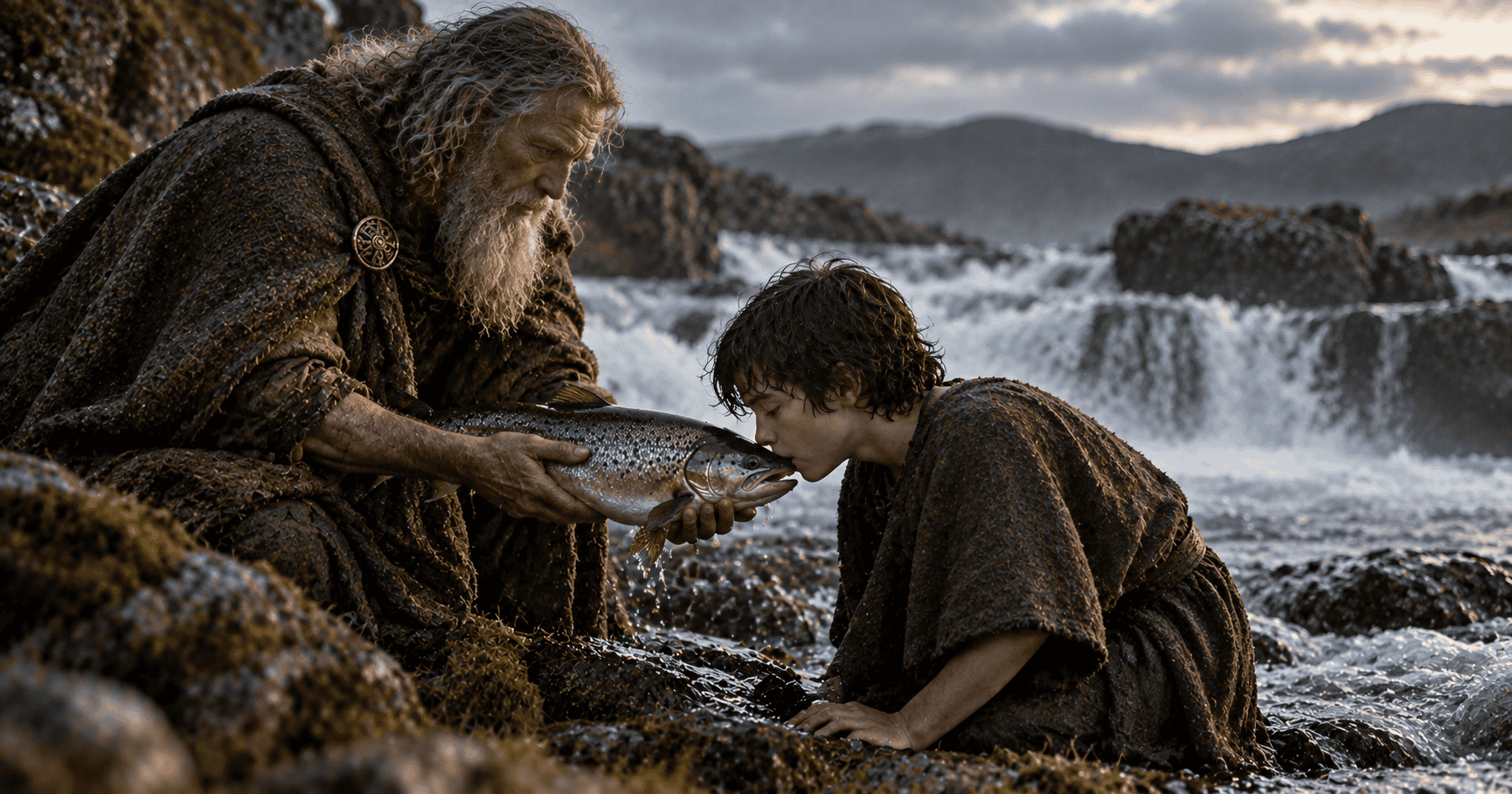
The Salmon of Knowledge (in Irish, An Bradán Feasa, pronounced roughly un brah-DAWN FASS-uh) is a salmon from Irish legend that held all the world’s wisdom, which would pass to the first person to taste it. The poet Finnéces waited seven years on the River Boyne to catch it. When he finally did, he told his young pupil to cook it but not eat any. The boy burned his thumb on the fish, put it in his mouth to ease the pain, and received the knowledge himself. That boy grew up to be Fionn mac Cumhaill, the great hero of the Fianna.
| Irish name | An Bradán Feasa |
|---|---|
| Pronunciation | Roughly un brah-DAWN FASS-uh; stress varies by dialect |
| The hero | Fionn mac Cumhaill, then a boy called Demne |
| His teacher | The poet Finnéces, often called Finnegas |
| Where | Fec’s Pool on the River Boyne, in County Meath |
| Main source | Macgnímartha Finn, “The Boyhood Deeds of Fionn,” a twelfth-century text |
| Gift | Knowledge of anything, whenever Fionn put his thumb in his mouth |
| Why the salmon was wise | In other medieval texts, the salmon of the Otherworld well eat the nuts of nine hazel trees |
| Cycle | Fenian Cycle |
The Story of the Salmon of Knowledge
A boy is on the run. His father, Cumhall, the leader of the Fianna, has been killed by his rivals, the sons of Morna, and they would kill the boy too if they found him. He has grown up in hiding in the forests, under a false name, Demne. Now he has come to the banks of the River Boyne, looking for somewhere safe. He finds it in the house of a poet. In early Ireland, poets and their students had a special status, and the text makes clear that studying poetry was the boy’s way of staying safe from his enemies.
The poet’s name is Finnéces, and he is waiting for a fish. For seven years, he has sat beside a deep pool in the Boyne called Fec’s Pool, watching for a particular salmon. A prophecy has told him that he will eat the salmon of Fec’s Pool, and that once he does, nothing in the world will remain unknown to him.
At last, the salmon is caught. Finnéces hands it to his young pupil to cook, with one strict instruction: he must not eat any of it. The boy cooks the fish and brings it to his master. Finnéces looks at him closely and asks whether he has eaten anything. No, the boy says, but he burned his thumb on the fish while it was cooking, and he put his thumb in his mouth to ease the pain.
The poet asks him his name. Demne, says the boy. No, Finnéces tells him: “Finn” is your name, and the salmon was meant for you. The prophecy had never been about the poet at all, only about someone named Finn. Finnéces gives him the whole salmon, and the boy eats it. From that day on, whenever Fionn puts his thumb in his mouth, whatever he does not know is revealed to him.
Where the Story Comes From
The tale comes from Macgnímartha Finn, “The Boyhood Deeds of Fionn,” a medieval Irish text that tells of Fionn’s childhood and youth. The scholars Kuno Meyer and Gerard Murphy dated it to the twelfth century. It survives in a fifteenth-century manuscript now in the Bodleian Library in Oxford, known as Laud 610, and it breaks off unfinished before Fionn reaches Tara. The salmon episode, though, is complete. Meyer published an English translation in 1904, and most modern retellings, including Lady Gregory’s, descend from it.
Much of what makes the story feel familiar comes from those later retellings. The medieval text is short and matter-of-fact. It does not describe the salmon, the pool, or the cooking in any detail, and it does not even say how the salmon came to be so wise.
Why Was the Salmon Wise?
Most modern versions explain that the salmon had eaten nine hazelnuts that fell from nine hazel trees into a magical well, and that the nuts carried all the knowledge of the world. That idea is genuinely medieval, but it comes from other texts, not from the story of Fionn.
Medieval Irish writers described a hidden well in the Otherworld, known as the Well of Segais, or in some texts as Connla’s Well, surrounded by hazel trees whose nuts fell into the water and fed the salmon living there. The well was said to be the source of great rivers. In one story, the goddess Boann walked around it in the wrong direction, and its waters rose up and rushed out across the land, creating the River Boyne. The river took her name, and she was swept away and drowned. Since Fec’s Pool is on the Boyne, later storytellers joined the two traditions together, and the salmon Fionn tasted became a salmon that had eaten the hazelnuts of wisdom.
Fec’s Pool
The pool where Finnéces waited is called Linn Féic in Irish, “Fec’s Pool.” Local tradition and place-name studies place it at Rosnaree, on the Boyne in County Meath, a short distance west of Slane. The stretch of river is close to Brú na Bóinne, the great prehistoric passage tombs of Newgrange, Knowth, and Dowth, which Irish legend treats as homes of the Tuatha Dé Danann. It is a fitting landscape for a salmon that carried knowledge from the Otherworld.
The Thumb of Knowledge
The salmon gave Fionn a gift he used for the rest of his life. According to the medieval text, whenever he put his thumb in his mouth and chanted, whatever he had been ignorant of became known to him. The text names the chant teinm láida, one of three special skills that early Irish poets were expected to master. The other two were imbas forosnai, a kind of visionary knowledge, and díchetal di chennaib, a form of spontaneous poetic insight. The text says that Fionn learned all three.
His first act as a poet, according to the same text, was to compose a poem in praise of May and the coming of summer. In later Fenian stories, Fionn puts his thumb to his mouth again and again to find out who has killed someone, what an enemy is planning, or how to get out of danger. The gift became as much a part of his character as his spear or his hounds.
Why the Names Match
The story turns on a pun. Finnéces means something like “Finn the poet,” and the prophecy said that “Finn” would eat the salmon. The poet naturally assumed that meant him. But the boy, too, had been called Finn, which means “fair” or “bright,” because of his fair hair. So the prophecy was true all along, just not in the way Finnéces had hoped. Losing seven years of waiting to a boy who only burned his thumb is one of the great quiet disappointments of Irish literature, and the poet accepts it with remarkable grace.
Fintan, the Salmon Who Remembered Everything
Some writers identify the Salmon of Knowledge with Fintan mac Bóchra, a figure from the medieval legends of Ireland’s earliest settlers. Fintan was said to have survived the biblical Flood by turning into a salmon, and then into an eagle and a hawk, living for thousands of years and remembering the whole history of Ireland. The medieval text about Fionn does not make this connection, but the idea of a salmon as a keeper of ancient wisdom runs through Irish tradition.
Similar Stories Beyond Ireland
The burned thumb that brings sudden knowledge appears in other traditions too. In the Welsh tale of Taliesin, a boy named Gwion Bach is set to stir a cauldron of magic brew for the witch Ceridwen. Three drops splash onto his thumb, he puts it in his mouth, and he gains all knowledge before going on to become the great poet Taliesin. In the Norse legend of Sigurd, the hero roasts the heart of the dragon Fáfnir, burns his thumb on it, puts it in his mouth, and suddenly understands the speech of birds. Scholars have long noted these parallels, which suggest the story was part of a wider pattern of tales about how heroes and poets came by their wisdom.
The Salmon of Knowledge in Popular Culture
The Salmon of Knowledge is one of the first Irish legends that many children in Ireland learn at school, and it is retold in countless picture books and collections of Irish myths. The salmon has become a symbol of wisdom, learning, and Irish storytelling, appearing in schools, libraries, and public art.
What Does the Salmon of Knowledge Symbolize?
Above all, wisdom. In Irish tradition, both the salmon and the hazel tree were linked with knowledge and poetry, and the story brings them together. It also carries a gentler lesson that readers have always noticed. Finnéces spent seven years trying to seize wisdom for himself, and it went instead to a boy who had not been looking for it. Knowledge, the story seems to say, comes to those it is meant for, and sometimes by accident. Whether the medieval writer intended that moral is impossible to know, but it is one of the reasons the story has lasted.
Sources and Further Reading
- Kuno Meyer, trans., “The Boyish Exploits of Finn,” Ériu 1 (1904).
- Joseph Falaky Nagy, The Wisdom of the Outlaw: The Boyhood Deeds of Finn in Gaelic Narrative Tradition, University of California Press (1985).
- Edward Gwynn, ed. and trans., The Metrical Dindshenchas, vol. 3, Royal Irish Academy (1913).
- Lady Augusta Gregory, Gods and Fighting Men, John Murray (1904).
- James MacKillop, Fionn mac Cumhaill: Celtic Myth in English Literature, Syracuse University Press (1986).