In Short
The bean nighe (pronounced roughly ben NEE-uh, Scottish Gaelic for “washerwoman”) is a spirit seen at lonely streams, washing the blood from the clothes of people who are about to die. She belongs mainly to the folklore of the Scottish Highlands and Islands, but she is a close cousin of the banshee and grows out of an older figure shared with Ireland: the washer at the ford, who appears in medieval Irish literature washing the arms and armor of warriors doomed to fall in battle.
| Name | Bean nighe, “washerwoman”; also nigheag na h-àth, “little washer of the ford” |
|---|---|
| Pronunciation | Roughly ben NEE-uh |
| Where | Mainly the Scottish Highlands and Islands |
| What she does | Washes the bloodstained clothes or shrouds of those about to die |
| Appearance | Small, dressed in green, with webbed feet; in some places one nostril and a single long tooth |
| Who she is | Said to be the ghost of a woman who died in childbirth |
| If caught | May name the doomed person, answer questions, or grant wishes |
| Irish relatives | The washer at the ford of medieval Irish literature, and the banshee |
What Is the Bean Nighe?
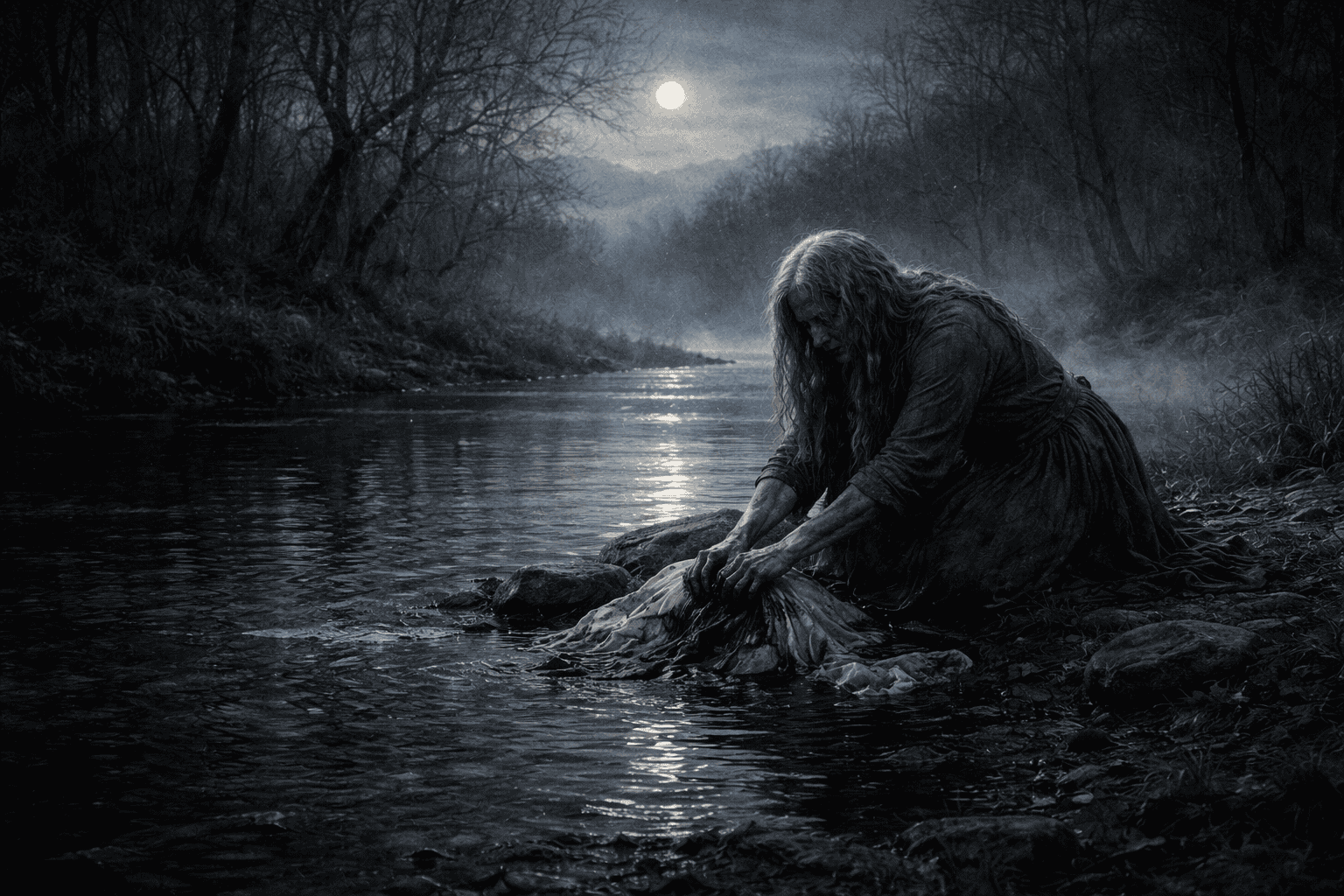
A traveler crossing a lonely glen at dusk hears the slap of wet cloth on stone. Down by the stream, a small woman in green is kneeling at the water’s edge, scrubbing at a piece of linen. The water running past her is red. She does not look up. The traveler knows what he is seeing, and he knows what the linen is: the shroud of someone who will soon need it.
That is the bean nighe, the washerwoman. Her Gaelic name means exactly that, and she is also called the nigheag, “the little washer,” or the little washer of the ford. Like the banshee, she is a messenger of death. But where the banshee cries aloud outside the house, the bean nighe works in silence, far from any house at all, preparing the clothes the dead will need.
Is the Bean Nighe Irish or Scottish?
This is the most common confusion about her. The bean nighe, under that name and with her distinctive habits, belongs to the folklore of the Scottish Highlands and Islands, collected there in the nineteenth and early twentieth centuries, especially on islands such as Mull, Tiree, and the Outer Hebrides.
But she did not come from nowhere. Ireland and Gaelic Scotland shared a language, a literature, and much of their folklore for centuries, and the washer at the ford is one of the oldest images in that shared tradition. In Ireland, the same idea developed in a different direction: over time, the grim washerwoman of the battle stories seems to have given way to the keening banshee. So the bean nighe is best understood as Scotland’s version of a figure whose roots lie in the common Gaelic past.
The Washer at the Ford in Irish Literature
Medieval Irish writers knew the washer well. In Caithréim Thoirdhealbhaigh, a history of the O’Brien wars in County Clare written around 1350, an army marching to battle in 1317 meets a hideous woman at a lake, washing a heap of human heads and limbs until the water runs red. She tells them the heads are their own. By evening, their leader and most of his kin are dead.
In some later versions of the death of Cú Chulainn, the hero, riding out to his last fight, passes a young woman at a ford washing bloodstained armor, and realizes it is his own. The washer is often linked to the war goddess Badb and to the Morrígan, who foretell slaughter in the old tales.
What She Looks Like
Descriptions vary from place to place. She is usually small, dressed in green, and sometimes said to have red, webbed feet like a water bird. In parts of the Highlands, she has only one nostril and a single long, protruding tooth. On Mull and Tiree, she was said to have breasts so long that they got in the way of her washing, so she threw them over her shoulders to hang down her back.
Who Is She?
Highland tradition had a sad explanation. The mnathan-nighe, the washerwomen, were said to be the ghosts of women who had died giving birth. They were doomed to wash the clothes of the dying until the day their own lives would naturally have ended. The fate could be avoided, some said, if all the clothes the dead woman left behind were washed. If any were left dirty, she would have to finish the washing after death.
What Happens If You Meet Her
Unlike the banshee, the bean nighe could be dealt with, if you were brave and careful enough. The traditions differ, but they agree that you must approach her without being seen.
- Get between her and the water. If you manage this before she notices you, she must answer your questions or grant you wishes, sometimes three of each. But she may ask you questions in return, and you must answer them truthfully.
- Seize her and ask whose shroud it is. She will tell you the name of the person who is going to die.
- Claim her as your foster mother. On Mull and Tiree, the bold approach was to creep up behind her, take hold of one of her breasts, put it to your mouth, and declare yourself her foster child. She would then have to treat you as her own and grant your wish.
Not every washer was so obliging. The caointeach of Islay, a closely related spirit, was said to strike anyone who interrupted her with her wet linen, leaving them lame.
Washerwomen Beyond Scotland
Similar figures appear elsewhere in the Celtic-speaking world. In Brittany, the lavandières de nuit, “night washerwomen,” wash shrouds by moonlight and ask passersby to help them wring out the linen. Those who refuse, or who help badly, may be dragged into the water or have their arms broken. The shared image across these traditions suggests how old and widespread the idea of the washer at the ford is.
The Bean Nighe in Popular Culture
The bean nighe has become a favorite of modern fantasy and horror, and she often turns up in lists of “Irish” creatures, usually merged with the banshee. She appears in fantasy novels, games, and illustrated bestiaries, typically as a crone washing blood from clothes at a river, a faithful echo of the old image.
What Is the Difference Between the Bean Nighe and the Banshee?
Both foretell death, and both are fairy women from the same Gaelic tradition. But the banshee is chiefly Irish, is usually heard rather than seen, and cries or keens outside the house of the family she follows. The bean nighe is chiefly Scottish, is seen rather than heard, washes the clothes of the doomed at a stream, and can be caught and questioned. The banshee mourns. The washer prepares.
Sources and Further Reading
- John Gregorson Campbell, Superstitions of the Highlands and Islands of Scotland, James MacLehose and Sons (1900).
- Katharine Briggs, An Encyclopedia of Fairies, Pantheon Books (1976).
- Lewis Spence, The Fairy Tradition in Britain, Rider (1948).
- Standish Hayes O’Grady, ed. and trans., Caithréim Thoirdhealbhaigh: The Triumphs of Turlough, Irish Texts Society (1929).
- Patricia Lysaght, The Banshee: The Irish Supernatural Death-Messenger, Glendale Press (1986).