In Short
Tír na nÓg (pronounced teer nuh NOHG) is the Land of Youth, an Otherworld realm across the western sea where no one grows old, falls sick, or dies. Its fame rests on a single story, the tale of the Fianna warrior Oisín, who followed Niamh of the Golden Hair there and spent three hundred years that passed like three. That story in its familiar form was written down around 1750, but the idea of a deathless country beyond the waves is among the oldest in Irish literature.
| Irish name | Tír na nÓg |
|---|---|
| Literal meaning | Land of the Young |
| Pronunciation | teer nuh NOHG |
| Type | Otherworld realm of the living, not a land of the dead |
| Location | West across the sea, beneath the waves, or within the fairy hills |
| Best-known visitor | Oisín, son of Fionn mac Cumhaill |
| Key text | Laoi Oisín i dTír na nÓg, by Mícheál Coimín, around 1750 |
| Older parallels | Mag Mell, Tír Tairngire, Tír na mBeo, Emain Ablach |
| Cycle | Fenian Cycle |
What Is Tír na nÓg?
Tír na nÓg translates literally as “the Land of the Young,” from the Irish word óg, meaning young. English retellings usually render it as the Land of Youth or the Land of Eternal Youth. It is a country where fruit and blossom grow on the same branch, where feasting never runs out, and where the people who live there neither age nor die. Above all, it is a place where time moves differently from the mortal world.
It was never the only name for such a place. Medieval Irish writers described the Otherworld under many titles: Mag Mell, the Plain of Delight; Tír Tairngire, the Land of Promise; Tír na mBeo, the Land of the Living; Emain Ablach, an island linked to the sea god Manannán mac Lir; and Tír fo Thuinn, the Land Under the Wave. Scholars generally read these as overlapping descriptions of one idea rather than a map of separate kingdoms. Tír na nÓg is the name that won out in the early modern period, and it is the one most people know today.
It is also worth saying what Tír na nÓg is not. It is not a land of the dead. The people who travel there go in their own bodies, fully alive, and usually at the invitation of a woman from the Otherworld. The danger of the place is not that visitors die there. The danger is that they come back.
The Story of Oisín and Niamh
The version everyone knows is Laoi Oisín i dTír na nÓg, “The Lay of Oisín in the Land of Youth,” a poem in Irish framed as Oisín’s own account, told in extreme old age to St. Patrick. Nearly every modern retelling descends from it.
The Invitation at Loch Léin
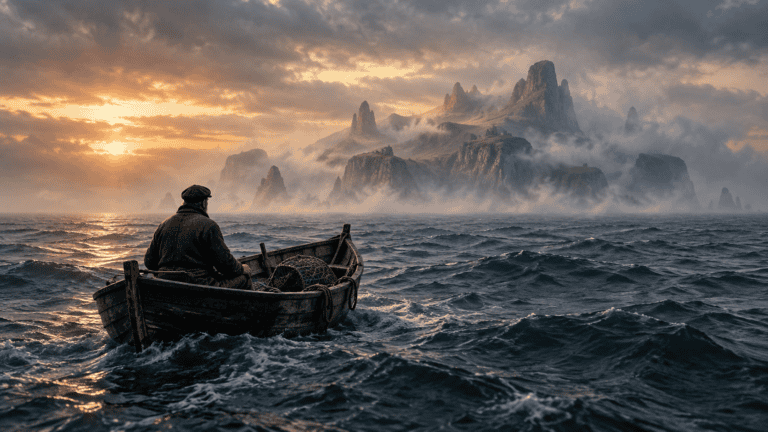
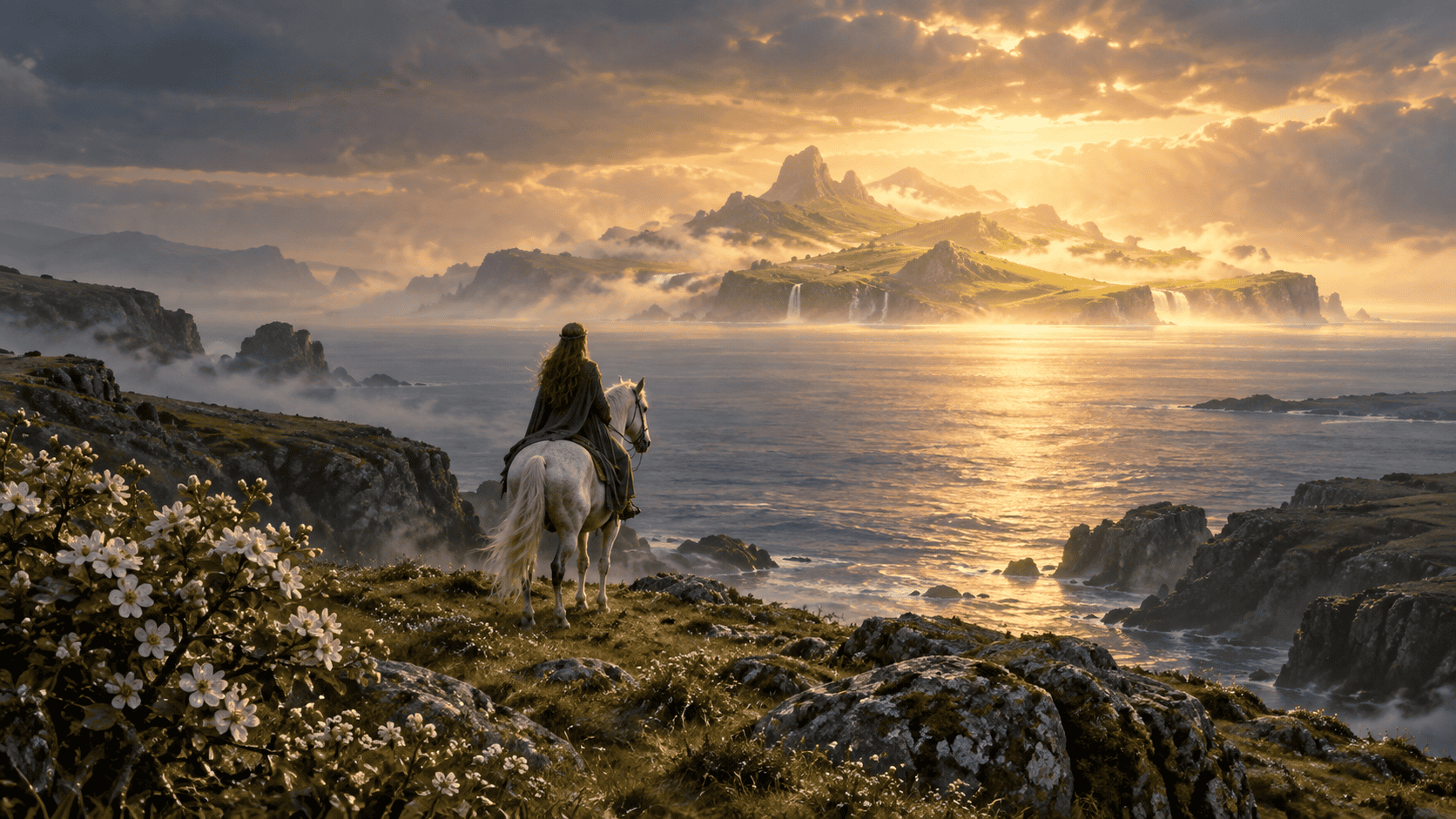
The Fianna are hunting near Loch Léin, the lake at Killarney now called Lough Leane, when a rider appears on a white horse. She is a young woman of unearthly beauty, and she names herself Niamh Chinn Óir, Niamh of the Golden Hair, daughter of the king of the Land of Youth. Many modern retellings make her father the sea god Manannán mac Lir, though the poem itself presents him simply as the king of that country. She has crossed the sea, she says, for love of Oisín, the poet son of Fionn mac Cumhaill. She describes a land of honey and wine, of gold and jewels, where no one decays. Oisín mounts behind her, and the horse carries them away over the waves while Fionn and the Fianna look on in grief.
Three Hundred Years in Three
On the journey west, Oisín sees strange things on the water: a hornless fawn chased by a white hound with a red ear, and a maiden holding a golden apple, pursued by a young horseman. The poem also has him stop to free a captive princess from a Fomorian giant before they reach the Land of Youth. There he is welcomed by the king, marries Niamh, and has three children with her, two sons named Fionn and Oscar and a daughter, Plúr na mBan, the Flower of Women.
After what seems to him three years, Oisín longs to see his father and his companions again. Niamh lends him the white horse but gives him a warning: he must not set foot on the soil of Ireland, or he will never return to her. What Oisín does not understand is that three hundred years have passed at home.
The Fall at Glenasmole
Oisín finds an Ireland he no longer recognizes. The men are smaller and weaker, the Fianna are remembered only in stories, and Fionn’s great stronghold on the Hill of Allen stands empty. At Glenasmole, in the hills south of Dublin, he comes upon a group of men straining to move a great stone. He leans down from the saddle and lifts it one-handed, but the girth breaks and he falls to the ground. The horse bolts for the sea, and in that moment Oisín becomes a blind, withered old man. He is brought to Patrick, and the poem closes with the last of the Fianna telling his story to the saint who brought Christianity to Ireland.
How Old Is the Legend?
The dates matter here, because the story is often presented as ancient. The lay is attributed to Mícheál Coimín, known in English as Michael Comyn, a County Clare poet who died around 1760, and it is usually dated to about 1750. It circulated in manuscript and was first printed with an English translation by Bryan O’Looney in the Transactions of the Ossianic Society in 1859. No medieval manuscript tells the story in this form, and the poem carries the literary polish of Coimín’s own century.
The raw materials, however, are far older. The Acallam na Senórach, a huge prose collection written around 1200, already has Oisín and his companion Caílte alive in Patrick’s time, walking Ireland with the saint and telling the lore of every hill and ford. But the Acallam explains their survival simply as extraordinarily long life. It says nothing about a Land of Youth. Coimín, or the oral tradition he drew on, supplied the missing explanation: Oisín outlived his generation because he spent those centuries somewhere time does not pass.
Older Voyages to the Land of the Living
The idea at the heart of the Oisín story, a mortal lured across the sea to a deathless country, appears in some of the earliest surviving Irish tales. Two, in particular, read like direct ancestors.
Connla and the Glass Boat
Echtra Condla, “The Adventure of Connla,” is an Old Irish tale often dated to the eighth century. Connla, son of the high king Conn of the Hundred Battles, is with his father at Uisnech when a woman only he can see calls to him from the Land of the Living, a place without death or sin. His father’s druid chants her away, but she throws Connla an apple, and for a month he eats nothing else, while the apple never grows smaller. When she returns, Connla leaps into her boat of glass, and the two sail off over the sea. He is never seen again.
Bran and the Man Who Turned to Ash
Immram Brain, “The Voyage of Bran,” is dated by most scholars to the seventh or eighth century. An Otherworld woman carrying a silver branch sings to Bran mac Febail of the island of Emain, and he sets out to sea with three companies of nine men. On the way he meets Manannán mac Lir driving a chariot over the waves, for whom the sea is a flowering plain. Bran reaches the Land of Women and stays for what feels like a single year. When homesickness finally draws the crew back to Ireland, one of them, Nechtan son of Collbran, leaps from the boat onto the shore and instantly crumbles into ashes, as though he had lain in the earth for centuries. Bran tells his tale to the people on the shore from the boat and then sails away forever. This is the same fatal return that ends Oisín’s story, told roughly a thousand years earlier.
Where Was Tír na nÓg?
Irish tradition never settled on a single location. Most often, the Otherworld lies west, across the open Atlantic, reached by boat or by a horse that gallops on water. Sometimes, it lies beneath the sea itself, as in the name Tír fo Thuinn. Just as often, it lies inside the land, within the síd mounds where the Tuatha Dé Danann were said to have withdrawn after the coming of the Milesians. These locations overlap freely, and the same tale can place the Otherworld over the sea in one passage and under a hill in the next.
Popular writing sometimes connects Tír na nÓg with Hy-Brasil, the phantom island that appeared on European sea charts from the fourteenth century and was said to rise from the waves west of Ireland once every seven years. The two traditions share a direction and a mood, but Hy-Brasil belongs to the cartographers and sailors’ tales, and the medieval texts do not identify it with the Land of Youth.
Time Runs Differently There
The most lasting feature of Tír na nÓg is its broken clock. A visitor who stays a few days or a few years returns to find that generations have passed, and contact with ordinary earth brings the lost time crashing down at once. The motif is so consistent across Irish tradition that it works almost as a rule of the Otherworld.
The same logic survived at a smaller scale in twentieth-century folk belief. Accounts gathered for the Schools’ Collection of the Irish Folklore Commission between 1937 and 1939 include stories of a man who joins the dancing inside a fairy fort for what seems a single night and walks out to find that years have gone by. The setting has shrunk from a kingdom across the sea to a mound in a neighbor’s field, but the danger is the same one Oisín faced.
Tír na nÓg in Popular Culture
W. B. Yeats gave the legend its most influential modern form in “The Wanderings of Oisin,” published in 1889. He reshaped Coimín’s single paradise into three islands, one of dancing, one of battle, and one of forgetfulness, with Oisín spending a hundred years on each. Through Yeats and the writers of the Irish Literary Revival, Tír na nÓg became a symbol of an older, enchanted Ireland. The name has stayed in circulation ever since, most memorably as the white horse in the 1992 film Into the West, which carries two Traveller boys across Ireland toward the sea.
Some modern neopagan and popular writing describes Tír na nÓg as a Celtic heaven, the place where souls go after death. That reading is recent. In the medieval texts and in Coimín’s poem alike, the Land of Youth is a place for the living, entered by invitation and left at great cost. Its lesson was never about what waits after death. It was about the price of stepping outside of time, and the grief of coming home to find everyone you knew already gone.
Sources and Further Reading
- Michael Comyn, “Laoi Oisín air Thír na nÓg: The Lay of Oisín in the Land of Youth,” ed. and trans. Bryan O’Looney, Transactions of the Ossianic Society, vol. 4 (1859).
- Kuno Meyer and Alfred Nutt, The Voyage of Bran Son of Febal to the Land of the Living, David Nutt (1895).
- Ann Dooley and Harry Roe, trans., Tales of the Elders of Ireland (Acallam na Senórach), Oxford University Press (1999).
- Dáithí Ó hÓgáin, Myth, Legend and Romance: An Encyclopaedia of the Irish Folk Tradition, Ryan Publishing (1990).
- John Carey, “The Location of the Otherworld in Irish Tradition,” Éigse 19 (1982).