In Short
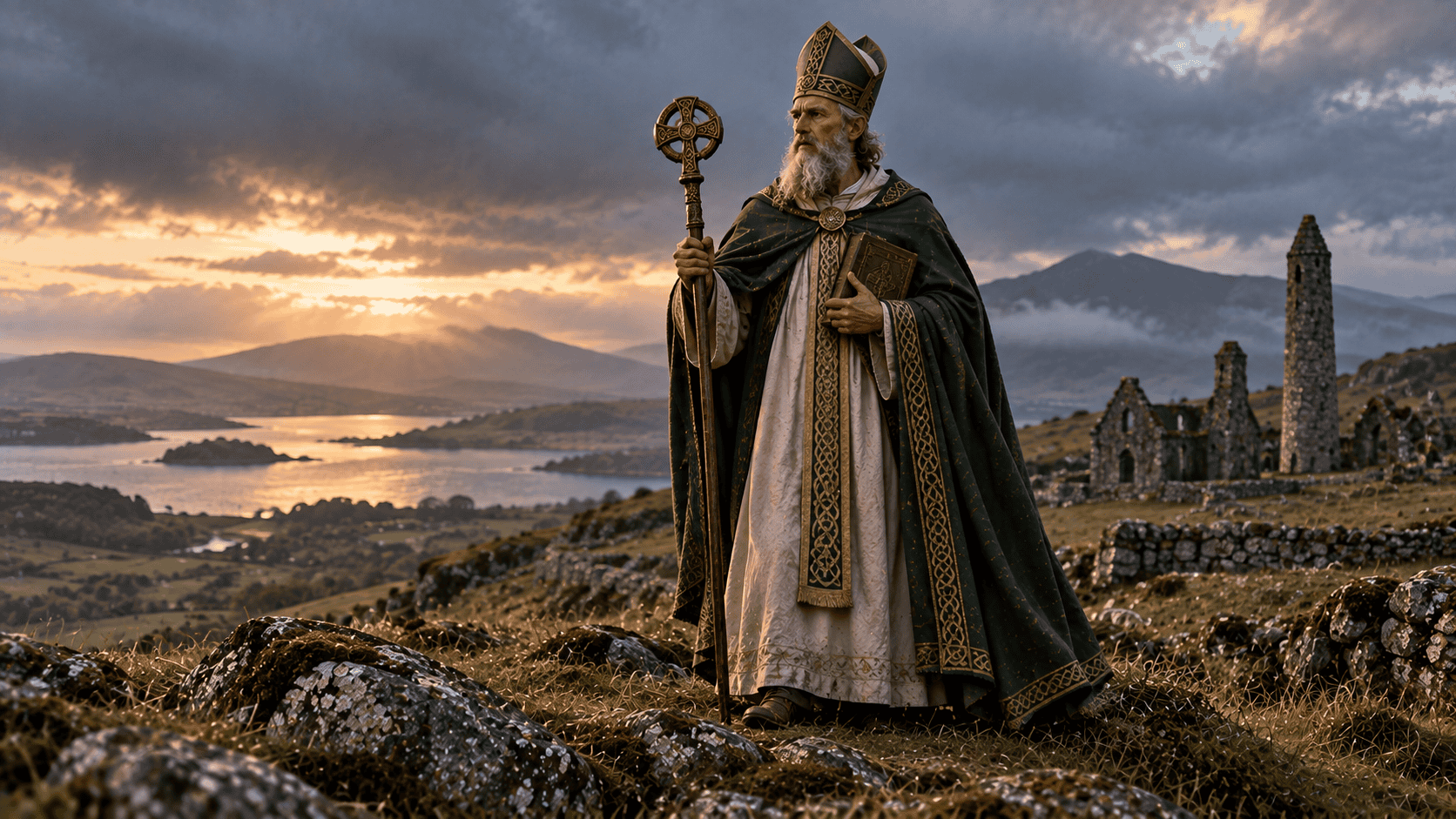
Saint Patrick is the patron saint of Ireland, a fifth-century Christian missionary born in Britain, who was enslaved in Ireland as a teenager and later returned as a bishop. His own writings survive, but most of the famous stories about him do not come from them. The Easter fire at Slane first appears in a biography of the saint written about two hundred years after his death, the snakes about seven hundred years after, and the shamrock is first recorded in 1726. This guide separates the Patrick of history from the Patrick of legend.
| Name | Patricius in Latin; Pádraig in Irish |
|---|---|
| Lived | Fifth century; exact dates unknown |
| Born | Britain, at a place he calls Bannavem Taburniae, never identified |
| Family | Son of Calpurnius, a deacon; grandson of Potitus, a priest |
| His own writings | The Confessio and the Letter to Coroticus |
| Earliest Lives | Muirchú and Tírechán, late seventh century |
| Feast day | 17 March, the traditional date of his death |
| Places | Slane, Tara, Croagh Patrick, Lough Derg, Armagh, Downpatrick |
| Later legends | The snakes, first written around 1185; the shamrock, first recorded in 1726 |
Who Was Saint Patrick?
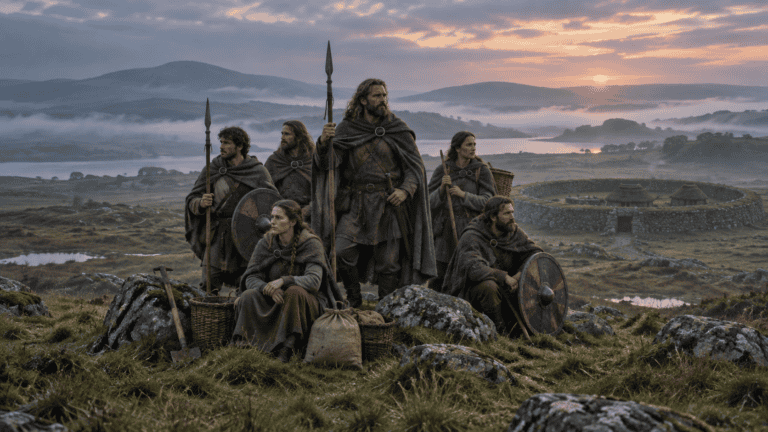
The most famous story about Saint Patrick goes like this. One spring night, Lóegaire, the High King of Ireland, is holding a great pagan festival at Tara, the ancient royal hill in County Meath. By law, nobody in Ireland may light a fire that night until the king has lit his own. But on the Hill of Slane, about ten miles away, a fire is already burning. It is Patrick, celebrating Easter with a bonfire. The king’s druids understand exactly what it means. If this Christian fire is not put out tonight, they warn him, it will burn in Ireland forever. In other words, the new religion will replace the old one.
It is a magnificent scene, and it has been told for more than thirteen centuries. It is also a legend. The real Patrick left us his own words, and they describe a very different life: humbler, harder, and in many ways more interesting than the one his admirers wrote for him. Understanding Saint Patrick means looking at both, the missionary who wrote the Confessio and the wonder-worker who grew up around his name.
The Patrick of History
Almost everything reliable we know about Patrick comes from two short Latin texts he wrote himself. The Confessio is his account of his life and his defense of his mission, written late in life. The Letter to Coroticus is an angry protest against a British warlord whose men had killed and enslaved some of Patrick’s newly baptized converts.
In them, Patrick tells us that he was a Briton, the son of a deacon named Calpurnius and the grandson of a priest named Potitus, from a place he calls Bannavem Taburniae. Nobody has ever identified it. At about sixteen, he was seized by Irish raiders and carried off to Ireland, where he spent six years as a slave, tending animals and praying constantly. A voice in a dream told him a ship was ready, and he walked a long way to reach it and escaped. Years later, he had another dream, in which the people of Ireland called on him to come back and walk among them again. He returned as a bishop and spent the rest of his life there.
His writings say nothing about kings, druids, fires, mountains, snakes, or shamrocks. He does not even name the places where he worked.
When Did Patrick Live?
Nobody knows exactly. The Irish annals give conflicting dates for his death in the later fifth century. Part of the confusion comes from another missionary. The chronicler Prosper of Aquitaine records that in 431, Pope Celestine sent a bishop named Palladius to “the Irish believing in Christ,” which shows there were already Christians in Ireland before Patrick. Later Irish writers claimed that Palladius had failed and that Patrick arrived the following year, in 432, a date that became traditional. In 1942, the scholar T. F. O’Rahilly argued that the stories of Palladius and Patrick had become tangled together, a theory known as “the two Patricks.” Historians still debate the details.
How the Legend Grew
Patrick was not the only early saint in Ireland, but he became the most important, largely because of the church of Armagh. Armagh is a small city in what is now Northern Ireland, and its church was said to have been founded by Patrick himself. It is still the seat of the archbishops who lead both the Catholic Church and the Church of Ireland on the island. In the seventh century, Armagh claimed authority over the whole Irish church on the grounds that Patrick had founded it, and it needed a founder worthy of that claim. The first two Lives of Patrick were written at this time, by Muirchú and by Tírechán. A Life, from the Latin vita, is a biography written to celebrate a saint, and it is usually more interested in miracles than in facts. Both were written about two hundred years after his death. These texts, along with Patrick’s own Confessio, were copied into the Book of Armagh around the year 807, which is why they survive.
These Lives turned Patrick into a heroic figure who confronts kings, defeats druids in contests of magic, and travels the length of Ireland founding churches. Later writers added more, century after century. The result is less a biography than a great gathering of stories, each of which tells us what Patrick meant to the people who told it.
The Fire on the Hill of Slane
The story of the fire comes from Muirchú’s Life, and it does not end with the druids’ warning. That same night, King Lóegaire rides to Slane with his chariots and his druids to confront Patrick. The druids tell everyone not to stand up when the stranger approaches, because anyone who rises to greet him will end up believing in him. Only one man, Erc, gets to his feet, and Patrick blesses him. Then a druid named Lochru begins to mock the Christian faith. Patrick prays that the blasphemer be destroyed, and Lochru is lifted into the air and dropped, and his head is smashed against a stone.
The next day, Easter Sunday, Patrick comes to the king’s feast at Tara, and the chief druid, Lucet Máel, challenges him to a contest of miracles. First, the druid slips a drop of poison into Patrick’s cup. Patrick blesses the cup, the drink freezes solid, and when he turns it upside down, only the poison falls out. Next, Lucet Máel covers the plain with deep snow and then with darkness, but he cannot undo either, while Patrick clears both with a prayer. Last comes a test by fire. A house is built, half of green wood and half of dry wood. Lucet Máel goes into the green half wearing Patrick’s robe, and Patrick’s young follower Benignus goes into the dry half wearing the druid’s cloak. The house is set alight. The druid burns to death, though Patrick’s robe does not burn, while Benignus walks out unharmed, though the druid’s cloak burns away around him.
Patrick warns the king that he must believe or die. Lóegaire’s counselors tell him it is better to believe than to die, and he is baptized, reluctantly. Patrick tells him that he may keep his throne, but because he did not believe at once, none of his descendants will be king after him.
The two earliest Lives do not even agree on how it ends. In Tírechán’s version, Lóegaire refuses to convert, saying that his father, Niall, would never have allowed it. It is a wonderful story either way, but it is a story written in the seventh century about the fifth. Scholars have noted how heavily Muirchú drew on the Bible, where prophets like Moses and Elijah also defeat the priests and magicians of rival gods in contests of miracles, and the story tells us far more about how Armagh wanted Patrick remembered than about what happened at Slane.
The Deer’s Cry
Another tale tells how Lóegaire set an ambush for Patrick and his companions on the road to Tara. Patrick sang a prayer of protection, and the men waiting in ambush saw no travelers at all, only eight deer and a fawn passing by. The fawn was Patrick’s young follower Benignus, with the saint’s book on his back.
The prayer is known as Saint Patrick’s Breastplate, or in Irish Fáeth Fiada, “the Deer’s Cry.” Its famous lines call on Christ to be with the speaker on every side, before and behind, above and below. It is one of the best-loved prayers in the Irish tradition, but most scholars think it was written well after Patrick’s time, and that it was attributed to him rather than written by him.
Forty Days on Croagh Patrick
Tírechán records that Patrick spent forty days fasting on a mountain in Connacht, following the example of Moses on Mount Sinai. That mountain is Croagh Patrick in County Mayo. In a ninth-century Irish Life, the Bethu Phátraic, Patrick is harassed on the summit by a flock of black demonic birds, which he drives away by ringing his bell, and he does not come down until God grants that he will judge the Irish on the Last Day. The mountain is still Ireland’s best-known pilgrimage site. On Reek Sunday, the last Sunday in July, thousands of pilgrims climb it, many of them barefoot.
The Snakes
The best-known Patrick legend of all is also one of the latest. Ireland has had no snakes since the last Ice Age, and Roman writers were already noting the fact two centuries before Patrick was born. The story that he drove them into the sea first appears in a Life of Patrick written by Jocelin of Furness around 1185, and even then, the writer Gerald of Wales doubted it. Our full article on Saint Patrick and the snakes tells how the legend came about.
The Shamrock
Every March, Patrick is pictured holding a shamrock, using its three leaves to explain the Christian Trinity: one God in three persons. Nothing in the early sources supports this. The first known record of the Irish wearing shamrock on St. Patrick’s Day comes from an English traveler, Thomas Dineley, in 1681, who noted it without any mention of the Trinity. The first written link between Patrick and the Trinity comes in 1726, in the botanist Caleb Threlkeld’s book on the native plants of Ireland, where he describes it as a “current tradition.” That is about twelve hundred years after Patrick’s death. The story may well be older than Threlkeld, but there is no written evidence for it before him.
Patrick and the Fianna
Patrick also became a character in Irish literature about much older heroes. In the Acallam na Senórach, “The Colloquy of the Ancients,” written around the year 1200, Patrick meets the aged warriors Caílte and Oisín, the last survivors of Fionn mac Cumhaill’s band, the Fianna. As they travel Ireland together, the old warriors tell him the story behind every hill and ford, and Patrick has the stories written down. Later ballads turned the meeting into an argument between the old pagan world and the new Christian one, with Oisín mourning the lost glory of the Fianna. The most famous of them tells how Oisín came back from Tír na nÓg to find Patrick’s Ireland.
Saint Patrick’s Purgatory
On Station Island in Lough Derg, County Donegal, there was once a cave said to lead to Purgatory, revealed to Patrick so that he could prove to doubters that the afterlife was real. In the twelfth century, a monk known as H. of Saltrey wrote a treatise telling how a knight named Owein went down into it and returned to describe what he saw. The story spread across medieval Europe and drew pilgrims from as far away as Italy and Hungary. The cave has long since been closed, but Lough Derg is still a place of pilgrimage, with a demanding three-day retreat of fasting and prayer.
St. Patrick’s Day
Patrick’s feast has been kept in Ireland on 17 March, the traditional date of his death, since at least the ninth or tenth century. In the 1630s, the Irish Franciscan Luke Wadding, working in Rome, helped have it added to the calendar of the whole Catholic Church. It became a public holiday in Ireland in 1903.
The parades began abroad. The earliest known procession in Patrick’s honor was held in 1601 in St. Augustine, in the Spanish colony of Florida, organized by the town’s Irish vicar, Ricardo Artur. The Irish in Boston marked the day in 1737, and Irish soldiers serving in the British army marched in New York in 1762. The first St. Patrick’s Day parade in Ireland is usually dated to 1903, in Waterford.
Saint Patrick in Popular Culture
Today, St. Patrick’s Day is celebrated around the world, often with very little of Patrick in it. Green rivers, leprechauns, and shamrock hats have far more to do with the Irish in America and with modern marketing than with the fifth-century bishop. The leprechaun, in particular, never appears in any of Patrick’s legends. Yet the saint himself remains a powerful figure, claimed by Catholic and Protestant churches alike, and his feast is Ireland’s national day.
Was Saint Patrick Irish?
No. Patrick tells us himself that he was a Briton, born into a Christian family in Roman Britain. He first came to Ireland as a captive, not by choice, and he returned because he believed God had called him to. His exact birthplace is unknown, and places in Scotland, England, and Wales have all been proposed. What made him Irish was the rest of his life, which he spent in Ireland, and the fifteen centuries of stories that the Irish have told about him since.
Sources and Further Reading
- Ludwig Bieler, trans., The Works of St. Patrick, Ancient Christian Writers 17, Newman Press (1953).
- Ludwig Bieler, ed. and trans., The Patrician Texts in the Book of Armagh, Dublin Institute for Advanced Studies (1979).
- T. F. O’Rahilly, The Two Patricks: A Lecture on the History of Christianity in Fifth-Century Ireland, Dublin Institute for Advanced Studies (1942).
- Ann Dooley and Harry Roe, trans., Tales of the Elders of Ireland (Acallam na Senórach), Oxford University Press (1999).
- Caleb Threlkeld, Synopsis Stirpium Hibernicarum, Dublin (1726).