In Short
Ogham (pronounced OH-um in Irish, often OG-um in English) is the earliest writing system used for the Irish language. Its letters are groups of straight lines and notches cut along a central line, usually the edge of a standing stone. About 400 ogham inscriptions survive, most from the fifth and sixth centuries and most in the south of Ireland, and nearly all of them record a person’s name. Medieval Irish scholars said the alphabet was invented by the god Ogma. Its real origin is unknown, but it was almost certainly modeled on the Latin alphabet.
| Name | Ogham; Old Irish ogam |
|---|---|
| Pronunciation | OH-um or OHM in Irish; often OG-um in English |
| What it is | An alphabet of lines and notches cut along a central line |
| Letters | 20 original letters in four groups of five, with extra letters added later |
| Language | Primitive Irish, the earliest recorded form of Irish |
| Date of the stones | Mostly fifth and sixth centuries AD |
| Surviving inscriptions | About 400 |
| Where | Mostly Cork, Kerry, and Waterford; also Wales, Scotland, and the Isle of Man |
| Legendary inventor | Ogma, a warrior and poet of the Tuatha Dé Danann |
| “Tree alphabet” | A medieval idea, and only partly accurate |
What Is Ogham?
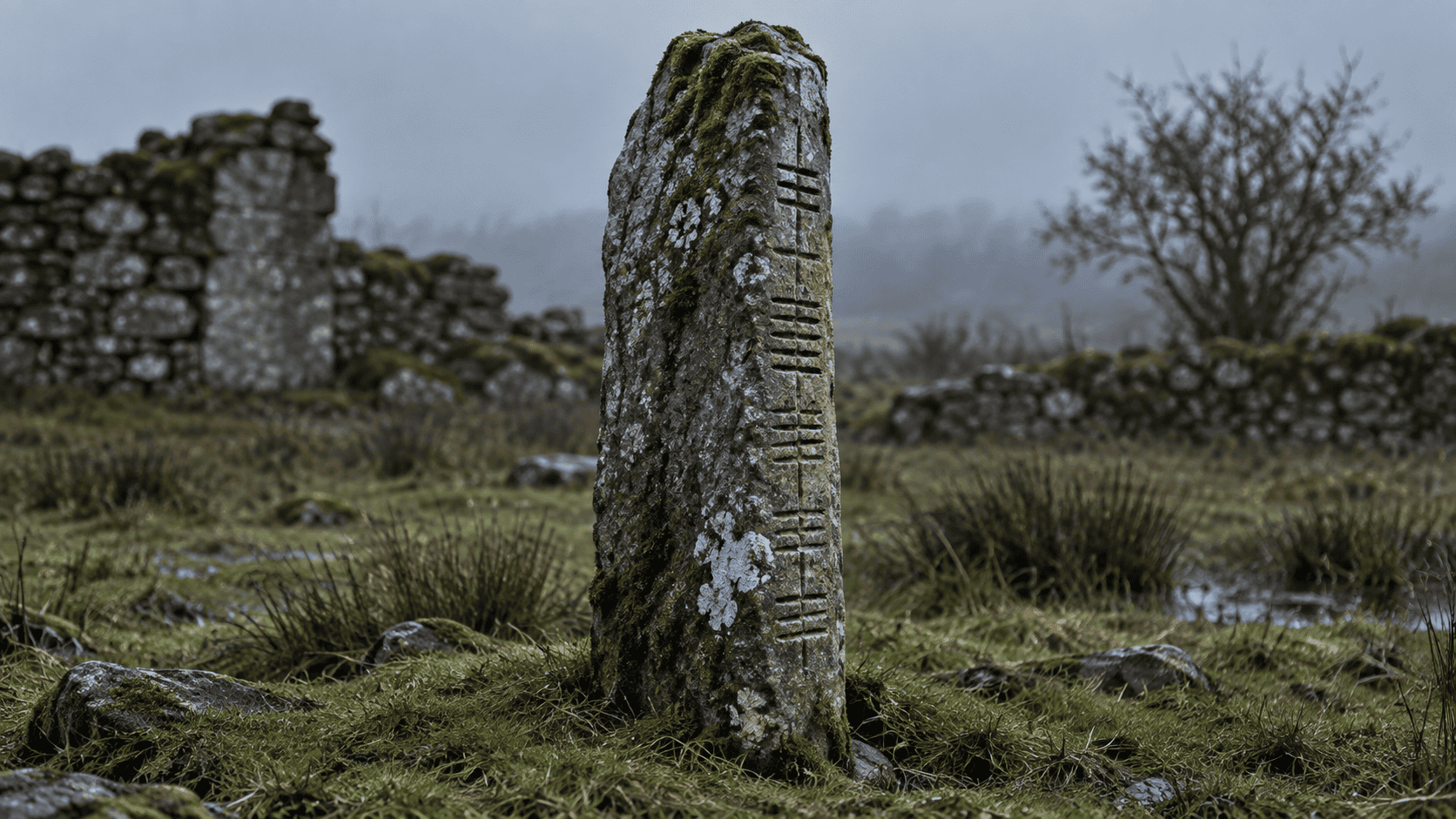
In a field on the Dingle Peninsula, a tall grey stone leans out of the grass. Run your eye up one edge and you will see it: a row of short, straight grooves, cut into the stone in little groups, some on one side of the edge, some on the other, some slanting right across it. It looks like a tally, or a code. It is actually a name, written about fifteen hundred years ago in the oldest form of the Irish language.
This is ogham, the first writing system used in Ireland. It was not written with a pen. It was cut with a chisel along the corner of a stone, using the stone’s natural edge as the line that holds all the letters together. It was probably designed in the fourth century, and it was used on stone monuments until around the seventh century. Medieval scholars kept it alive for centuries afterward in their manuscripts, and today it appears on jewelry, tattoos, and signs across Ireland.
How Ogham Works
Every ogham inscription is built around a single central line, called the stem line. On a standing stone, the stem line is the stone’s sharp vertical edge. In manuscripts, scribes drew it as a straight line across the page.
The original alphabet has twenty letters, arranged in four groups of five. Each group is called an aicme, “family,” and is named after its first letter. In the first group, the letters are made of one to five strokes on one side of the stem line. In the second group, they are one to five strokes on the other side. In the third, they are one to five strokes cut diagonally across the line. In the fourth, which holds the vowels, they are one to five short notches or strokes on the line itself. So a single stroke on one side might be B, while five strokes on the same side is N.
On a standing stone, an inscription is usually read from the bottom of the left-hand edge, upward, and sometimes over the top and down the other side. Later, medieval scholars added five extra letters, called the forfeda, “additional letters,” to represent sounds the original alphabet lacked.
The Ogham Alphabet
Each letter has an Irish name, which is also where many modern ideas about ogham come from. The sound values below are the ones usually given for the original letters. The meanings of several names are uncertain, and question marks show where scholars are unsure.
| First group | B, beith (birch); L, luis (rowan?); F or V, fern (alder); S, sail (willow); N, nin (ash?) |
|---|---|
| Second group | H, húath (whitethorn? or “fear”); D, dair (oak); T, tinne (holly?); C, coll (hazel); Q, ceirt (apple tree?) |
| Third group | M, muin (vine?); G, gort (ivy? or “field”); NG, ngétal (“wounding”); Z or ST, straif (sulphur? or sloe); R, ruis (elder?) |
| Fourth group (vowels) | A, ailm (pine?); O, onn (ash); U, úr (earth?); E, edad (meaning unknown); I, idad (yew?) |
| Later additions | Five forfeda for sounds such as EA, OI, UI, and later P |
Notice that there is no letter for P in the original alphabet. The earliest form of Irish had lost the P sound, so it did not need one. A P was only added later, as one of the extra letters.
Where Ogham Stones Are Found
About 400 ogham inscriptions survive on stone. The great majority are in Ireland, and most of those are in the south-west. Counties Cork and Kerry alone hold about sixty percent of all the Irish stones, and Waterford has many more. Outside Ireland, ogham stones are found in places where Irish settlers lived in the early Middle Ages: Wales, especially Pembrokeshire, which has the largest number outside Ireland, and also Cornwall, Devon, the Isle of Man, and Scotland. In Scotland, a handful of ogham inscriptions were carved in Pictish, the language of the Picts.
Many of the Welsh stones are bilingual, carrying the same name in ogham and in Latin letters. These twin inscriptions were a key to understanding how ogham worked, because they allowed scholars to match the ogham letters to known sounds.
A few ogham inscriptions appear on smaller objects. One was cut into a piece of deer antler found at Moynagh Lough, a lake in County Meath, but these portable inscriptions are very rare.
What the Stones Say
Almost every ogham stone says the same kind of thing. It gives a person’s name, and usually the name of their father or ancestor, following a set pattern. The most common formula is “X MAQI Y,” meaning “of X, son of Y.” Sometimes it names a more distant ancestor or a people. The name is usually in the possessive form, “of X,” as though the stone itself belongs to that person.
Nobody is completely sure what the stones were for. Many were probably memorials or grave markers. Others may have marked the boundaries of land, naming the person or family who owned it. Either way, they are the earliest written records of the Irish language and of the names of people who lived in Ireland during the fifth and sixth centuries.
Who Invented Ogham?
Nobody knows for certain. Most scholars agree that ogham was created by someone who knew the Latin alphabet well, because the way it divides up the sounds of speech follows the teaching of Latin grammarians closely. That suggests it was invented in Ireland or among the Irish in Britain, by people in contact with the Roman world, probably in the fourth century. Why they created a new script rather than simply using Latin letters is still debated. Some scholars have suggested it was designed to be understood only by the Irish, while others think it was simply better suited to carving on stone or wood.
The Legend of Ogma
Medieval Irish scholars had a more colorful answer. The Auraicept na nÉces, “The Scholars’ Primer,” a textbook for trainee poets, says that ogham was invented by Ogma, a warrior and poet of the Tuatha Dé Danann. It calls Ogma the father of ogham, and his hand or knife its mother. According to the same text, the very first thing ever written in ogham was seven B strokes cut on a birch rod. It was a warning to the god Lugh that his wife would be carried away into the Otherworld seven times unless the birch protected her. That, says the Auraicept, is why B for birch comes first in the alphabet. Another passage traces the Irish language itself back to the scholar Fénius Farsaid, who was said to have built it from the best parts of all the languages scattered at the Tower of Babel.
Ogham in the Manuscripts
Ogham stopped being carved on stones by around the seventh century, but it did not disappear. Irish scholars and poets went on studying it in the monasteries for centuries, writing it horizontally across the page. The main surviving treatises on ogham, including the Auraicept and a text known as In Lebor Ogaim, “The Book of Ogams,” are preserved in the Book of Ballymote, a great manuscript compiled around 1390.
In Lebor Ogaim lists about a hundred variant forms of ogham, which scholars call secret or scholastic oghams. There is a “shield ogham,” for example, and even a “Viking ogham,” which is actually the Scandinavian runic alphabet. Some of these were probably puzzles or exercises for students rather than scripts anyone used. The same text gives each letter a set of short poetic riddles, called bríatharogam, “word ogham,” which explain the letter names. One set is attributed to Cú Chulainn himself.
Ogham also appears in the old stories. In the Táin Bó Cúailnge, Cú Chulainn cuts ogham into a hoop made from a sapling and leaves it on a standing stone as a challenge to the invading army, forbidding them to go further until one of them can do the same.
Is Ogham a Tree Alphabet?
Ogham is often called the “Celtic tree alphabet,” and the idea is only partly true. Several of the letter names really are the names of trees. Beith means birch, dair means oak, coll means hazel, sail means willow, and onn means ash. Medieval scholars took this further and gave a tree name to every letter, and the word they used for a letter, fid, also meant “wood” or “tree.”
But many of the letter names are not trees at all. The leading modern scholar of ogham, Damian McManus, showed that several of them probably meant something quite different. Húath seems to mean “fear” or “horror,” gort means “field,” ngétal means “wounding,” and straif may mean “sulphur.” The medieval tree meanings were, in many cases, learned guesses made centuries after the alphabet was invented.
The Tree Calendar
The popular idea of an ogham tree calendar, in which each letter rules a month of the year and each person has a “birth tree,” is much younger still. It was invented by the poet Robert Graves in The White Goddess, published in 1948, and it has no basis in any early Irish source. It is now widespread in modern paganism and on horoscope websites, but it is a twentieth-century creation.
Where to See Ogham Stones
Many ogham stones can still be seen where they were first raised, especially in Kerry and Cork. Others are kept in museums and churches across Ireland. Two good places to start:
- Ballintaggart, County Kerry. On the Dingle Peninsula, a group of ogham stones stands inside a round enclosure, protected as a National Monument.
- Drumlohan, County Waterford. Here, ogham stones were reused as building stones in an underground passage, known locally as the Ogham Cave.
If you can’t travel, you can explore the stones online:
- Ogham in 3D. Hosted by the Dublin Institute for Advanced Studies, this database lets you view many of the stones as detailed 3D scans you can turn and zoom. It was relaunched in 2025 after a research project by the universities of Glasgow and Maynooth set out to document every known ogham inscription, in Ireland and abroad.
- The Discovery Programme on Sketchfab. The Irish archaeological research body that carried out much of the original scanning has published a collection of ogham stone models on the 3D-sharing site Sketchfab.
Ogham in Popular Culture
Ogham has had a lively modern afterlife. Since 1999, it has been part of Unicode, the international standard for digital text, so ogham letters can be typed on computers and phones. It appears on Irish jewelry, gravestones, sculpture, and signs, and it is a popular choice for tattoos, often spelling out a name. In modern paganism, sets of wooden “ogham staves” are used for divination, a practice with no known basis in early Irish tradition.
Can You Write Your Name in Ogham?
Yes, and it is a popular thing to do, but it takes some adjusting. The original alphabet was designed for early Irish, so it has no letters for J, K, P, V, W, X, or Y as English uses them. People writing modern names in ogham usually substitute the nearest sound: C for K, for example, or the later P letter where one is needed. Because there is no single agreed system, the same name can be written in more than one way. If you plan to have your name carved or tattooed in ogham, it is worth checking the spelling with someone who knows the script.
Sources and Further Reading
- Damian McManus, A Guide to Ogam, Maynooth Monographs 4, An Sagart (1991).
- Damian McManus, “Irish Letter-Names and Their Kennings,” Ériu 39 (1988).
- R. A. S. Macalister, Corpus Inscriptionum Insularum Celticarum, vol. 1, Stationery Office, Dublin (1945).
- George Calder, ed. and trans., Auraicept na n-Éces: The Scholars’ Primer, John Grant (1917).
- Dublin Institute for Advanced Studies, Ogham in 3D, ogham.celt.dias.ie.