In Short
The Hill of Tara, in Irish Teamhair, is an ancient ceremonial and burial site on a low ridge in County Meath, regarded as Ireland’s foremost royal site and best known as the seat of the High Kings.
Tara matters because it stood at the center of the most important kingship in Ireland from at least the sixth century AD. Medieval Irish writers made it the place where kings held the Feis Temro, which scholars read as a sacred marriage between king and land, and where the Lia Fáil LEE-uh FAWL roared under the rightful ruler. Its oldest monument, the Mound of the Hostages, is a passage tomb completed around 3100 BC, so people were laying their dead at Tara thousands of years before any king was inaugurated there. Tara remained a symbolic capital of Ireland long after its kings were gone, and in 1843 Daniel O’Connell held one of his monster meetings there.
| Irish name | Teamhair; Old Irish Temair |
|---|---|
| Location | Near Skryne, County Meath |
| Height | About 155 m (509 ft) |
| Oldest monument | Mound of the Hostages, about 3100 BC |
| Largest monument | Ráth na Ríogh, about 1 km around |
| Inauguration stone | Lia Fáil, the Stone of Destiny |
| Last Feast of Tara | Diarmait mac Cerbaill, AD 560 |
| Status | National Monument, managed by the OPW |
A Fire Seen From Tara
On the night of a great pagan feast, so the story goes, no fire could be lit in the kingdom before the king’s own fire blazed at Tara. King Lóegaire looked out across the plain and saw a flame already burning. His druids understood at once what it meant: unless that fire was put out the same night, it would never be put out, and it would rule over the whole kingdom.
The fire belonged to Saint Patrick. Tara itself is no castle, only a grassy ridge of banks, ditches, mounds, and one upright stone, yet whoever held it held the symbolic center of Ireland.
Where Is the Hill of Tara?
The hill stands near Skryne in County Meath, south of Navan, off the R147 road between Dublin and Navan. It rises only about 155 meters, but the flat land around it gives the summit wide views. Brú na Bóinne, home to Newgrange, Knowth, and Dowth, lies in the nearby Boyne valley, and Tara’s own passage tomb is small in comparison with the great tombs there.
The Old Irish name Temair is of uncertain meaning; one suggestion links it to a word for a sacred enclosure, akin to the Greek temenos.
Medieval writers explained the name through a woman. In the Lebor Gabála Érenn, Tea, daughter of Lugaid and wife of the Milesian leader Érimón, chose the hill as her marriage price, and the name Temair was read as Tea Múr, the Wall of Tea. The Dindshenchas adds that she built a rampart around her house and was buried there. This is legend rather than real etymology, and medieval scholars themselves offered rival explanations, among them a Greek word meaning to behold.
The Monuments of Tara
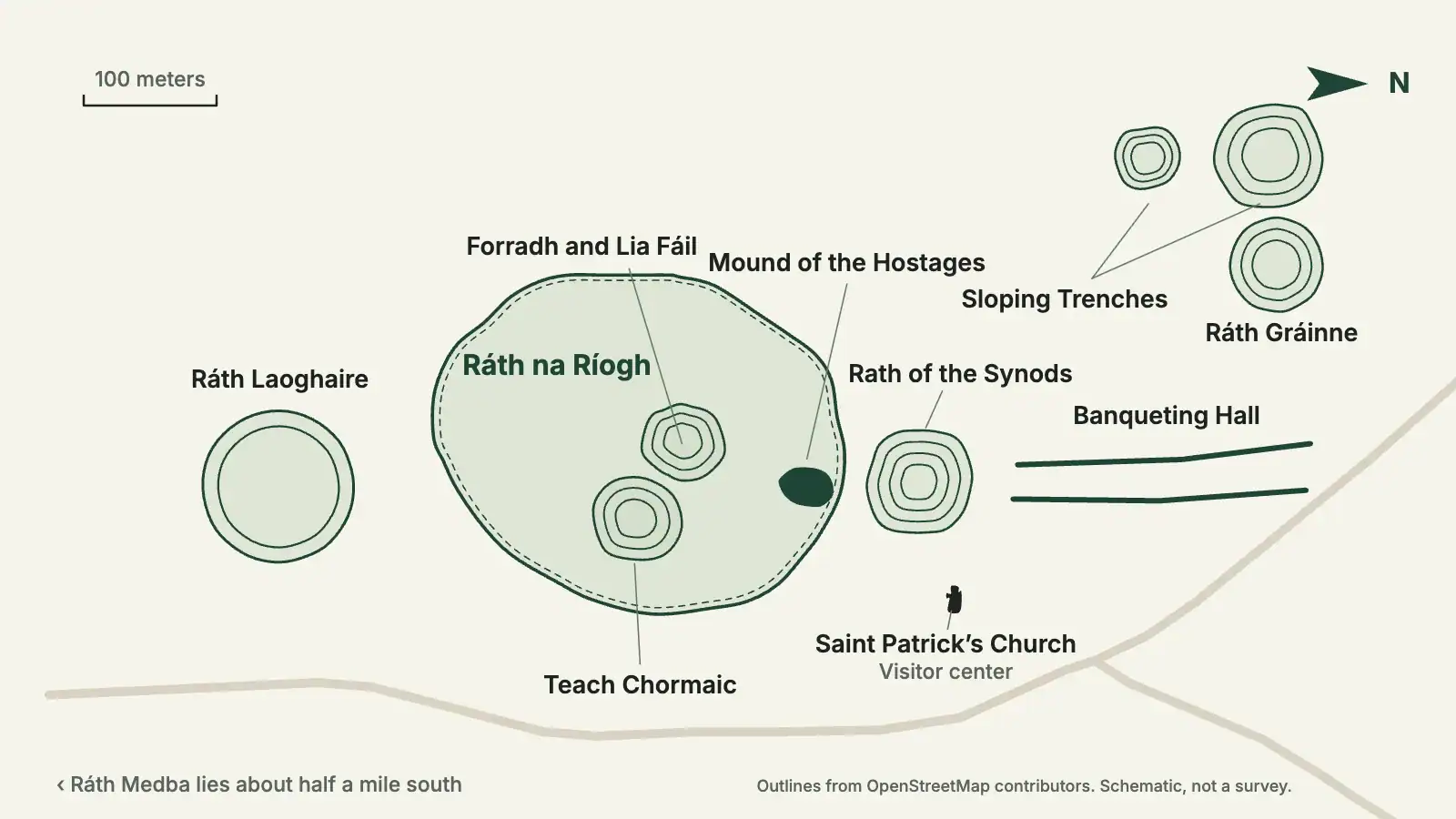
The remains of about 30 monuments are easily identified on the hill today, out of some 61 sites and monuments recorded on the State-owned lands. The rest survive as low-profile or buried features, many of them identified through aerial photography, and geophysical surveys have revealed further enclosures. Many of the names reflect stories that later generations attached to the hill, so they belong to Tara’s folklore, not to its builders.
The Mound of the Hostages
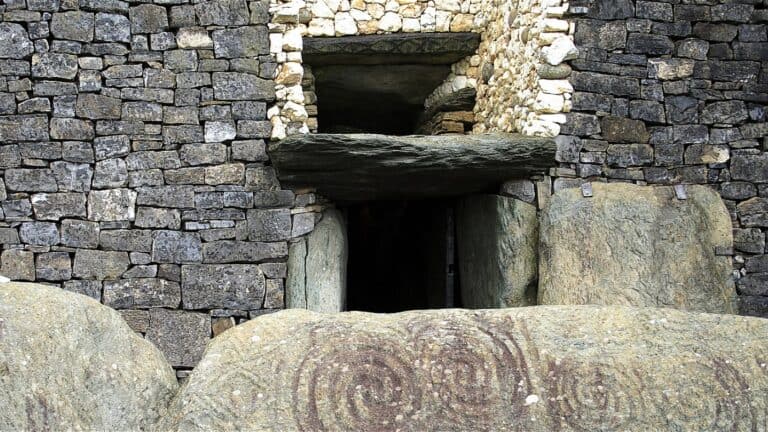
The oldest visible monument is Duma na nGiall, the Mound of the Hostages, a Neolithic passage tomb completed around 3100 BC. Excavators found the remains of an estimated 250 to 500 people, mostly cremated, and burials continued into the Bronze Age. The passage is aligned so that the rising sun shines in around Samhain and Imbolc. The name refers to the hostages that kings of Tara supposedly held as pledges of loyalty, though the tomb is older than those kings by three thousand years.
Ráth na Ríogh, the Forradh, and Teach Chormaic
The largest monument is Ráth na Ríogh, the Enclosure of the Kings, an oval about 318 by 264 meters, dated to around the first century BC. Its ditch, up to 3 meters deep, lies inside its bank rather than outside it. Archaeologists have long read that layout as a ritual boundary around sacred ground, although Katharina Becker argues that such royal sites were more than purely ceremonial places. Inside sit two linked earthworks shaped like a figure eight: the Forradh, or Royal Seat, where the Lia Fáil now stands, and Teach Chormaic, Cormac’s House, named for the legendary king Cormac mac Airt.
The Rath of the Synods and the Banqueting Hall
Ráith na Senad, the Rath of the Synods, is a ring of banks and ditches occupied between the first and fourth centuries AD. Ó Ríordáin’s excavation in 1952 recovered Roman pottery, glass, and a lock, proof that Tara’s people were in touch with the Roman world. The name recalls church synods reputedly held here by Saints Patrick, Ruadán, and Adomnán, although the famous synod of 697 that guaranteed Adomnán’s law met at Birr, in what is now County Offaly.
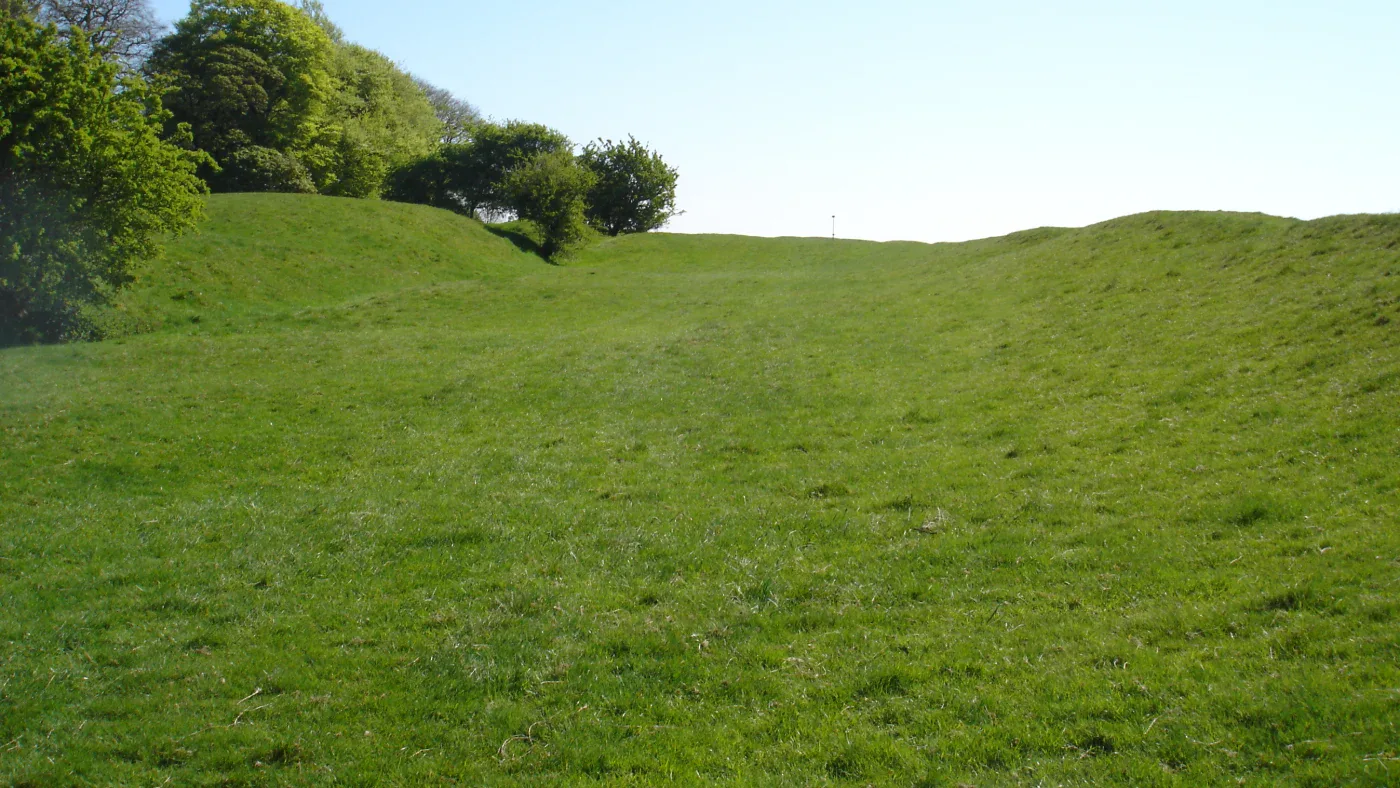
The Banqueting Hall, Teach Miodhchuarta, is a pair of parallel banks about 203 meters long at the north end of the hill. Medieval writers pictured it as a vast feasting hall and even drew up plans of where each rank sat. Archaeologists now think it was most likely a ceremonial avenue leading up to the summit.
Ráth Gráinne and the Sloping Trenches
On the northwestern slope lie the Claonfhearta, the Sloping Trenches, two ring barrows built on the steep hillside. Just east of them is Ráth Gráinne, a third large ring barrow about 70 meters across, whose name recalls Gráinne, the daughter of Cormac mac Airt who eloped with Diarmuid Ua Duibhne rather than marry Fionn mac Cumhaill. Tradition explains the slope: when the usurping king Lugaid mac Con gave a false judgment at Tara, one half of the house in which he gave it slid down the hillside and stayed there forever, and that, says the tale, is why the “sloping mounds of Tara” lean as they do.
Ráth Laoghaire
At the southern end of the hill is Ráth Laoghaire, named for King Lóegaire mac Néill. Tradition says he was buried in its rampart standing upright, armed, and facing south toward his Leinster enemies. In the seventh-century account by Tírechán, Lóegaire explains why he cannot accept Patrick’s faith: his father, Niall, had commanded him to be buried in the ramparts of Tara like a warrior facing the foe.
The Lia Fáil: The Stone of Destiny
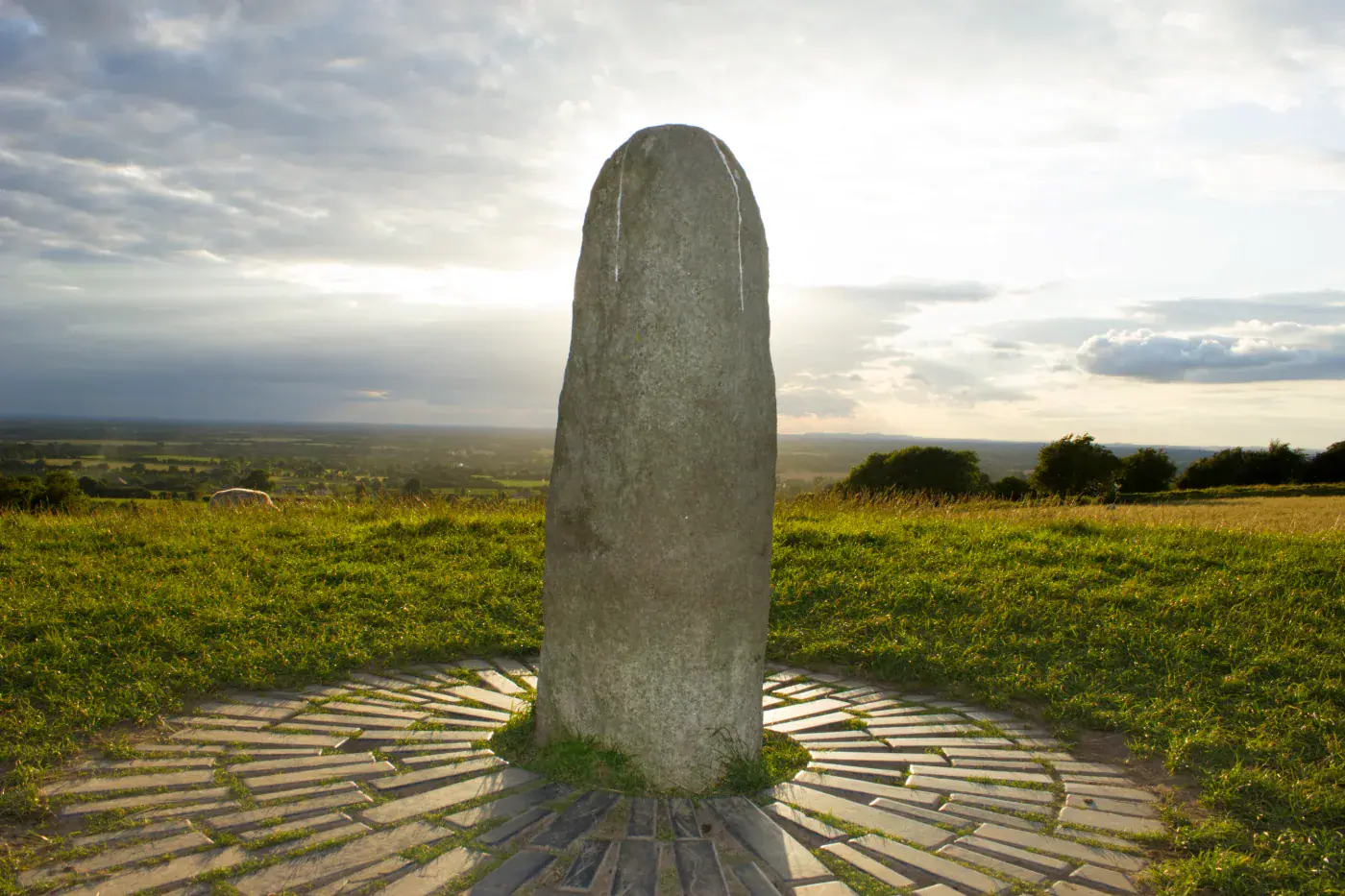
In tradition, the Lia Fáil is the inauguration stone of the kings of Tara. In the medieval pseudo-history Lebor Gabála Érenn, it is one of the Four Treasures that the Tuatha Dé Danann brought from the city of Falias, and it was said to cry out beneath the rightful king. Ireland itself was called Inis Fáil, the Island of Fál. When it stayed silent under Cú Chulainn’s foster son Lugaid Riab nDerg, Cú Chulainn split it with his sword, and afterward it cried out only under Conn of the Hundred Battles.
Is the Stone on the Forradh the Real Lia Fáil?
The granite pillar on the Forradh was not always there. In the nineteenth century, local people set it up to mark the grave of rebels killed at Tara in 1798; P. W. Joyce dated this to about 1821, while other accounts give 1824. George Petrie believed the pillar was the true Lia Fáil and had originally stood near the Mound of the Hostages. Joyce, writing in 1911, rejected that view and said the stone had lain in the Forradh’s own trench for generations. The identification therefore rests on tradition rather than proof.
The stone has been attacked repeatedly in recent years. In June 2012, it was struck, possibly with a hammer, in eleven places; in May 2014, vandals covered at least half its surface in green and red paint; and in February 2023, someone spray-painted the word “Fake” on it.
The High Kings of Tara: Myth and History
The traditional lists of High Kings reach back into myth. The early title was King of Tara, a claim to overlordship used by branches of the Uí Néill dynasty, and although the idea of a national kingship was voiced as early as the seventh century, the high kings never ruled Ireland as a politically unified state. Tara’s prestige rested less on armies than on ritual: it was where kingship was made sacred.
The Feis Temro and Medb Lethderg
The central rite was the Feis Temro, the Feast of Tara. The word feis has a sexual sense, and the scholar D. A. Binchy, writing in 1958, described the feast as a symbolic mating between the king and the goddess of the land. He called it a fertility rite, and early Irish tradition held that a ruler’s truth made people, cattle, and crops thrive. Binchy also concluded from the annals that the feast was held only once in each reign, seemingly at its height rather than its start, not yearly as later legend claimed.
The goddess of Tara’s sovereignty was Medb Lethderg, “Medb of the Red Side,” said to be the wife or lover of nine successive kings, among them Art mac Cuinn and his son Cormac mac Airt. Ráth Medba, a large enclosure about half a mile south of the hill, bears her name.
Cormac mac Airt
Cormac mac Airt is the ideal king of Tara in Irish tradition, placed by the annals in the third century, though their dates disagree. He won the kingship by wisdom. A woman’s sheep had grazed the queen’s woad, a valuable dye plant, and Lugaid mac Con ruled the sheep forfeit. The young Cormac argued that one shearing should pay for another, since both wool and woad would grow back, and Mac Con’s false ruling cost him the throne. When Cormac later lost an eye, he gave up his duties at Tara, because a blemished king could not rule there.
Niall of the Nine Hostages
Niall Noígíallach is the ancestor of the Uí Néill dynasties that dominated Ireland from the sixth to the tenth century. The annals date him to around 400, but modern historians such as Francis John Byrne place his death closer to 452. One saga explains his epithet as five hostages from the provinces of Ireland plus one each from the Scots, Saxons, Britons, and Franks. In Echtra mac nEchach, Niall alone kisses a hideous hag guarding a well, and she becomes a beautiful woman, the Sovereignty of Ireland. It shares the idea of kingship as a union with the land, told here as an adventure.
Saint Patrick and the Paschal Fire
The famous confrontation comes from Muirchú’s Life of Patrick, written in the late seventh century. Patrick kindled his Easter fire on the night of Lóegaire’s pagan festival, at a place Muirchú calls the burial ground of the men of Féc, which later tradition identified with the Hill of Slane to the north. The king rode out with his two chief druids, Lucet Máel and Lochru. When Lochru mocked the faith, he was lifted into the air and dashed against a stone. After further contests, Muirchú says, Lóegaire submitted.
The episode is legend rather than history. Tírechán, writing at about the same time, has Lóegaire remain pagan to the grave. Historians such as Niamh Wycherley read Muirchú’s account as shaped by a clear agenda rather than as a record of events, and his showdown sets the saint face to face with the king of Tara.
The Decline of Tara
The last Feast of Tara in the historical record was held by Diarmait mac Cerbaill, entered in the annals under 560, and D. A. Binchy argued that the rite was then dropped as a relic of paganism. Later legend gives a more dramatic cause: Saint Ruadán of Lorrha cursed the hill after a quarrel with Diarmait, and Tara was left desolate.
Tara in Modern Irish History
Tara’s symbolic power never faded, and in the modern era the hill became a stage for political and cultural struggle.
The Battle of Tara, 1798
During the 1798 Rebellion, several thousand United Irishmen camped on the hill, partly to command the road between Ulster and Dublin. On 26 May 1798, government troops attacked with musket volleys and cannon. About 400 rebels are said to have been killed and buried on the hill, in the grave the Lia Fáil was later raised to mark, and the defeat effectively ended the rising in County Meath.
Daniel O’Connell’s Monster Meeting, 1843
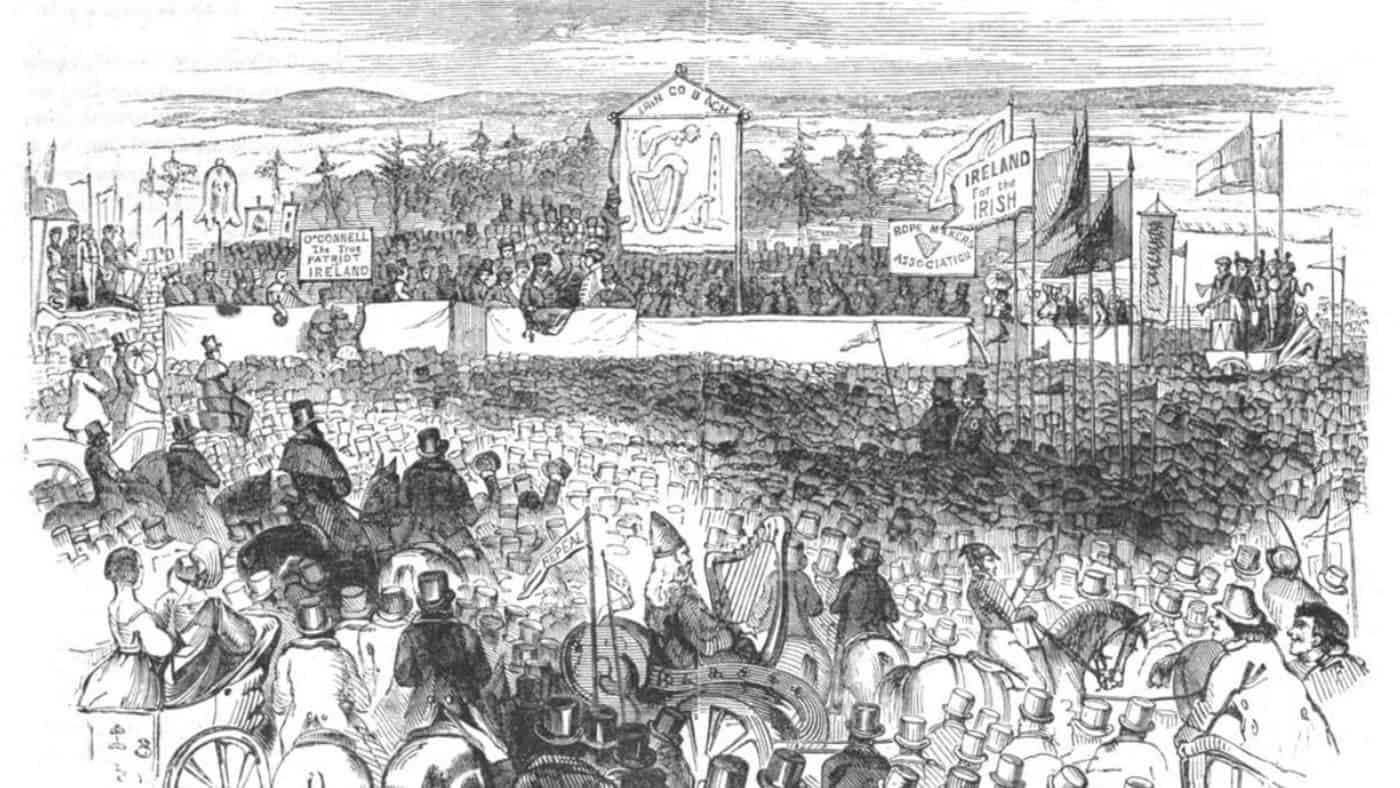
On 15 August 1843, Daniel O’Connell held one of his “monster meetings” at Tara to demand repeal of the Act of Union. The Nation claimed about 750,000 people attended. John Mitchel called that an exaggeration but still put the crowd at no fewer than 350,000.
The British Israelites and the Ark of the Covenant
Between 1899 and 1902, British Israelites, who believed the British descended from the lost tribes of Israel, dug into the Rath of the Synods looking for the Ark of the Covenant. Douglas Hyde, W. B. Yeats, and George Moore protested in a letter to The Times, Arthur Griffith joined protests on the hill, and Maud Gonne lit a bonfire there and sang “A Nation Once Again.” No Ark was found, but the rath was badly damaged.
The M3 Motorway Controversy
In 2003, An Bord Pleanála approved a route for the M3 motorway through the Tara and Skryne valley, about 2.2 km from the hilltop. In 2007, road archaeologists found the Lismullin henge, an Iron Age ceremonial enclosure about 80 meters across, which was excavated and then cleared for the road. That September, more than 1,500 people formed a human harp and the words “SAVE TARA VALLEY” on the hill. The World Monuments Fund put Tara on its 2008 Watch List, but the motorway opened on 4 June 2010.
Why Was Tara Sacred?
Tara’s holiness was built up in layers over five thousand years. The Mound of the Hostages made it a place of the ancestral dead, and the sunrises that enter it around Samhain and Imbolc may have tied it to the turning year. Iron Age builders then ringed the summit with an enclosure that many archaeologists read as a ritual boundary rather than a defense. When medieval writers made Tara the seat of the High Kings, they drew on that inherited sanctity, and scholars suggest that the ancient burial ground and the idea of a symbolic marriage between king and land gave Tara’s kingship a legitimacy no ordinary fortress could give.
The Hill of Tara in Popular Culture
Thomas Moore’s song “The Harp That Once Through Tara’s Halls,” from his Irish Melodies (issued from 1808), made the silent harp of Tara a lasting image of Ireland’s lost glory. In Margaret Mitchell’s Gone with the Wind (1936), Gerald O’Hara, an emigrant from County Meath, names his Georgia plantation Tara after the hill, and the 1939 film made the name famous worldwide. The Tara Brooch, by contrast, has no link to the hill: it was found around 1850 near Bettystown on the Meath coast, and the Dublin jeweler George Waterhouse named it after Tara to sell his reproductions.
Common Questions
These are the questions readers ask most often about Tara and its kings.
Did the High Kings Live on the Hill of Tara?
Probably not in any permanent sense. Kings were inaugurated and feasted there, but Tara was a ceremonial center, and no royal palace has been found. The Uí Néill kings who claimed the title are traditionally thought to have stopped using the site around the sixth century, though later burials show the hill was not left empty.
Can You Visit the Hill of Tara?
Yes. The hill is a National Monument managed by the Office of Public Works and open all year. The seasonal visitor center in the former Saint Patrick’s Church has an audiovisual show and a Pentecost window by the stained-glass artist Evie Hone.
Sources and Further Reading
- Edel Bhreathnach (ed.), The Kingship and Landscape of Tara, Four Courts Press (2005).
- Conor Newman, Tara: An Archaeological Survey, Discovery Programme and Royal Irish Academy (1997).
- Muiris O’Sullivan, Duma na nGiall: The Mound of the Hostages, Tara, Wordwell (2005).
- D. A. Binchy, “The Fair of Tailtiu and the Feast of Tara,” Ériu 18 (1958).
- Francis John Byrne, Irish Kings and High-Kings, 2nd ed., Four Courts Press (2001).
- Ludwig Bieler (ed. and trans.), The Patrician Texts in the Book of Armagh, Dublin Institute for Advanced Studies (1979).
- Mairéad Carew, Tara and the Ark of the Covenant, Discovery Programme and Royal Irish Academy (2003).
- P. W. Joyce, The Wonders of Ireland, Longmans, Green (1911).
- Tara Conservation Management Plan (2022).
- Niamh Wycherley, “Meet St Patrick’s Spin Doctor,” Maynooth University.
- Katharina Becker, “Irish Iron Age Settlement and Society: Reframing Royal Sites,” Proceedings of the Prehistoric Society 85 (2019).
- R. A. Stewart Macalister (ed. and trans.), Lebor Gabála Érenn, Part V, Irish Texts Society (1956).
- Whitley Stokes (ed. and trans.), “The Prose Tales in the Rennes Dindshenchas,” Revue Celtique 15 (1894).
- Image credit: “Die Repealversammlung auf dem Berge Tara,” Illustrirte Zeitung, Leipzig, 28 October 1843, public domain, via Wikimedia Commons.
- Site plan: Irish Folklore, with outlines from OpenStreetMap contributors (ODbL) and labels following the OPW site sign and the Tara Conservation Management Plan.
- Banqueting Hall photograph: Brholden, 2007, public domain, via Wikimedia Commons.
- Photo: JohnJDuncan, CC BY-SA 4.0, via Wikimedia Commons.