In Short
Lughnasadh, pronounced Loo-NA-sah, is the Gaelic festival of the beginning of harvest, traditionally held on August 1 and named after the god Lugh. Medieval Irish writers said Lugh founded its games to honor his foster mother Tailtiu at Teltown in County Meath. Rural communities later kept it on the last Sunday in July or the first Sunday in August, climbing hills, picking bilberries, and holding fairs.
| Irish Name | Lúnasa, which is also the Irish word for August |
|---|---|
| Date | August 1, often kept on the last Sunday in July or the first Sunday in August |
| Named For | Lugh, the god skilled in many arts |
| Medieval Assembly | The fair of Tailtiu at Teltown, County Meath |
| Folk Names | Garland Sunday, Bilberry Sunday, Lammas Sunday, Domhnach Chrom Dubh, Reek Sunday |
| Marks | The start of harvest and of autumn |
Long ago, the old stories say, a queen named Tailtiu set out to clear a great forest. Before the end of a year the wood was gone, roots and all, and a plain of clover spread where the trees had stood. The strain burst her heart, and as she lay dying she asked the men of Ireland to hold funeral games in her memory.
Her foster son kept faith with her. He was Lugh, the god of many skills, and the fair held around her grave became, in the words of the Metrical Dindshenchas, a medieval collection of verse on Irish place-names, “the chief Fair of noble Erin.” The festival took his name, Lughnasadh, and the first days of August came to belong to harvest and gathering.
What Is Lughnasadh?
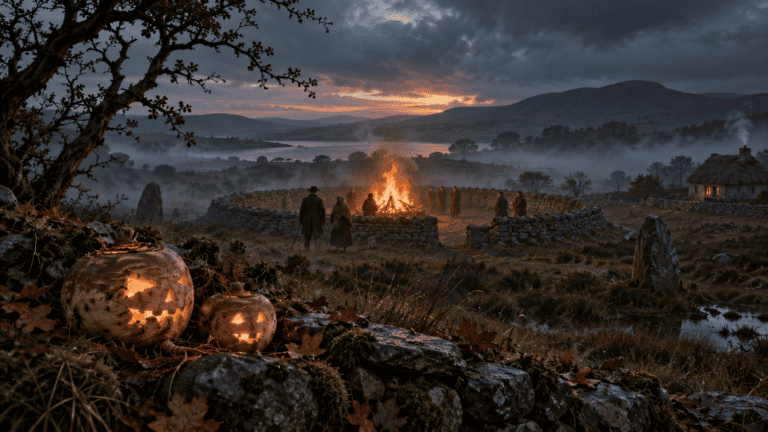
Lughnasadh is one of the four great seasonal festivals of the Gaelic year, alongside Samhain, Imbolc, and Bealtaine. It marked the beginning of harvest and of autumn. It was a time for harvest fairs, games, courting, and gatherings on hills and lakeshores.
The Name and Its Meaning
The festival is named after Lugh, a god praised as samildánach, meaning he was highly skilled in many arts at once. In Modern Irish the name is spelled Lúnasa, and the same word is the ordinary Irish name for the month of August. The day itself is often called Lá Lughnasa.
The Lebor Gabála Érenn, or Book of the Taking of Ireland, an origin legend of the Irish people that survives in many versions in poetry and prose, explains the name directly. In R. A. S. Macalister’s 1941 translation, the festival is “Lughnasadh, that is, the celebration (?) or the festival of Lugh.” The question mark is the translator’s own.
When Is Lughnasadh?
The traditional date is August 1, which was also the day of the harvest fair. In practice, the National Museum of Ireland notes that the festival was celebrated on either the last Sunday in July or the first Sunday in August.
Lugh, Tailtiu, and the Funeral Games
The heart of the Lughnasadh story lies in the Mythological Cycle, the stories of the settling of Ireland and the adventures of its gods. Two texts tell how the festival began, and they agree on the main points while differing on the details.
Tailtiu, Queen of the Fir Bolg
According to the Lebor Gabála Érenn, Tailtiu was the daughter of Mag Mór, king of Spain, and queen of the Fir Bolg. Her husband, Eochu son of Erc, was king of Ireland until the Tuatha Dé Danann killed him. She then cleared the forest of Coill Cuan until it was “a plain under clover-flower before the end of a year.”
The same text says Cian son of Dian Cecht gave her his son in fosterage. That child was Lugh, whose mother was Eithne, daughter of Balar. When Tailtiu died, the place took her name, and the text says “Her games were performed every year and her song of lamentation, by Lugh.” They were held with feats of arms “a fortnight before Lugnasad and a fortnight after.”
The Dying Queen in Verse
The Metrical Dindshenchas, in the edition and translation by Edward Gwynn, tells the story more dramatically. Here Tailtiu is the “daughter of gentle Magmor,” and her husband is named Eochu Garb. Her heart, the poem says, “burst in her body from the strain beneath her royal vest.”
The poem fixes her death to the festival itself: “About the Calends of August she died, on a Monday, on the Lugnasad of Lug.” Not every source agrees on what the day honored, though. One reference work instead describes it as the feast of a god’s marriage, so the funeral story is best read as one old explanation among others.
The Fair at Teltown
Tailtiu’s grave gave its name to Teltown, at Donaghpatrick near Navan in County Meath. The fair of Tailtiu, later known as the Tailteann games, was the chief Lughnasadh gathering of early Ireland, and the Dindshenchas poem paints it in rich color.
Gold, Chariots, and a Sacred Truce
The poem describes “A fair with gold, with silver, with games, with music of chariots,” and with “adornment of body and of soul by means of knowledge and eloquence.” Strict rules kept the peace. No man was to enter the seats of the women, nor any woman the seats of the men, and an unbroken truce of the fair held “through Erin and Alba alike” while it lasted.
The poem says the fair was kept by the Fir Bolg, the Tuatha Dé Danann, and the Children of Míl down to the time of Saint Patrick. How long it lasted is unclear: The Lebor Gabála speaks of two weeks on either side of the feast, while a modern local heritage account describes the games as lasting three days.
Lughnasadh Among the Four Quarter Days
An early Irish tale preserves one of the clearest descriptions of the old festival year. In Tochmarc Emire, or The Wooing of Emer, a story of the hero Cú Chulainn translated by the scholar Kuno Meyer for the Archaeological Review in 1888, Cú Chulainn explains the coded words he and Emer exchanged, and the explanation names four turning points of the year.
For the harvest feast, the tale uses a different name, Brón Trogaill, glossed as “Lammas-day, viz., the beginning of autumn; for it is then the earth is afflicted, viz., the earth under fruit.” The same passage explains that the year once had two halves, “summer from Beltaine (the first of May), and winter from Samuin to Beltaine.”
| Name in the Tale | Modern Name | How the Tale Explains It |
|---|---|---|
| Samuin | Samhain | The end of summer |
| Oimolc | Imbolc | The beginning of spring, when sheep come out and are milked |
| Beltaine | Bealtaine | A favoring fire, when druids drove cattle between two fires |
| Brón Trogaill | Lughnasadh | Lammas Day, the beginning of autumn |
Set side by side, the four names trace the farming year. Where Imbolc greeted the season when sheep were milked, Brón Trogaill greeted the earth under fruit.
How Lughnasadh Was Celebrated in Folk Tradition
Much of what is known about Lughnasadh in living memory comes from one great study. Máire MacNeill, a folklore scholar, joined the newly formed Irish Folklore Commission, which gathered accounts from collectors across the country, in 1935. In 1962 she published The Festival of Lughnasa, subtitled a study of the survival of the Celtic festival of the beginning of the harvest.
Her work rested on a 1942 questionnaire titled “Domhnach Crom Dubh or Garland Sunday,” which drew 1,073 pages of replies. They are now bound in four volumes in the National Folklore Collection, the archive that also holds MacNeill’s own papers. She examined 195 sites linked to Lughnasa gatherings and identified more than 80 local names for the festival.
Hilltops, Lakes, and Holy Wells
Above all, people went up. Communities made group visits to mountain and hill tops, or to the shores of lakes and rivers. The National Museum of Ireland records the same pattern, with gatherings on mountains or at lakes, and notes that the day was also a traditional time for harvest fairs.
In south Sligo, people traditionally climbed Keashcorran, a holy hill topped by Neolithic monuments, on Garland Sunday. Garland Sunday is also still kept at Tobernalt Holy Well, just outside Sligo town, where the day begins with an early morning Mass. The season also brought an annual pilgrimage to the summit of Mount Brandon.
Bilberry Sunday and the Fraughans
Bilberries were the fruit of the festival. In Irish they are fraochán or fraochóg, names that come from the word for heather, since the plant often grows among it. Boys strung the berries on straw, rushes, or thread to make bracelets and necklaces for their sweethearts.
Courting ran through the day. Young women baked bilberry cakes and presented them to the young men they loved, and berries were carried home for anyone too young, too old, or unable to make the climb. Lughnasa was remembered as the first day to eat new potatoes and the last day to eat fraughans.
New Potatoes and the End of Hungry July
The timing mattered. July was a month marked by scarcity of food before the harvest came in. The festival marked the end of that hungry season with the first official meal of new potatoes, served with meat.
Harvest Knots and the Last Sheaf
As the harvest went on, the whole family and community helped with reaping. The National Museum of Ireland explains that the cutting of the last sheaf, often called the cailleach, was accompanied by a special ceremony. The sheaf was often decorated and hung above the table at the harvest meal, and in some areas men and women made straw “harvest knots” to exchange as love tokens.
Crom Dubh and the Struggle for the Harvest
Behind the cheerful customs lies a darker figure. In some parts of Ireland, the festival Sunday was known as Domhnach Chrom Dubh, or Crom Dubh’s Sunday. Crom Dubh, the Dark Stooped One, appears in folklore as an old tyrannical god with evil powers.
One folk belief holds that Lugh fought and defeated the older god Crom Dubh to take back the harvest. Accounts of Crom Dubh vary widely. They differ over whether he was a pagan wizard or an evil sorcerer beaten by Lugh, and even over whether his name meant a lord of the harvest or a bringer of famine.
Saint Patrick and the Bull at Maam Éan
In Connemara, the story took a Christian turn. At Maam Éan, the only pass through the Maam Turk mountains, the pagan god Crom Dubh was said to guard the way. When Saint Patrick approached, Crom Dubh took the form of a bull and charged.
The two wrestled across the mountainside until Patrick drove the bull into a lake. In one version it drowned, and in another it repented and knelt before the saint. A pattern, or local pilgrimage day, was held at the pass on Garland Sunday until the end of the nineteenth century.
Fairies and the Spoiled Berries
The supernatural also set a deadline. Tradition held that bilberries were not to be picked after the first Sunday in August, because the fairies and Crom Dubh were said to have spat on them, much as they spoiled blackberries at Halloween. The fruit of the festival belonged to its season and no longer.
Reek Sunday on Croagh Patrick
One survival of the Lughnasadh season is Reek Sunday, one of the names the festival Sunday has carried in Ireland. On the last Sunday in July, pilgrims climb Croagh Patrick in County Mayo, a mountain of 764 meters (2,507 feet), where tradition holds that Saint Patrick fasted and prayed for forty days in 441.
Some pilgrims still climb barefoot as penance, and Masses are held at the summit, where a small chapel was dedicated in 1905. One writer on Irish pilgrimage argues the mountain was likely a pagan destination before Patrick’s time, but that remains an interpretation rather than a proven fact.
Puck Fair in Killorglin
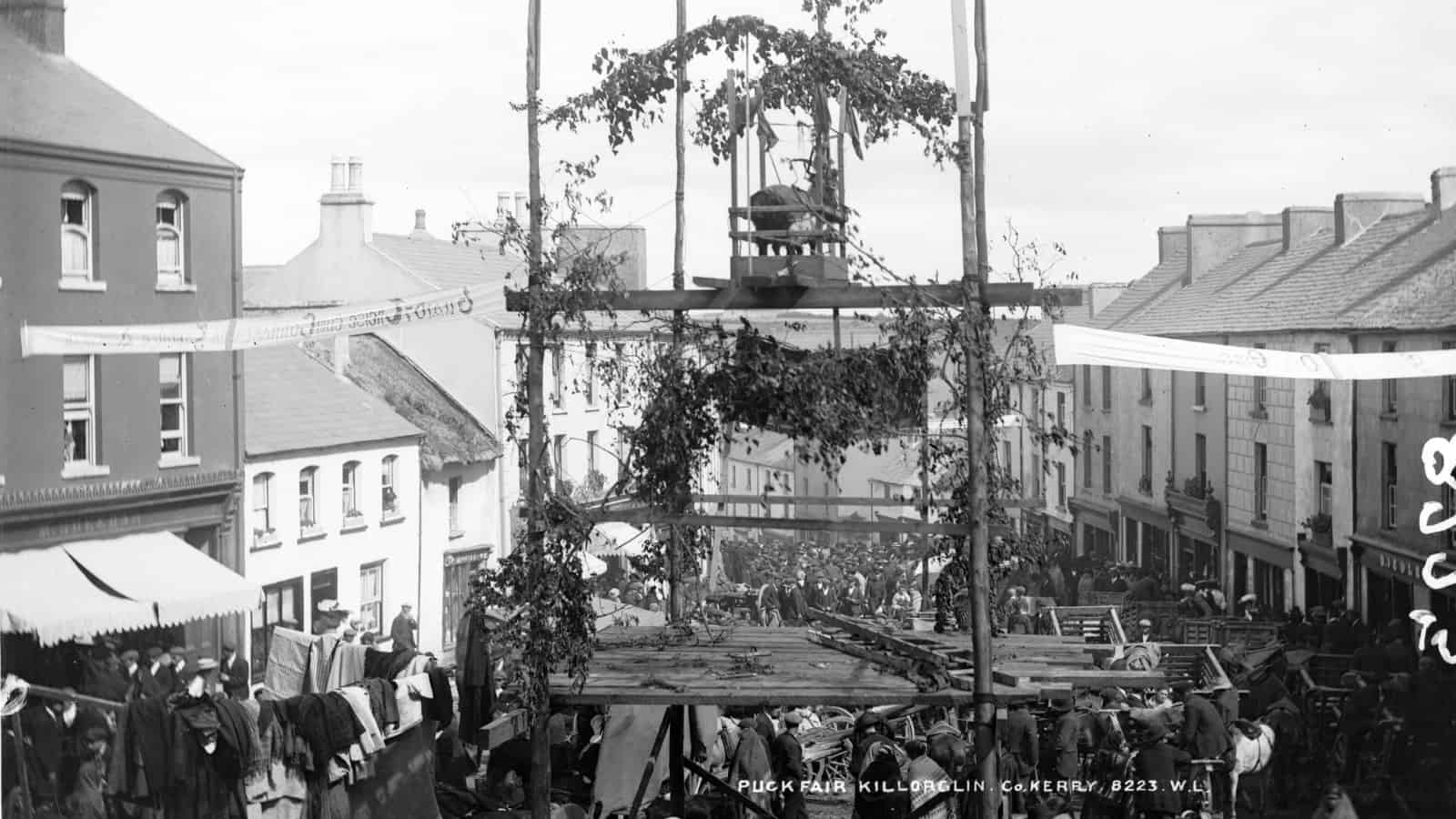
In Killorglin, County Kerry, Puck Fair keeps the harvest fair tradition alive over three days each August. A male goat is crowned King Puck by the Queen of the Puck and hoisted above the town square. In 2025 he was raised for no more than two hours during the opening and closing ceremonies, then returned to a farm by experienced handlers.
The fair’s own history notes a 1613 charter from King James I that granted legal status to an existing fair, and it lists several theories of origin. One links it to pre-Christian celebrations of a fruitful harvest, with the male goat as a pagan symbol of fertility. Puck Fair is sometimes billed as Ireland’s oldest festival, though its own history says its origins are unknown.
Lughnasadh Today
The festival never fully disappeared. One local heritage account records the ancient Tailteann games continuing as late as 1168, while another account ties their end to the Norman invasion of 1171. They were revived in 1924, after the Irish Civil War, to present an independent Ireland to visitors, and were held again in 1928 and abandoned after 1932.
The Catholic Church in Ireland has also set the date aside for blessing farmers’ fields, and local communities have found new ways to keep the day. At Keash in Sligo, Garland Sunday now includes events such as a King of the Hill run alongside music and family fun. Many people still mark Lughnasadh with dancing, song, and bonfires, keeping alive one of the oldest threads in Irish tradition.
Common Questions
Here are short answers to common questions about Lughnasadh. Each answer draws on the sources listed at the end of this article.
How Do You Pronounce Lughnasadh?
It is pronounced Loo-NA-sah. In Modern Irish it is spelled Lúnasa, which is also the Irish word for August.
Is Lughnasadh the Same as Lammas?
They share a date, but the two names have different roots. Lammas, from the Saxon phrase for “loaf mass,” is the Christian harvest feast when bread was blessed in thanks for the harvest. On one view it took the place of the older pre-Christian festival.
The early Irish tale The Wooing of Emer glosses the Irish festival as Lammas Day, the beginning of autumn. The fair at Killorglin was also long held on Lammas Day, August 1.
Who Was Tailtiu?
In medieval Irish tradition, Tailtiu was a Fir Bolg queen and the foster mother of Lugh. She died after clearing a forest, and Lugh held funeral games for her each year at Teltown in County Meath.
What Other Names Does Lughnasadh Have?
Garland Sunday is one of the many folk names for the festival Sunday. Others include Bilberry Sunday, Reek Sunday, Lammas Sunday, Mountain Sunday, Harvest Sunday, and Domhnach Chrom Dubh, and Máire MacNeill identified more than 80 local names in all.
Sources and Further Reading
These are the sources opened and read for this article. They are grouped by publisher, with the primary texts first.
- CELT, University College Cork: Part 33 of The Metrical Dindshenchas (tr. Edward Gwynn) · The Wooing of Emer by Cú Chulainn (tr. Kuno Meyer)
- Celtic Literature Collective: Lebor Gabála Érenn, §55 to 64: The Tuatha Dé Danann (tr. R. A. S. Macalister) · Irish Mythological Cycle
- Royal Irish Academy: Leabhar Gabhála: The Book of the Invasions
- Encyclopaedia Britannica: Lugnasad · Dindshenchas
- National Museum of Ireland: Autumn
- RTÉ Brainstorm: Why the Last Sunday in July Was Celebrated in Ireland of Old · It’s Bilberry Sunday This Weekend but Have You Ever Eaten One? · The Joys of Lúnasa
- UCD Cultural Heritage Collections: History Recorded and History Remembered
- Foclóir.ie: August
- Discover Boyne Valley: Teltown; The Táilteann Games
- Archdiocese of Tuam: Croagh Patrick
- Irish Examiner: Reek Sunday Climb: Why Croagh Patrick Still Draws Pilgrims Despite Ireland’s Secular Shift · Puck Fair 2026: Everything You Need to Know About Ireland’s Oldest Festival
- Puck Fair: History and Origins of Puck Fair
- Radio Kerry: Six Complaints to Department’s Animal Welfare Hotline Over Puck Fair
- Galway Advertiser: The Place Where St Patrick Wrestled With a Bull
Image credit: Puck Fair, Killorglin, Co. Kerry (about 1900), National Library of Ireland on The Commons (NLI ref. L_CAB_08223), public domain in the United States, via Wikimedia Commons.