In Short
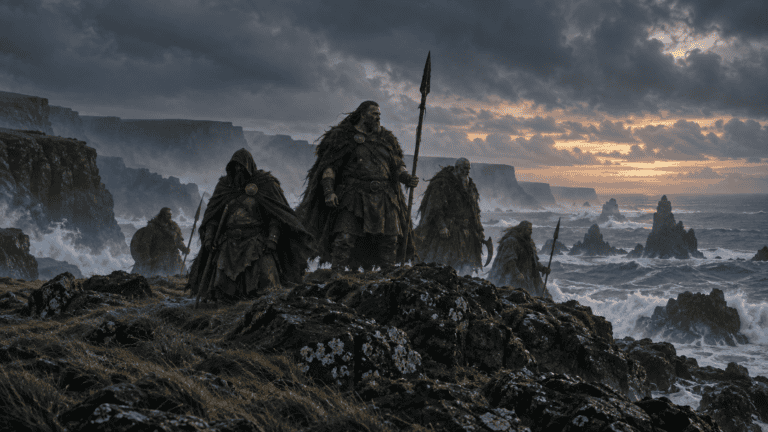
The Fir Bolg (pronounced roughly fir BOL-ug, “men of bags”) are the fourth of the six peoples who, according to medieval Irish legend, settled Ireland. Descended from the survivors of Nemed’s people, they spent generations as slaves in Greece, forced to carry soil in leather bags to make rocky hills fertile, which is how the legend explains their name. They escaped, returned to Ireland, divided it into five provinces, and set up its first kingship. They ruled until the Tuatha Dé Danann arrived and defeated them at the First Battle of Mag Tuired, after which, in one account, they were given the province of Connacht.
| Name | Fir Bolg, also Firbolg; “men of bags,” according to the legend |
|---|---|
| Pronunciation | Roughly fir BOL-ug |
| Place in the legend | The fourth of the six takings of Ireland |
| Ancestors | Survivors of the people of Nemed |
| Exile | Enslaved in Greece |
| Kindred groups | The Fir Domnann and the Gailióin |
| Achievements | The five provinces and the first kingship |
| Last king | Eochaid mac Eirc |
| Defeated by | The Tuatha Dé Danann, at the First Battle of Mag Tuired |
| Main sources | Lebor Gabála Érenn; Cath Maige Tuired Cunga |
Who Were the Fir Bolg?
In the Lebor Gabála Érenn, the Book of Invasions, Ireland is settled six times by six different peoples. The first three end in disaster: Cessair’s people drown in the Flood, Partholón’s die of plague, and Nemed’s are crushed by the Fomorians. The Fir Bolg come fourth. They are the first to give Ireland the shape it still has, dividing it into provinces and setting up a king, and they rule until the gods arrive to take the land from them.
They are also among the most sympathetic of the legendary peoples: former slaves who escaped their masters, came home, built a kingdom, and fought bravely to keep it.
Slaves in Greece
The story of the Fir Bolg begins with the fall of Nemed’s people. After the storming of the Fomorian tower on Tory Island, only one boatload of Nemed’s people survived, and they scattered. One group went into the north of the world, and their descendants became the Tuatha Dé Danann. Another went to Greece.
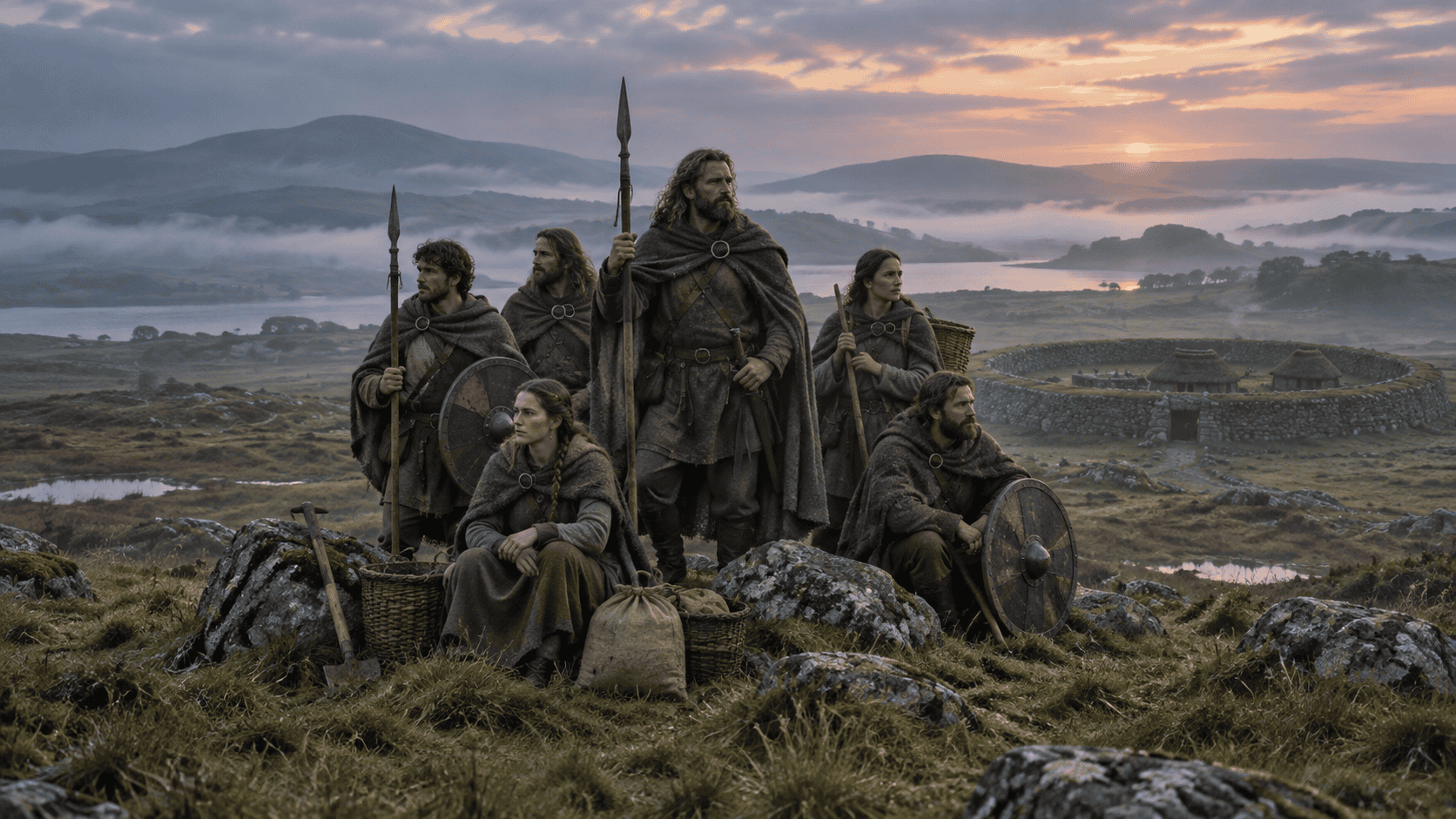
In Greece, the descendants of Nemed were enslaved. According to the legend, the Greeks set them to work digging earth and carrying it up to bare, rocky hillsides in leather bags, to turn the rock into fertile fields. From those bags, the Lebor Gabála explains, came their name: the Fir Bolg, “the men of bags.” The seventeenth-century historian Geoffrey Keating added that the related Fir Domnann were named for the pits they dug, and the Gailióin for the spears they carried while guarding the others at their work.
After about two hundred and thirty years, they escaped. The Lebor Gabála says they left Greece at the same time as the Israelites fled from Egypt, a detail typical of the medieval writers’ efforts to fit Irish legend into the history of the Bible. In one version, they made boats from the very bags they had been forced to carry, and sailed home to Ireland.
The Five Provinces
Back in Ireland, the Fir Bolg divided the country among five brothers, the sons of Dela. Gann took North Munster, Sengann took South Munster, Genann took Connacht, Rudraige took Ulster, and Sláine took Leinster. The medieval historians credited the Fir Bolg with the division of Ireland into provinces, which is still reflected in the Irish word for province, cúige, meaning “a fifth.”
They were also said to have established the first kingship over all Ireland. Their last and greatest king was Eochaid mac Eirc, whose reign was remembered as a golden age. According to the legend, no rain fell during his reign, only dew, and yet no year passed without a harvest. Falsehood was banished from Ireland, and he was the first to establish justice there. In early Irish thought, a just king brought fertile land and good weather, and a bad one brought famine, so these details were the highest praise the storytellers could give.
The First Battle of Mag Tuired
The Fir Bolg’s rule ended when the Tuatha Dé Danann arrived. Their story is told in Cath Maige Tuired Cunga, “The First Battle of Mag Tuired,” a Middle Irish text that sets the battle on a plain near Cong, in County Mayo.
Before the battle, the two peoples sent champions to meet. The Fir Bolg sent Sreng, a huge warrior, and the Tuatha Dé sent Bres. They examined each other’s weapons with great curiosity: the Fir Bolg carried heavy, blunt spears, and the Tuatha Dé light, sharp ones. The Tuatha Dé offered to share the island, but the Fir Bolg refused, and the two sides fought for four days.
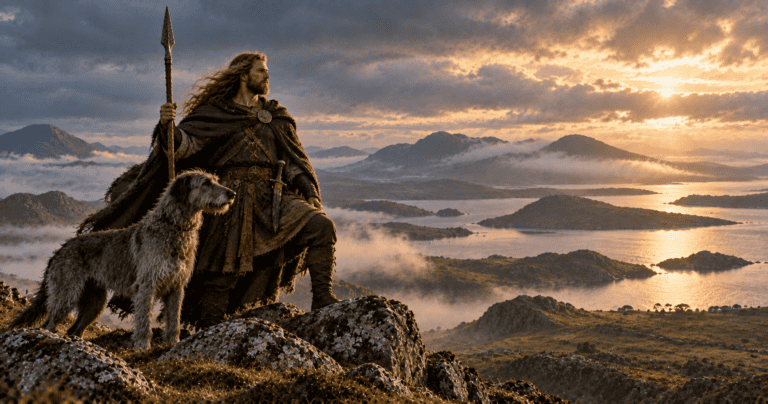
The battle was savage. Sreng struck off the arm of Nuada, king of the Tuatha Dé, with a single blow, a wound that would later cost Nuada his throne. But Eochaid mac Eirc was killed, and the Fir Bolg were defeated. In the version of the Cath Maige Tuired Cunga, the Tuatha Dé, admiring the Fir Bolg’s courage, offered them a province of their own, and Sreng chose Connacht. Other versions say the survivors fled to the islands off the coast.
The Fir Bolg and Dún Aonghasa
One of the most dramatic ancient sites in Ireland is linked with the Fir Bolg. Dún Aonghasa, a great semicircular stone fort on the edge of a sheer cliff on Inis Mór, the largest of the Aran Islands, is traditionally named after Aonghus mac Úmhóir, a leader of the Fir Bolg. According to the seventeenth-century scholar Dubhaltach Mac Fhirbhisigh, Aonghus led his people, driven from their lands by war, to the shores of Galway Bay and the Aran Islands.
The fort itself is far older than the medieval legend, and archaeologists have dated its first phase to the late Bronze Age. But the tradition gives it a fitting story: a last stronghold of a defeated people, looking out over the Atlantic.
Tailtiu, Queen of the Fir Bolg
The Fir Bolg also connect to one of the most famous festivals of Ireland. Tailtiu, a queen of the Fir Bolg, was the foster-mother of the god Lugh. She cleared a great plain in County Meath for farming, and the effort killed her. Lugh held funeral games in her memory at the place named after her, Teltown, and this was said to be the origin of the harvest festival of Lughnasa.
Who Were the Fir Bolg Really?
Most modern scholars see the Lebor Gabála as a learned medieval creation, not a record of real events, and the Fir Bolg as legendary rather than historical. But their name has attracted many theories. The “bags” explanation is almost certainly a later invention to explain an older name. Some scholars, notably T. F. O’Rahilly, connected the Fir Bolg with the Belgae, a people of ancient Gaul and Britain, or with a god called Bolg. Others have linked the word bolg with a meaning like “belly” or “bulge,” perhaps referring to a type of weapon or shield. None of these ideas is proven.
Later writers used the Fir Bolg in less flattering ways. In 1650, Dubhaltach Mac Fhirbhisigh wrote in his great book of genealogies that everyone who was black-haired, a tattler, guileful, noisy, and inhospitable was descended from the Fir Bolg. In the nineteenth century, some antiquarians tried to identify them as a real ancient race of small, dark people. These ideas say more about the prejudices of their writers than about ancient Ireland, and they are rejected today.
The Fir Bolg in Popular Culture
The Fir Bolg have lent their name to the firbolg, a race of gentle, forest-dwelling giants in the Dungeons and Dragons role-playing game, and they appear in fantasy novels and games based on Irish myth. In retellings of the Mythological Cycle, they are often shown as a proud, earthy people, the last mortal rulers of Ireland before the gods.
Were the Fir Bolg Giants?
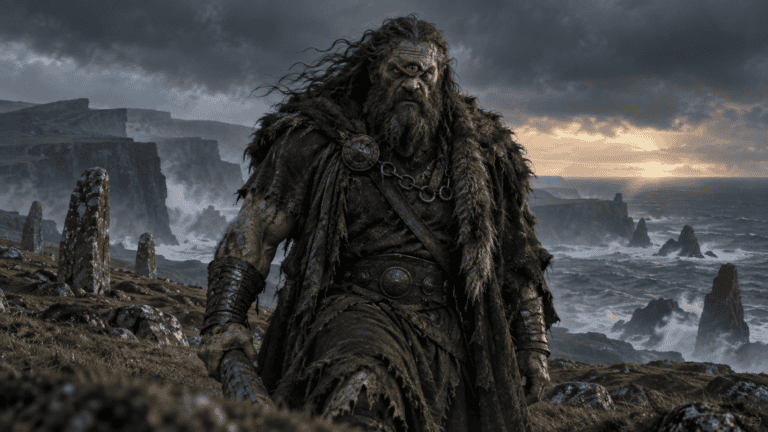
Not in the medieval sources, where they are ordinary, if formidable, people. Their champion Sreng is described as huge and fearsome, but the idea of the Fir Bolg as a race of giants comes mostly from modern fantasy, especially role-playing games.
Sources and Further Reading
- R. A. S. Macalister, ed. and trans., Lebor Gabála Érenn: The Book of the Taking of Ireland, Irish Texts Society (1938 to 1956).
- J. Fraser, ed. and trans., “The First Battle of Moytura,” Ériu 8 (1916).
- Geoffrey Keating, Foras Feasa ar Éirinn: The History of Ireland, ed. and trans. David Comyn and Patrick S. Dinneen, Irish Texts Society (1902 to 1914).
- T. F. O’Rahilly, Early Irish History and Mythology, Dublin Institute for Advanced Studies (1946).
- Nollaig Ó Muraíle, ed. and trans., Leabhar Mór na nGenealach: The Great Book of Irish Genealogies, De Búrca (2003 to 2004).