In Short
The Children of Lir (pronounced LEER) is an Irish legend about four children of the Tuatha Dé Danann, Fionnuala and her brothers Aodh, Fiachra, and Conn, who are turned into swans by their jealous stepmother, Aoife. They keep their human voices and minds, and must spend nine hundred years on the waters of Ireland: three hundred on Lough Derravaragh, three hundred on the stormy Sea of Moyle, and three hundred off the coast of Mayo. They are finally freed when the bell of a Christian monk rings, but they return to human form as withered old people and die soon after. The tale, known in Irish as Oidheadh Chlainne Lir, is one of the “Three Sorrows of Storytelling.”
| Irish title | Oidheadh Chlainne Lir, “The Tragic Fate of the Children of Lir” |
|---|---|
| Pronunciation | Lir: LEER. Fionnuala: fin-NOO-luh |
| The children | Fionnuala, Aodh, and the twins Fiachra and Conn |
| Their parents | Lir of the Tuatha Dé Danann, and Aobh |
| The stepmother | Aoife, Aobh’s sister |
| The curse | 900 years as swans, keeping their human speech |
| The three places | Lough Derravaragh, the Sea of Moyle, and Erris and Inishglora in Mayo |
| The ending | A monk’s bell, baptism, old age, and death |
| Date | A late medieval tale, probably fourteenth or fifteenth century |
| Group | One of the “Three Sorrows of Storytelling” |
The Story of the Children of Lir
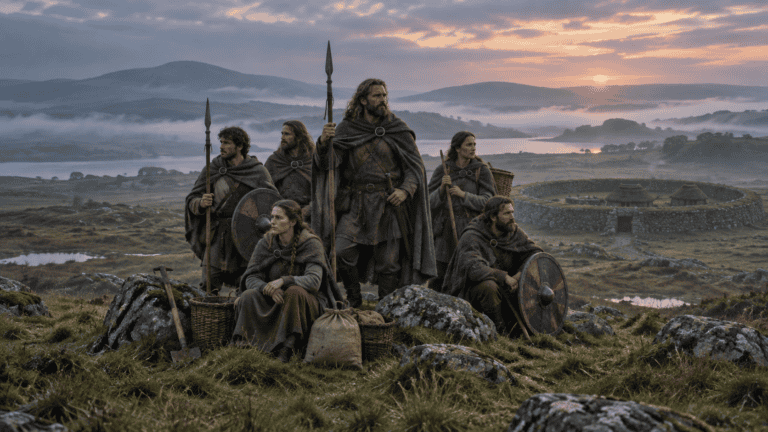
The story begins at a time of change. The Tuatha Dé Danann have lost Ireland to the Milesians and withdrawn into the hills and mounds, and they need a new king. They choose Bodb Derg. Lir, who had hoped to be chosen himself, storms off in anger. To make peace, Bodb Derg offers him a wife from his own household, a young woman named Aobh.
Lir and Aobh are happy, and they have four children: a daughter, Fionnuala, a son, Aodh, and twin boys, Fiachra and Conn. But Aobh dies, and Lir is heartbroken. Again Bodb Derg offers help, and Lir marries Aobh’s sister, Aoife. At first, Aoife loves the children too. But Lir adores them, and so does everyone who meets them, and slowly her love turns to jealousy.
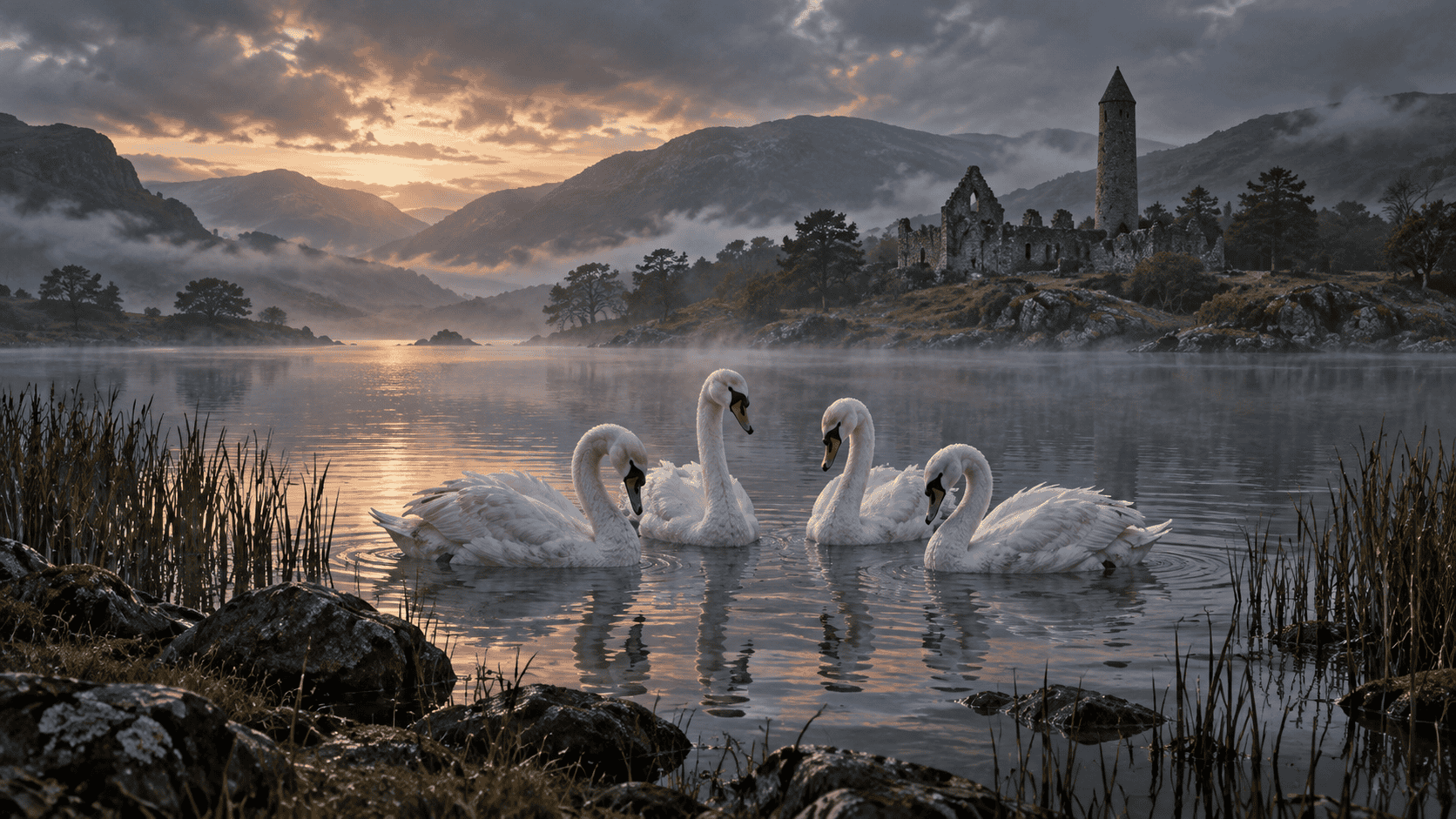
One day, Aoife sets out with the children in her chariot, as if to visit Bodb Derg. At the shore of Lough Derravaragh, in what is now County Westmeath, she orders her servants to kill them. They refuse. She cannot bring herself to do it either. Instead, she drives the children into the water, and with a druid’s wand she turns them into four white swans.
Fionnuala, still able to speak, begs to know how long the curse will last. Aoife’s answer is terrible. They will spend three hundred years on Lough Derravaragh, three hundred years on the Sea of Moyle, and three hundred years on the western sea off Erris and the island of Inishglora in Mayo. They will be free only when a woman from the south marries a man from the north. Aoife lets them keep their human speech, their minds, and the gift of singing music so beautiful that it will comfort anyone who hears it.
Aoife’s Punishment
When Bodb Derg learns what Aoife has done, he asks her what shape she most hates. She tells him: a demon of the air. He strikes her with his wand, and she becomes one, doomed to wander the winds forever. The story says she is a demon of the air still.
Nine Hundred Years on the Water
The first three hundred years are the gentlest. On Lough Derravaragh, the swans are near their father, and Lir and the Tuatha Dé come to the shore to talk with them and listen to their songs. People travel from all over Ireland to hear them.
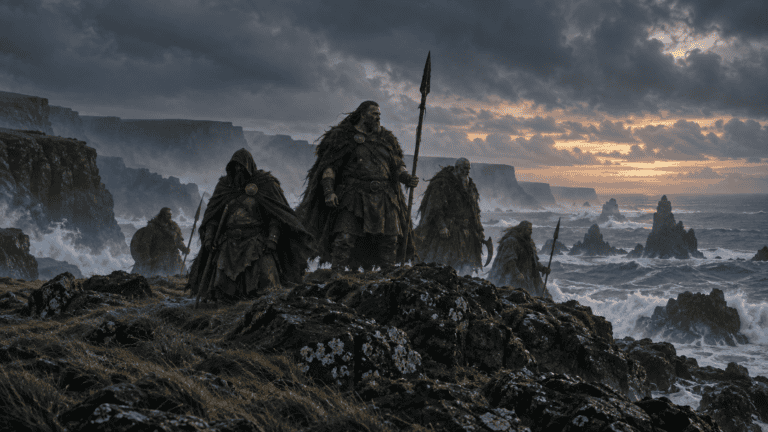
Then they must leave for the Sea of Moyle, the narrow, storm-swept strait between the north coast of Ireland and Scotland. Here the story turns bleak. The swans are battered by gales, frozen by winter ice, and scattered in storms. Fionnuala shelters her brothers under her wings, Conn under her right wing, Fiachra under her left, and Aodh under the feathers of her breast.
After three hundred years on the Moyle, they fly to the western sea, off Erris in County Mayo, for their last three hundred years. It is just as cold and just as lonely. And somewhere during these long centuries, without the swans knowing it, Christianity has come to Ireland.
The Bell
At last, on the island of Inishglora, the swans hear a sound they have never heard before: the bell of a Christian hermit, a holy man named Mo Chaomhóg. They go to him, tell him their story, and he takes them in. He links them together with silver chains, and they live with him and join in his prayers.
Now the old prophecy comes true. Deoch, a princess from Munster in the south, has married a northern king named Lairgnéan. She hears of the wonderful singing swans and demands them. Lairgnéan goes to the hermit’s cell and seizes them. As soon as he does, the swans’ feathers fall away, and in their place stand four people bent with age, withered and white-haired, nine hundred years old.
Fionnuala asks Mo Chaomhóg to baptize them before they die, and to bury them together: Conn at her right side, Fiachra at her left, and Aodh in front of her face, just as she held them under her wings through all those years. He baptizes them, they die, and he buries them as she asked.
Where the Story Comes From
For all its ancient setting, the Children of Lir is a relatively late tale. It survives as Oidheadh Chlainne Lir, “The Tragic Fate of the Children of Lir,” in manuscripts from the late Middle Ages onward, and it was probably composed in the fourteenth or fifteenth century. The scholar Robin Flower suggested that it may have been written by someone in the circle of the Mac Fhirbhisigh family, the great hereditary historians of north-west Connacht.
From the eighteenth century onward, it was grouped with two other tragic tales, Oidheadh Chlainne Tuireann, “The Fate of the Children of Tuireann,” and Oidheadh Chlainne Uisnigh, “The Fate of the Children of Uisneach,” the story of Deirdre. Together they became known as the “Three Sorrows of Storytelling.”
The title contains a small linguistic slip that has stuck. In Irish, Lir is the possessive form of the name Ler, so the title properly means “the children of Ler.” But “the Children of Lir” is now so familiar that almost nobody uses anything else.
A Pagan Story with a Christian Ending
The tale is set among the gods of pagan Ireland, and it is full of magic wands, druidry, and shapeshifting. But it was written by Christians, and its ending is deeply Christian. The swans’ suffering ends not through any magic of the Tuatha Dé, but through the sound of a church bell and the sacrament of baptism. The scholar Caoimhín Breatnach has studied the tale’s religious meaning closely, and many readers see it as a story about the old world giving way to the new, with the children as a bridge between them: born to the pagan gods, but dying as Christians.
It is also a story about envy. Aoife’s jealousy is the root of all the suffering, and her punishment, to become a howling spirit of the air forever, is one of the harshest in Irish legend.
The Places in the Story
All three places in the curse are real and can still be visited.
- Lough Derravaragh, County Westmeath. The lake where the children were turned into swans lies a few miles from the village of Castlepollard, where a statue of the children stands on the green.
- The Sea of Moyle. The North Channel between County Antrim and the Mull of Kintyre in Scotland, one of the narrowest and roughest stretches of sea around Ireland.
- Erris and Inishglora, County Mayo. Inishglora is a small uninhabited island off the Mullet Peninsula. Local tradition connects it with the hermit Mo Chaomhóg, and says the children were buried there.
The Children of Lir in Popular Culture
The Children of Lir is one of the best-loved stories in Ireland, taught in schools and retold in countless books for children. In Dublin’s Garden of Remembrance, opened in 1966 to honor those who died for Irish freedom, a large bronze sculpture of the story by Oisín Kelly shows the children in the moment of their transformation, and it has become a symbol of rebirth. The poet Thomas Moore wrote “The Song of Fionnuala,” which begins “Silent, O Moyle, be the roar of thy water,” for his Irish Melodies. The story has also inspired music, from folk songs to a 1974 album by the Irish band Loudest Whisper, which is now one of the most sought-after rare records in Ireland.
Is the Children of Lir a True Story?
No. It is a legend, and a literary one, composed by a medieval writer rather than handed down from ancient times. Lir and his family belong to the Tuatha Dé Danann, the divine race of Irish mythology, and the nine hundred years, the talking swans, and the demon of the air are all the stuff of legend. What is real is the landscape, the lakes and seas the story names, and the long Irish tradition of telling it.
Sources and Further Reading
- Eugene O’Curry, ed. and trans., “The Fate of the Children of Lir,” The Atlantis 4 (1863).
- Richard J. O’Duffy, ed. and trans., Oidhe Chloinne Lir: The Fate of the Children of Lir, Society for the Preservation of the Irish Language (1883).
- Caoimhín Breatnach, “The Religious Significance of Oidheadh Chloinne Lir,” Ériu 50 (1999).
- James MacKillop, A Dictionary of Celtic Mythology, Oxford University Press (2004).
- Lady Augusta Gregory, Gods and Fighting Men, John Murray (1904).