In Short
The Dagda (usually pronounced DAHG-duh in English) is the great father god of Irish mythology and a leader of the Tuatha Dé Danann. His name means “the good god,” in the sense of good at everything: he is a warrior, a druid, a king, and a master of every craft. He owns a cauldron that never runs empty, a club that kills with one end and restores life with the other, and a harp that can make people weep, laugh, or sleep. He is also one of the most human of the old gods, a huge, greedy, comic figure who eats a pit full of porridge for a bet, as well as a wise and powerful father whose children include Óengus and Brigid.
| Name | In Dagda, “the good god”; modern Irish An Daghda |
|---|---|
| Other names | Eochaid Ollathair, “Eochaid the All-Father”; Ruad Rofhessa, “Red One of Great Knowledge” |
| People | The Tuatha Dé Danann |
| Treasures | A cauldron, a club or staff, and a harp |
| Home | Brú na Bóinne, the passage tomb of Newgrange |
| Partners | The Morrígan; Boann, goddess of the River Boyne |
| Children | Óengus, Brigid, Cermait, Aed, and others |
| Main source | Cath Maige Tuired, “The Second Battle of Mag Tuired” |
| Compared with | The Gaulish god Sucellus; Odin, the Norse “All-Father” |
Who Is the Dagda?
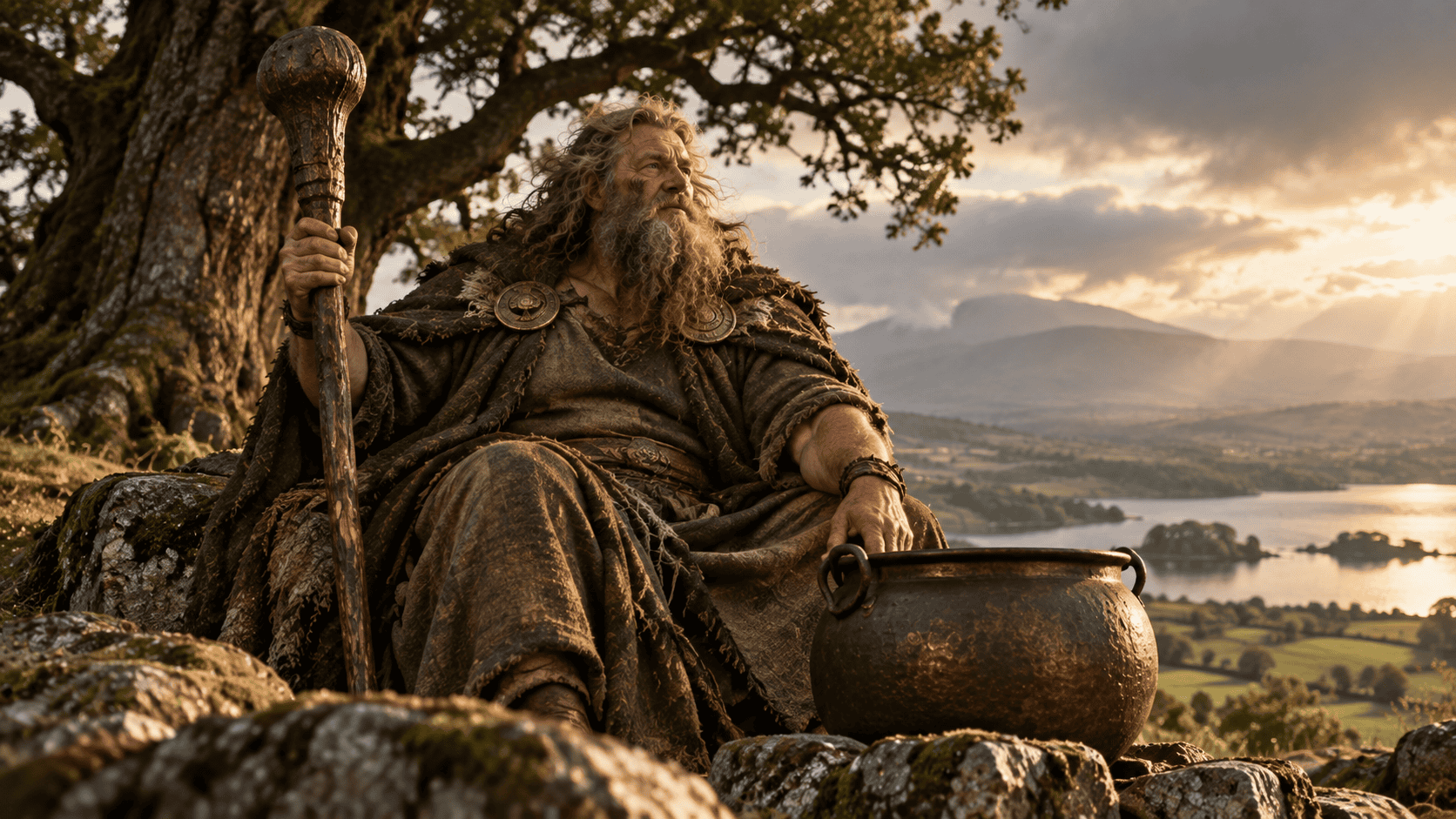
Picture a giant of a man in a tunic too short to cover his backside, dragging a club so heavy that it leaves a trench in the ground behind him deep enough to mark the boundary between two provinces. He is eating porridge from a hole in the ground with a ladle big enough for two people to lie in. And he is the father of the gods.
That is the Dagda as he appears in the medieval Irish tale Cath Maige Tuired. He is the chief of the old gods of Ireland, a master of magic, war, craft, and music, the owner of wonderful treasures, and the father of some of the most important Irish deities. He is also, in the same stories, a figure of broad comedy: greedy, crude, and constantly getting into undignified scrapes. Both sides belong to him. He is a god of plenty, and plenty, in the old stories, includes appetite and laughter.
Why Is He Called “the Good God”?
The name Dagda is usually traced back to an ancient Celtic form meaning “good god.” But “good” here does not mean kind or virtuous. It means good at things: skilled, capable, excellent in every art.
Cath Maige Tuired tells how he earned the name. Before the great battle against the Fomorians, the leaders of the Tuatha Dé Danann each announced what they would contribute: the smith would forge weapons, the physician would heal the wounded, the sorcerer would work spells. When it was the Dagda’s turn, he declared that he would do all of those things himself. “It is you who are the good god,” they told him, and the name stuck.
He had other names too. He was called Eochaid Ollathair, “Eochaid the All-Father,” and Ruad Rofhessa, “the Red One of Great Knowledge.” Those titles show how the medieval Irish saw him: as a father of gods and people, and as a figure of deep wisdom.
The Dagda’s Three Treasures
The Dagda is closely linked to three magical objects, each of which says something about his power.
The Cauldron
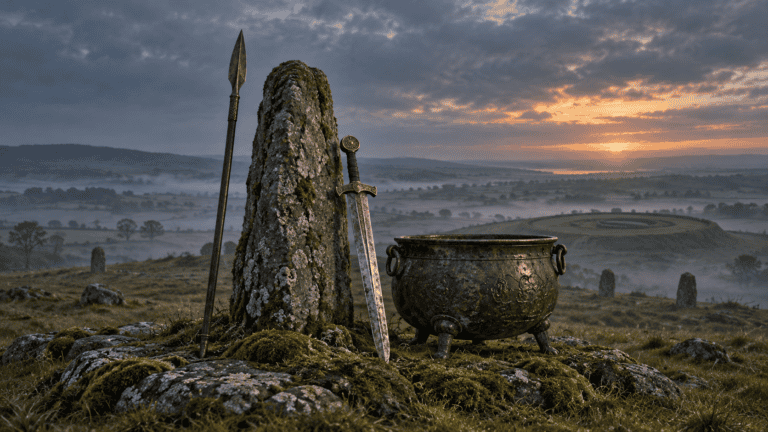
The Dagda’s cauldron was one of the Four Treasures that the Tuatha Dé Danann brought to Ireland from the mythical northern cities where they had learned their arts. According to the texts, no company ever went away from it unsatisfied. It is the Dagda’s role as a god of abundance in a single image: a pot that never empties, feeding everyone who comes.
The Club
The Dagda carried a great club or staff, the lorg mór. One end killed, and the other brought the dead back to life. In one story, when his son Cermait was killed, the Dagda restored him to life with the smooth end of the staff. The club makes him a god of both death and life, able to take away and to give back.
The Harp
The Dagda’s harp could play three kinds of music, the three strains by which, in early Ireland, a master harper was known: sorrowful music, joyful music, and sleep music. The harp had two names, “Oak of Two Blossoms” and “Four-Angled Music,” and it would play only when he called it by them. Many modern books say the harp itself was called Uaithne, but in Cath Maige Tuired, Uaithne is the name of the Dagda’s harper.
The harp has its own story. After the battle, the Fomorians carried it off and hung it on the wall of their hall. The Dagda, Lugh, and Ogma followed them. The Dagda called the harp by its names, and it leapt from the wall, killing nine men as it flew to him. Then he played. He played sorrowful music, and the Fomorian women wept. He played joyful music, and the women and boys laughed. He played sleep music, and the whole host fell asleep, and the three gods walked out unharmed.
The Dagda and the Porridge
The most famous Dagda story is also the funniest. Before the Second Battle of Mag Tuired, the Dagda went to the Fomorian camp to ask for a truce. The Fomorians decided to mock him. They knew how much he loved porridge, so they made him a porridge: eighty gallons of new milk with meal and fat, and whole goats, sheep, and pigs boiled into it, and they poured it into a great hole in the ground. He had to eat it all, they told him, or they would kill him, so that he could never say he had been refused hospitality.
The Dagda took up a ladle so big that a man and a woman could have lain in it together, and he ate the whole pit. At the end, he scraped out the gravel at the bottom with his finger. Then, his belly swollen as large as a cauldron, he staggered off and fell asleep, while the Fomorians laughed at him.
The story is comic, but it makes a serious point. Refusing hospitality, or failing to accept it, was a grave matter in early Ireland. The Fomorians set a trap they thought he could not escape, and the god of abundance escaped it by being abundant.
The Dagda and the Morrígan
Also before the battle, at Samhain, the Dagda had a meeting with the war goddess the Morrígan. He found her washing herself at the river Unshin in Connacht, standing with one foot on each bank. They lay together, and the place was afterward known as the Bed of the Couple. In return, she promised to help the Tuatha Dé in the coming battle, and told the Dagda where the Fomorians would land. The meeting of the father god and the goddess of war, at the turning of the year on Samhain, is one of the great moments of Irish mythology.
Serving Under Bres
Before the war with the Fomorians, the Tuatha Dé suffered under the rule of Bres, a king who was half Fomorian and a miser. Even the Dagda was reduced to labor, forced to build a fort for Bres, and a greedy satirist named Cridenbél demanded the three best pieces of the Dagda’s food every night, so that the god grew thin. His son Óengus advised him to hide three gold coins in the pieces. Cridenbél swallowed them and died. When Bres accused the Dagda of poisoning him, the Dagda had the satirist’s body opened, and the gold was found. The story shows the Dagda as cunning as well as strong.
The Dagda and Boann: The Birth of Óengus
The Dagda fell in love with Boann, the goddess of the River Boyne, who was married to another. To hide their affair, the Dagda sent her husband on a journey and made the sun stand still in the sky for nine months, so that the whole time seemed like a single day. Óengus, the young god of love, was conceived and born within that one “day,” and nobody was the wiser. Óengus, also called the Mac Óg, “the young son,” became one of the best-loved of the Irish gods.
Brú na Bóinne
The Dagda’s great home was Brú na Bóinne, the ancient passage tomb now known as Newgrange, in the valley of the Boyne. When the Tuatha Dé were defeated by the sons of Míl and withdrew into the hills, it was the Dagda, as their king, who shared out the fairy mounds, the síd, among them. But he forgot to give one to Óengus.
Óengus asked his father if he could live in the Brú for a day and a night. The Dagda agreed. When the time was up, Óengus refused to leave, saying that all time is made up of days and nights, so the Brú was his forever. In another version, the same trick is played not on the Dagda but on Boann’s husband, Elcmar. Either way, Newgrange became the home of Óengus. The story is a fine example of how the old gods became the fairy people of later folklore, living in the ancient mounds of the Irish countryside and in the Otherworld beneath them.
The Dagda’s Children
The Dagda is the father of many of the Irish gods. The best known are Óengus, the god of love and youth, and Brigid, the goddess of poetry, healing, and smithcraft, whom the medieval glossary of Cormac mac Cuilennáin calls his daughter. Other sons include Cermait, whom he brought back to life, and Aed. Some texts also name Midir and Bodb Derg as his sons. Through his children, the Dagda sits at the center of the family of the Irish gods.
The Death of the Dagda
The gods of Irish mythology were not immortal in the stories. According to the Lebor Gabála Érenn, the Dagda was wounded at the Second Battle of Mag Tuired by Cethlenn, the wife of the Fomorian champion Balor, and he later died of that wound. The medieval historians who wrote the account treated the Tuatha Dé as an ancient people rather than as gods, which is why they gave them deaths as well as reigns.
Was the Dagda Worshipped?
The Dagda was almost certainly a real god of pre-Christian Ireland. A medieval tract on the meaning of names, Cóir Anmann, describes him as a god whom the Tuatha Dé worshipped, “an earth-god to them,” because of his great magical power. Scholars have compared him with gods of other Celtic peoples, especially Sucellus, a Gaulish god shown with a great mallet and a pot, and with Odin, the Norse “All-Father.” Because the Irish stories were written down by Christian monks, the Dagda we meet in them is part god, part hero, and part comic giant.
The Dagda in Popular Culture
The Dagda appears in fantasy novels, comics, and video games, usually as a powerful, big-bellied father god with a club and a cauldron. His cauldron of plenty has become a familiar image in modern fantasy, and his harp, with its three kinds of music, is often retold. He also features in many modern retellings of Irish mythology for children and adults, where the porridge story is nearly always included.
Was the Dagda the King of the Gods?
He is often called the chief god of Ireland, and in spirit he is: the father, the provider, and the most powerful of the Tuatha Dé. But in the stories, he is not always their king. Nuada leads them into Ireland and loses his arm in battle, and Lugh leads them to victory over the Fomorians. According to the Lebor Gabála Érenn, the Dagda became king only after them. He is best thought of not as a ruler on a throne, but as the great father figure at the heart of the family of the gods.
Sources and Further Reading
- Elizabeth A. Gray, ed. and trans., Cath Maige Tuired: The Second Battle of Mag Tuired, Irish Texts Society (1982).
- R. A. S. Macalister, ed. and trans., Lebor Gabála Érenn: The Book of the Taking of Ireland, Irish Texts Society (1938 to 1956).
- Osborn Bergin and R. I. Best, eds. and trans., “Tochmarc Étaíne,” Ériu 12 (1938).
- Dáithí Ó hÓgáin, Myth, Legend and Romance: An Encyclopaedia of the Irish Folk Tradition, Ryan Publishing (1990).
- John T. Koch, ed., Celtic Culture: A Historical Encyclopedia, ABC-CLIO (2006).