In Short
The Fenian Cycle is the body of Irish tales and ballads about Fionn mac Cumhaill, pronounced FIN muh-KOOL, and the Fianna, pronounced FEE-uh-nuh, his band of warrior-hunters. Tradition sets it in the third century, in the reign of the high king Cormac mac Airt. Most surviving texts were written down from the twelfth century onward, and the ballads were still being sung and told in the twentieth. It is also called the Fionn Cycle, Fianaigecht, or the Ossianic Cycle, after Fionn’s son Oisín, and it belongs equally to Scottish Gaelic tradition.
| Also called | Fionn Cycle, Ossianic Cycle, Fianaigecht, an Fhiannaíocht |
|---|---|
| Hero | Fionn mac Cumhaill, leader of the Fianna |
| Setting | Third century, reign of Cormac mac Airt |
| Landscape | Forests, hills, and hunting grounds, chiefly Leinster and Munster |
| Key texts | Macgnímartha Finn, Acallam na Senórach, Duanaire Finn |
| Main forms | Prose tales and ballads, or lays (laoithe) |
| Shared with | Scottish Gaelic tradition, and the Isle of Man |
| Oral life | Recorded from storytellers into the twentieth century |
An Old Man Talking to a Saint
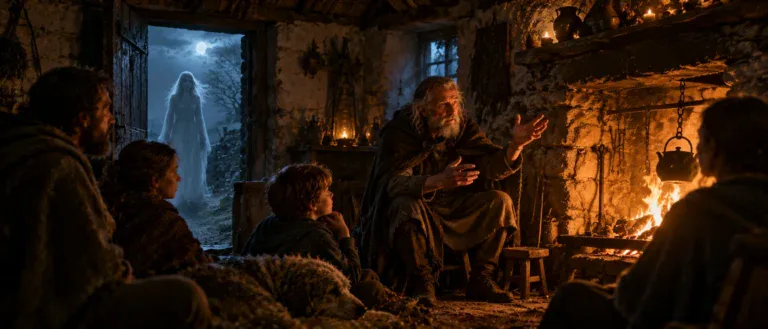
Long after the last battle of the Fianna, two old warriors meet Saint Patrick: Caílte mac Rónáin, Fionn’s fastest runner, and Oisín, Fionn’s son. Patrick asks what kind of man their lord was, and Caílte answers with stories of hunts, hounds, and feasts, and of how each hill and spring got its name. The saint has the tales written down so they will not be lost.
That scene, from the Acallam na Senórach, is a fair picture of the whole Fenian Cycle: stories told by survivors about a world of open country and wandering warriors. Fionn’s band does not sit in a royal hall. It roams the woods and mountains, hunting deer and boar and defending Ireland from raiders, and storytellers kept returning to that world for centuries after most medieval tales had fallen silent.
What the Fenian Cycle Is
The Fenian Cycle is one of four groups into which modern scholars sort early Irish narrative, alongside the Mythological Cycle, the Ulster Cycle, and the Cycle of the Kings. The four-cycle scheme is a modern convenience: medieval scribes listed tales by type, such as battles, voyages, and cattle raids, not by cycle. Even so, the Fenian tales hang together, because they share one hero, one band, and one setting.
Several names are in use. “Fenian” comes from fian, an Old Irish word for a roving war band, and Fianna is its plural. “Fionn Cycle” names the hero. Fianaigecht, Fenian lore, was the title of Kuno Meyer’s 1910 survey of the early texts, and Modern Irish calls the tradition an Fhiannaíocht. “Ossianic Cycle” comes from Ossian, the anglicized form of Oisín, the narrator of many ballads.
The cycle is not exclusively Irish. The same stories and ballads were told throughout the Scottish Highlands and Islands, and Scottish manuscripts and storytellers preserved some of the most important Fenian material. A smaller body of Fionn tradition survives on the Isle of Man.
How It Differs from the Ulster Cycle
The Ulster Cycle centers on a royal court at Emain Macha, on kings, champions, and the honor of a province at war. The Fenian Cycle looks outward. The Fianna live on the margins of settled society, in forest camps and on hilltops, and their stories are full of hunting, hounds, weather, and the turning seasons. Many tales exist partly to explain how a hill, lake, or ford got its name.
The two cycles also had different lives. Ulster sagas such as the Táin Bó Cúailnge belonged above all to learned prose literature. Most Fenian texts were written down later, and from the twelfth century the cycle increasingly took the form of ballads, known as lays, which passed easily into popular song and storytelling. As a result, Fionn became the best-loved hero of Gaelic folk tradition, and collectors in Ireland and Scotland were still recording Fenian lays and tales from storytellers in the twentieth century.
Who Were the Fianna?
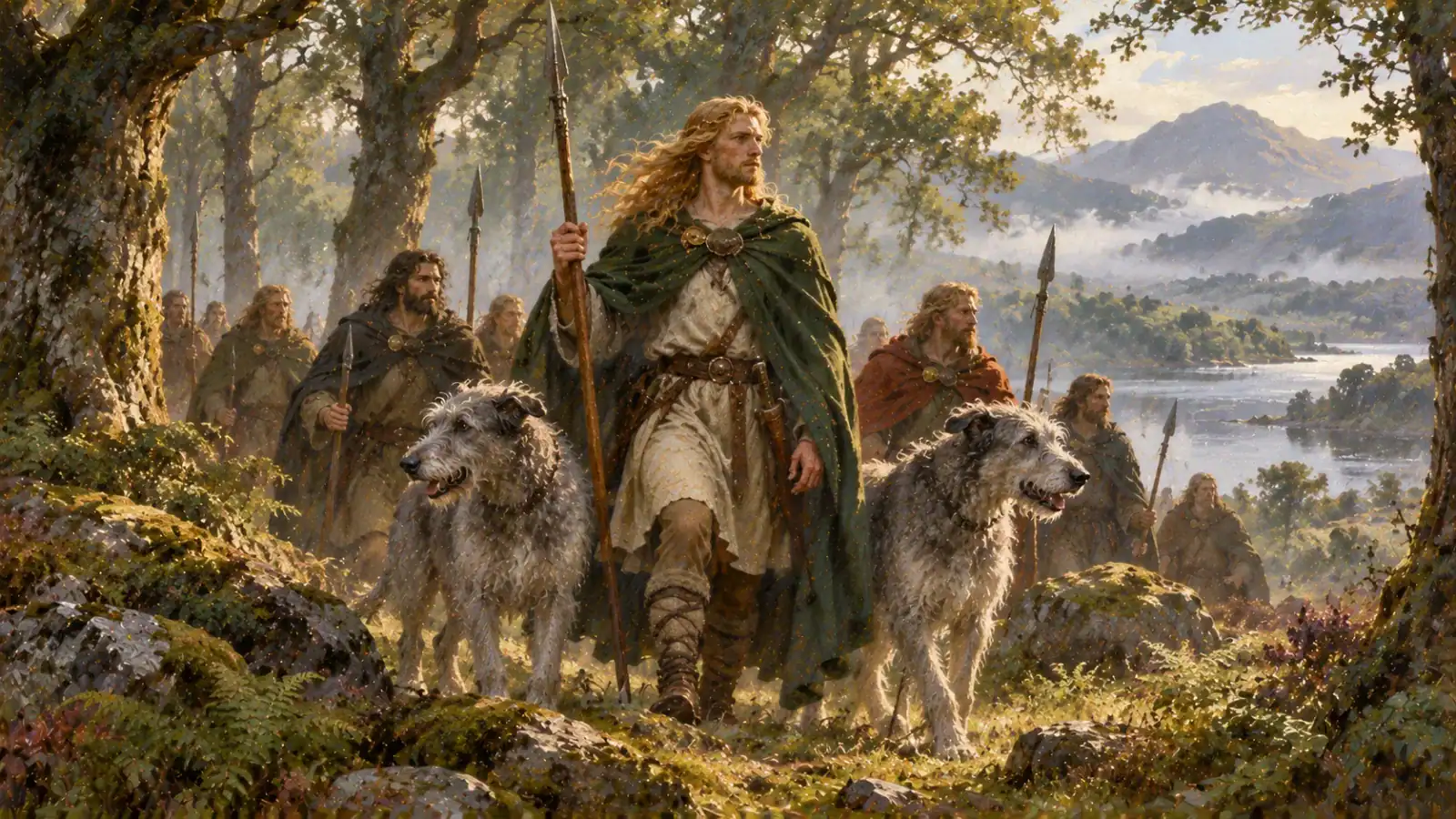
The Fianna of the stories are a war band in the service of the high king. Geoffrey Keating summed up the tradition in his Foras Feasa ar Éirinn, a history of Ireland completed around 1634. The Fianna, he wrote, were quartered on the people from Samhain to Bealtaine, keeping order and guarding the harbors against foreign raiders. From Bealtaine to Samhain they lived by hunting, taking the meat for food and the skins as pay. Country people, Keating added, still called ancient outdoor cooking pits fulacht fian, “cooking places of the Fianna.”
The legend probably grew from a real institution. Early Irish sources describe the fían as a band of young, landless men who had left fosterage but had not yet inherited property. They lived in the wild, hunted, raided, and fought for hire until they could settle down, and churchmen condemned them as marauders. That background explains why the Fianna of story stand slightly outside the law: they protect Ireland, but they are not part of its settled order.
The Tests for Entry
Later tradition records a famous list of tests that every candidate had to pass. The fullest versions appear in Keating’s history and in a Middle Irish text, the Enumeration of Finn’s People, translated by Standish Hayes O’Grady in Silva Gadelica (1892). Details vary slightly, but the main tests are these:
- The candidate had to be a poet, versed in the twelve books of poetry.
- He stood in a pit reaching above his knees, armed only with a shield and a hazel stick, while nine warriors threw spears at him. If he was wounded, he was refused.
- With his hair braided, he ran through a forest with the Fianna in pursuit. If he was caught, if a branch loosened a braid, or if a dry stick cracked under his foot, he failed.
- At full speed, he had to leap a branch as high as his forehead, stoop under one as low as his knee, and pull a thorn from his foot without slowing down.
Keating also lists four rules binding every member: never take a dowry with a wife, never force a woman, never refuse anyone who asks for food or valuables, and never flee from fewer than nine warriors. The tests make sense in story terms. A band that lived by hunting needed men who moved silently through woodland, and a band that fought outnumbered needed men who would not run. The poetry requirement reflects Fionn himself, a seer and poet as well as a warrior.
The Sources of the Fenian Cycle
Fionn is an old figure in Irish writing, even though most long Fenian texts are late. Meyer traced references back to a poem he dated to the seventh century. Fenian episodes appear in Cormac’s Glossary, in the place-name lore of the Dindshenchas, and in the great twelfth-century manuscripts. Fotha Catha Cnucha, “The Cause of the Battle of Cnucha,” survives in Lebor na hUidre, written before 1106, and tells how Fionn’s father, Cumhall, was killed by the rival clan of Morna.
Macgnímartha Finn
The Macgnímartha Finn, “The Boyhood Deeds of Fionn,” was composed in the twelfth century and survives in the Bodleian Library manuscript Laud 610. After his father’s death, the boy Demne is raised in secret in the forest by the druidess Bodhmall and the warrior woman Liath Luachra. He earns the name Fionn, “fair,” and later, while cooking a salmon for the poet Finnéces beside the Boyne, he burns his thumb, sucks it, and gains the salmon’s wisdom. The text breaks off unfinished.
Acallam na Senórach
The Acallam na Senórach, “The Colloquy of the Ancients,” dates to around 1200 and is one of the longest works of medieval Irish literature. Its frame is the meeting of Saint Patrick with Caílte and Oisín, and as the company travels Ireland, Caílte explains place after place through stories of the Fianna. The work also makes a careful argument: the heroic past was noble, and Christian Ireland could honor it.
Duanaire Finn and the Book of the Dean of Lismore
Two manuscript collections preserve most of the Fenian lays. Duanaire Finn, “The Poem Book of Fionn,” was copied in Louvain and Ostend in 1626 and 1627, in the Spanish Netherlands. Its scribe was Aodh Ó Dochartaigh, and its patron was Captain Somhairle Mac Domhnaill, an Antrim officer serving abroad. Eoin MacNeill and Gerard Murphy edited it in three volumes (1908 to 1953).
In Scotland, the Book of the Dean of Lismore was compiled at Fortingall in Perthshire, with dated entries running from 1512 to 1542. Compiled under Sir James MacGregor, it records Gaelic verse in a spelling based on Lowland Scots and includes some of the earliest recorded Ossianic ballads, proof that the lays were a shared Irish and Scottish tradition by then.
Key Fenian Cycle Stories and Their Sources
The cycle is too large to list in full, but a handful of tales and sources form its backbone. The table gives the best-known Fenian Cycle stories, with Irish titles and the dates of their earliest substantial versions.
| Tale or Source | Irish Title | Earliest Main Version | What Happens |
|---|---|---|---|
| The Cause of the Battle of Cnucha | Fotha Catha Cnucha | Lebor na hUidre, before 1106 | Fionn’s father, Cumhall, is killed by the sons of Morna |
| The Boyhood Deeds of Fionn | Macgnímartha Finn | Twelfth century | Fionn’s hidden childhood and the Salmon of Knowledge |
| The Colloquy of the Ancients | Acallam na Senórach | Around 1200 | Caílte and Oisín tell Saint Patrick the lore of the Fianna |
| The Battle of Ventry | Cath Finntrágha | Late medieval manuscripts | The Fianna defend Ireland against the “King of the World” |
| The Rowan Tree Hostel | Bruidhean Chaorthainn | Early modern Irish prose | Fionn and his men are trapped by enchantment and rescued by Diarmuid |
| The Pursuit of Diarmuid and Gráinne | Tóraigheacht Dhiarmada agus Ghráinne | Early modern Irish; references much older | Gráinne elopes with Diarmuid, and Fionn hunts them across Ireland |
| The Battle of Gabhair | Cath Gabhra | Medieval references; later lays | The high king’s army destroys the Fianna |
| The Poem Book of Fionn | Duanaire Finn | 1626 to 1627 | The great collection of Fenian lays |
| The Lay of Oisín in the Land of Youth | Laoi Oisín i dTír na nÓg | About 1750 | Oisín goes to Tír na nÓg with Niamh and returns old |
The Pursuit of Diarmuid and Gráinne
The aging Fionn is to marry Gráinne, daughter of Cormac mac Airt, but at the betrothal feast she drugs the company and binds Diarmuid Ua Duibne by a geis, a binding obligation, to run away with her. Fionn pursues them for years, and Diarmuid dies from a boar’s wound on Ben Bulben. Medieval tale lists already name the elopement, but the full surviving text is in early modern Irish.
The Rowan Tree Hostel
In Bruidhean Chaorthainn, Midac, son of the king of Lochlann, invites Fionn and his companions to a feast in an enchanted hostel. Inside, the fine hall turns cold and bare, and the guests are stuck fast to the floor. Diarmuid frees them by killing three foreign kings and sprinkling their blood on the enchanted floor. P. W. Joyce retold it in 1879 as “The Fairy Palace of the Quicken Trees.”
Cath Gabhra
The end of the Fianna comes in the reign of Cormac’s son, Cairbre Lifechair. Tired of the tribute the Fianna demand, Cairbre gathers the provinces against them, and Clann Morna joins him. At the Battle of Gabhair, usually placed near Garristown in north County Dublin, Oscar kills Cairbre and dies of his wounds. The Fianna are almost wiped out, and Oisín and Caílte are among the few survivors. Accounts of Fionn’s death differ, and a popular folk belief holds that he never died but sleeps in a cave with his warriors until Ireland needs them.
Oisín in Tír na nÓg and Other Late Tales
Oisín’s journey to the Land of Youth is best known from Laoi Oisín i dTír na nÓg, usually credited to the Clare poet Mícheál Coimín and dated to about 1750, though his authorship has been questioned. Niamh of the Golden Hair carries Oisín over the sea, and when he returns, three hundred years have passed. The tale of Fionn building the Giant’s Causeway to fight a Scottish giant, and escaping by disguising himself as a baby, belongs to later folk tradition. A comic nineteenth-century telling, set on Knockmany Hill in County Tyrone with a giant named Cucullin as the rival, reached a wide audience through Joseph Jacobs’s Celtic Fairy Tales in 1892.
The Main Figures of the Fianna
The cycle has a large cast, split between two rival clans: Clann Baíscne, Fionn’s kin, and Clann Morna, led by Goll mac Morna. That rivalry runs from Cumhall’s death to the final battle.
- Fionn mac Cumhaill: Leader of the Fianna, warrior, poet, and seer, whose wisdom comes from the salmon of the Boyne.
- Oisín: Fionn’s son, the poet of the band, whose name means “little deer.”
- Oscar: Son of Oisín, the strongest young warrior of the Fianna, killed at Gabhair.
- Caílte mac Rónáin: Fionn’s swift runner and the chief storyteller of the Acallam.
- Diarmuid Ua Duibne: The handsome warrior whom Gráinne chose over Fionn.
- Goll mac Morna: The one-eyed head of Clann Morna, who killed Fionn’s father and later served under Fionn.
- Conán Maol: Conán “the Bald,” a quarrelsome, foul-mouthed member of Clann Morna who provides the cycle’s comedy.
- Gráinne: Daughter of Cormac mac Airt, betrothed to Fionn and fled with Diarmuid.
- Sadb: Oisín’s mother, turned into a deer by a druid, which explains the meaning of her son’s name.
Macpherson’s Ossian and the Authenticity Controversy
The Fenian Cycle reached the wider world through a Scottish book. In 1760, James Macpherson published Fragments of Ancient Poetry, which he claimed to have translated from the Gaelic of Ossian, a third-century bard. Then came the epics Fingal, issued in 1761 though dated 1762, and Temora in 1763. His Fingal is Fionn and his Ossian is Oisín, but the misty, brooding poems differ greatly from the Gaelic ballads.
Samuel Johnson denounced the poems as forgeries, while Irish scholars such as Charles O’Conor objected that Macpherson had moved Irish heroes to Scotland. Later research, notably by Derick Thomson in 1952, concluded that Macpherson had collected genuine Gaelic ballads but reshaped them freely and added much of his own. The poems were a European sensation all the same. Goethe put his own translation of a passage into The Sorrows of Young Werther (1774), and Napoleon admired them so much that he suggested the name Oscar for the son of his general Bernadotte.
The Fenian Name in Irish Politics
In 1858, John O’Mahony, a Gaelic scholar who had translated Keating’s history the year before, founded the Fenian Brotherhood in the United States and named it after Fionn’s warriors. Its sister organization in Ireland, the Irish Republican Brotherhood, was founded in Dublin by James Stephens on Saint Patrick’s Day of the same year. “Fenian” became the common name for members of both.
Na Fianna Éireann, a nationalist youth movement, followed in 1909. The political party Fianna Fáil, founded by Éamon de Valera in 1926, takes its name from the same word, usually translated as “Soldiers of Destiny” or “Warriors of Fál,” Fál being an old poetic name for Ireland.
The Fenian Cycle in Popular Culture
Modern writers have returned to Fionn often. W. B. Yeats’s long poem The Wanderings of Oisin (1889) restages the old warrior’s argument with Saint Patrick. Flann O’Brien’s comic novel At Swim-Two-Birds (1939) brings Finn MacCool into a Dublin student’s novel, where Finn tells the story of the mad king Sweeny. James Joyce’s Finnegans Wake, published the same year, borrows its title from a street ballad, though many readers also hear in it Finn’s return. Mendelssohn’s Hebrides overture, or Fingal’s Cave, followed his 1829 visit to the Staffa cave named after Macpherson’s hero.
Common Questions
One question about the Fenian Cycle comes up more than any other: whether its setting is historical.
When Is the Fenian Cycle Set, and Was Fionn Real?
Tradition places Fionn in the third century, during the reign of Cormac mac Airt, and the annalists put the destruction of the Fianna at Gabhair in the 280s. These dates belong to legend, not history. The fían as an institution was real, but no contemporary record proves that Fionn himself existed.
Sources and Further Reading
- Ann Dooley and Harry Roe, trans., Tales of the Elders of Ireland (Acallam na Senórach), Oxford University Press (1999).
- Eoin MacNeill and Gerard Murphy, eds., Duanaire Finn: The Book of the Lays of Fionn, 3 vols., Irish Texts Society (1908, 1933, 1953).
- Kuno Meyer, Fianaigecht, Royal Irish Academy Todd Lecture Series 16 (1910).
- Gerard Murphy, The Ossianic Lore and Romantic Tales of Medieval Ireland, Cultural Relations Committee of Ireland (1955).
- Joseph Falaky Nagy, The Wisdom of the Outlaw: The Boyhood Deeds of Finn in Gaelic Narrative Tradition, University of California Press (1985).
- Geoffrey Keating, Foras Feasa ar Éirinn: The History of Ireland, ed. David Comyn and Patrick S. Dinneen, Irish Texts Society (1902 to 1914).
- Standish Hayes O’Grady, Silva Gadelica, Williams and Norgate (1892).