In Short
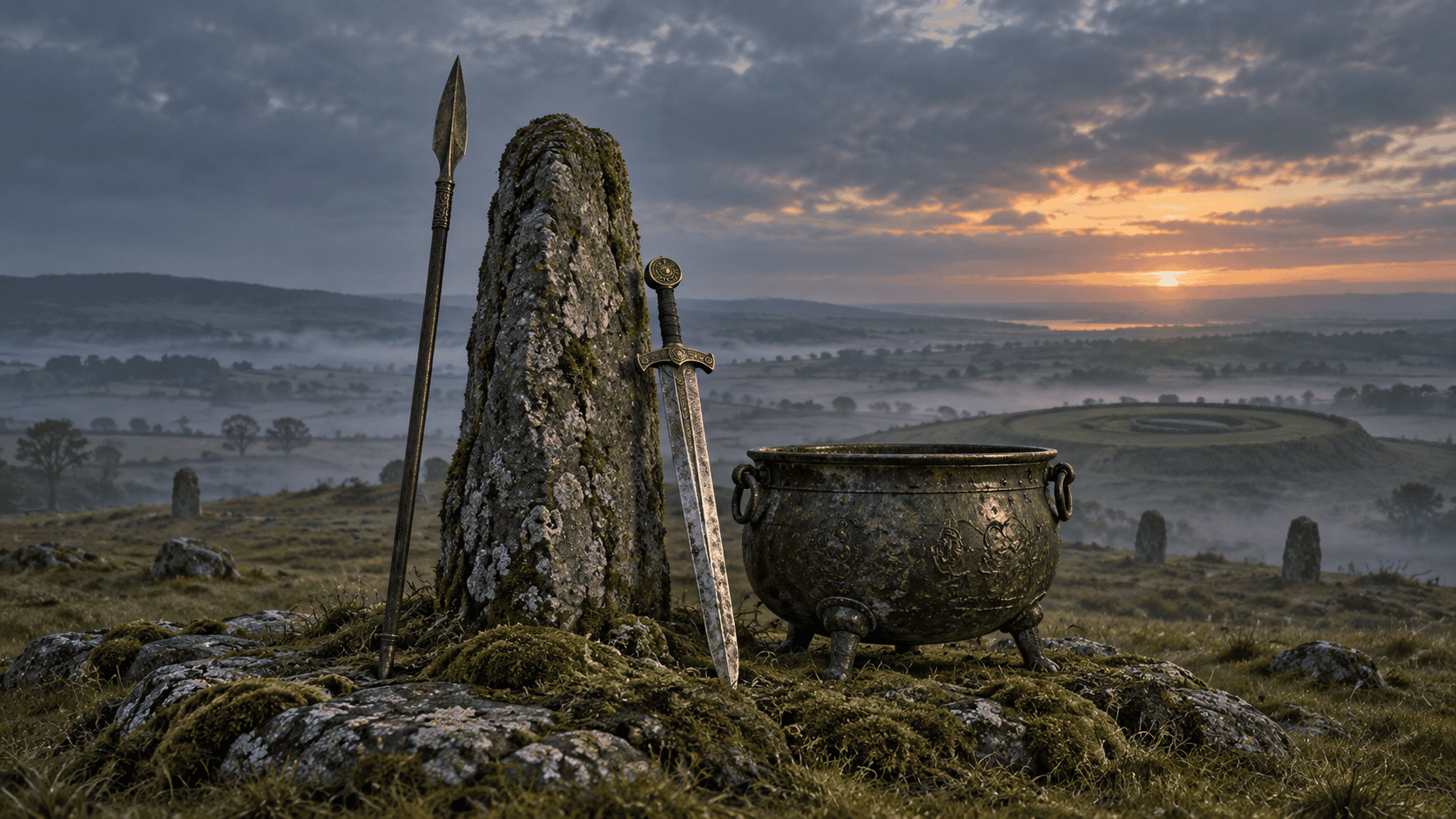
The Four Treasures of the Tuatha Dé Danann are four magical objects that the gods of Ireland brought with them from four cities in the northern islands of the world, where they had learned their arts. From Falias came the Lia Fáil, the Stone of Destiny, which cried out beneath the rightful king of Ireland. From Gorias came the spear of Lugh, against which no battle could be won. From Findias came the sword of Nuada, from which no one escaped once it was drawn. And from Murias came the cauldron of the Dagda, from which no company ever went away unsatisfied. A standing stone on the Hill of Tara is still pointed out as the Lia Fáil today.
| The four cities | Falias, Gorias, Findias, and Murias |
|---|---|
| Where | “The northern islands of the world” |
| The four teachers | Morfessa, Esras, Uiscias, and Semias |
| From Falias | The Lia Fáil, which cried out under the rightful king |
| From Gorias | The spear of Lugh; no battle was won against it |
| From Findias | The sword of Nuada; no one escaped it once drawn |
| From Murias | The Dagda’s cauldron; no company left it unsatisfied |
| Sources | Lebor Gabála Érenn; Cath Maige Tuired; “The Four Jewels” |
| Surviving today | The Lia Fáil, on the Hill of Tara, County Meath |
What Are the Four Treasures?
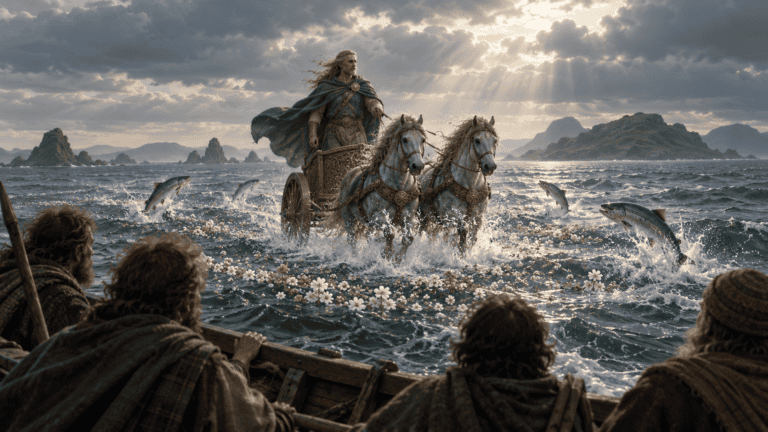
Before the Tuatha Dé Danann came to Ireland, the old stories say, they lived in the northern islands of the world, studying magic, druidry, prophecy, and every secret art, until they surpassed the wisest people anywhere. When they sailed for Ireland, they brought four great treasures with them, one from each of the four cities where they had learned.
Each treasure was a symbol of power, and each belonged to one of the great gods. Together they sum up what the Tuatha Dé were: rulers, warriors, and providers, with the magic to back all three. The objects appear only briefly in the medieval texts, but they have become some of the most famous images in Irish mythology.
Where the Story Comes From
The Four Treasures are described in three medieval Irish texts. They appear in one version of the Lebor Gabála Érenn, the Book of Invasions, and in the opening lines of Cath Maige Tuired, “The Second Battle of Mag Tuired,” which borrows the passage from it. A third, later text, known as “The Four Jewels of the Tuatha Dé Danann” and found in the Yellow Book of Lecan, retells it in prose and verse. In the seventeenth century, the historian Geoffrey Keating drew on the same tradition in his history of Ireland.
The descriptions are short, just a sentence for each treasure. Much of what is written about them today, including names like “the Sword of Light,” comes from later folklore and modern retellings.
The Four Cities
The four cities, Falias, Gorias, Findias, and Murias, are placed “in the northern islands of the world.” They do not correspond to any real places. In each city lived a wise teacher, a poet or druid, from whom the Tuatha Dé learned their arts: Morfessa in Falias, Esras in Gorias, Uiscias in Findias, and Semias in Murias.
The names are almost certainly the invention of medieval scholars, and some of them may be built from Irish words: Findias has been linked to find, “bright” or “white,” and Murias to muir, “the sea.” They give the Tuatha Dé a suitably mysterious homeland, beyond the edge of the known world, and help explain the gods’ magical learning.
The Lia Fáil: The Stone of Destiny
From Falias came the Lia Fáil, the Stone of Fál, which stood at Tara, the seat of the High Kings of Ireland. It cried out beneath every king who would take the sovereignty of Ireland. When the rightful king stood on it, the stone gave a shout that could be heard across the land. It was the ultimate test of a king’s claim, and the stories treat it as the voice of the land itself choosing its ruler.
The Lebor Gabála Érenn adds a Christian twist. The stone, it says, cried out under every king from the time of Lugh until the birth of Christ, and never again after that, because a demon had lived in it, and the power of every idol ceased when Christ was born.
The stone also gave Ireland one of its poetic names. Inis Fáil, “the Island of Fál,” and Fál itself, were old names for Ireland, and the tenth-century poet Cináed Ua hArtacáin wrote that Ireland was named after the stone on which he stood.
The Stone That Screamed for Conn
The most famous story about the Lia Fáil is told of Conn of the Hundred Battles, a legendary king of Tara. One morning, walking on the ramparts of Tara, Conn stepped on a stone, and it screamed. His druids told him that the stone was the Fál, that it had come from Falias, and that the number of its cries was the number of kings of his line who would rule Ireland. Conn was then carried into the Otherworld, where the god Lugh himself foretold the names of the kings who would come after him.
The Lia Fáil at Tara Today
On the Hill of Tara in County Meath, a tall standing stone on the mound called the Forradh is still pointed out as the Lia Fáil. According to local tradition, it was moved there from its original position in 1798, to mark the graves of rebels killed in a battle on the hill during the rising of that year. Whether it is the same stone as the one in the legend cannot be known, but it has become one of the most visited ancient monuments in Ireland. It has also been vandalized in recent years, struck with a hammer in 2012 and splashed with paint in 2014.
A rival tradition, repeated by some medieval and early modern writers, claimed that the Lia Fáil had been taken to Scotland and became the Stone of Scone, on which Scottish kings were crowned. Irish tradition generally rejects this, and the stone at Tara remains the one Irish people know as the Lia Fáil.
The Spear of Lugh
From Gorias came the spear that belonged to Lugh, the young god “skilled in all the arts.” No battle was ever sustained against it, the texts say, or against the one who held it. Whoever carried it could not be defeated.
The spear is one of the treasures most often misremembered. In Cath Maige Tuired, Lugh kills Balor not with the spear but with a stone from his sling. Later versions and modern retellings often give him the spear for that deed. A different fiery spear, which had to be kept in a cauldron of water to stop it from burning up the city around it, appears in the later tale of the Sons of Tuireann, and it too became mixed up with Lugh’s spear in popular retellings.
The Sword of Nuada
From Findias came the sword of Nuada, the king of the Tuatha Dé. No one ever escaped from it once it was drawn from its deadly sheath, and no one could resist it.
Nuada himself is a tragic figure. He lost his hand in battle against the Fir Bolg, and a king with a blemish could not rule, so he gave up his throne until the physician Dian Cécht made him a hand of silver. He was later killed by Balor at the Second Battle of Mag Tuired. Modern writers often call his sword the Claíomh Solais, “the Sword of Light,” but that name belongs to later Irish folktales, in which a shining sword is a common treasure. The medieval texts do not use it for Nuada’s sword.
The Cauldron of the Dagda
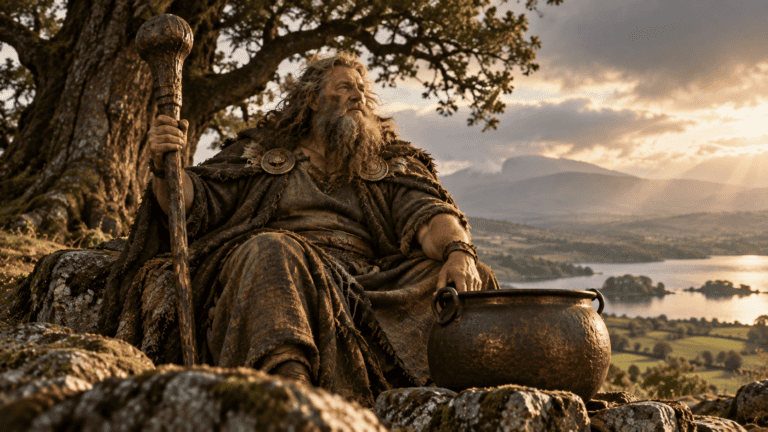
From Murias came the cauldron of the Dagda, the great father god. No company ever went away from it unsatisfied. It stands for abundance: a pot that never empties, feeding everyone who comes, just as the Dagda himself was a god of plenty. The story of the Dagda eating a whole pit of porridge before the Second Battle of Mag Tuired, with a ladle big enough for two people to lie in, shows the same idea of endless, overflowing food.
What the Treasures Mean
The four treasures can be read as a picture of everything a people needs. The stone stands for rightful kingship and the land’s approval of its ruler. The spear and the sword stand for victory in war and the defense of the people. The cauldron stands for food, plenty, and hospitality. Some scholars have linked this pattern to the idea, proposed by the French scholar Georges Dumézil, that early Indo-European societies saw the world in terms of three functions: sovereignty, war, and fertility. That theory is debated, but the treasures fit it neatly.
They also help explain why the Tuatha Dé were remembered as gods. They did not merely win battles. They arrived with the powers that make a kingdom possible: a way to choose a king, weapons that could not lose, and food that never ran out.
Treasures Across the Celtic World
Magical treasures are common in Celtic tradition. In Wales, a list known as the Thirteen Treasures of the Island of Britain includes a cauldron that would not boil the meat of a coward, and the Welsh tale of Branwen tells of a cauldron that could bring dead warriors back to life. Some scholars have argued that magic cauldrons of plenty like the Dagda’s helped inspire the Holy Grail of the Arthurian romances, though this is much debated.
The Four Treasures in Popular Culture
The Four Treasures appear in fantasy novels, video games, and comics inspired by Irish mythology, where they are often treated as legendary weapons or artifacts to be found. The Lia Fáil at Tara draws visitors from around the world, and the four treasures are a favorite subject of modern artists, who usually show them together as a set.
Where Are the Four Treasures Now?
Only the Lia Fáil is said to survive, as the standing stone on the Hill of Tara. The spear, the sword, and the cauldron were never said to have been left in the human world. When the Tuatha Dé Danann withdrew into the Otherworld after the coming of the sons of Míl, their treasures, in the logic of the stories, went with them.
Sources and Further Reading
- Elizabeth A. Gray, ed. and trans., Cath Maige Tuired: The Second Battle of Mag Tuired, Irish Texts Society (1982).
- R. A. S. Macalister, ed. and trans., Lebor Gabála Érenn: The Book of the Taking of Ireland, Irish Texts Society (1938 to 1956).
- Kevin Murray, ed. and trans., Baile in Scáil: “The Phantom’s Frenzy”, Irish Texts Society (2004).
- Geoffrey Keating, Foras Feasa ar Éirinn: The History of Ireland, ed. and trans. David Comyn and Patrick S. Dinneen, Irish Texts Society (1902 to 1914).
- Dáithí Ó hÓgáin, Myth, Legend and Romance: An Encyclopaedia of the Irish Folk Tradition, Ryan Publishing (1990).