In Short
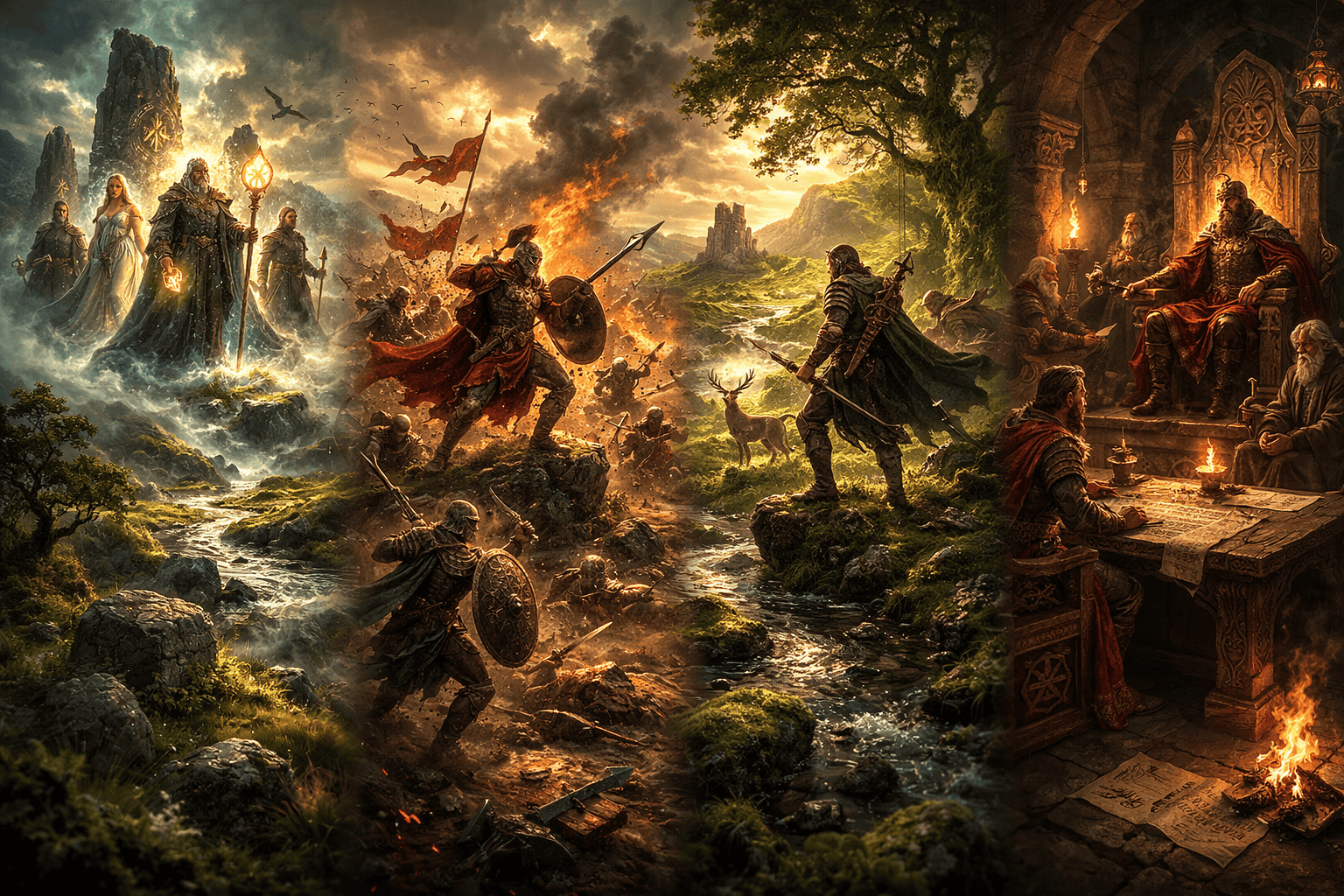
The four cycles of Irish mythology are the Mythological Cycle, about the gods; the Ulster Cycle, about Cú Chulainn and the cattle raid of Cooley; the Fenian Cycle, about Fionn mac Cumhaill and the Fianna; and the Cycles of the Kings, about legendary rulers. The division is a nineteenth-century scholarly convenience, not a medieval one.
| Mythological Cycle | The Tuatha Dé Danann, the invasions, the battles of Mag Tuired |
|---|---|
| Ulster Cycle | Cú Chulainn, Conchobar, Medb, and Táin Bó Cúailnge |
| Fenian Cycle | Fionn mac Cumhaill, Oisín, and the Fianna |
| Cycles of the Kings | Legendary and semi-historical rulers, from Labraid Loingsech to Brian Boru |
| Who divided them | Nineteenth-century scholars, not medieval Irish writers |
| Medieval system | Tales were classed by type: cattle raids, wooings, deaths, voyages, visions |
| Key manuscripts | Lebor na hUidre, the Book of Leinster, the Yellow Book of Lecan |
| Does not fit neatly | The immrama, the voyage tales |
Where the Four Cycles Came From
The four cycles are how Irish mythology is taught, and it is worth knowing at the outset that no medieval Irish writer would have recognized the scheme. It was assembled by scholars in the nineteenth century, working from manuscripts that were never organized that way, in order to make a sprawling body of material teachable.
The medieval system was different and more revealing. Irish storytellers classified tales by type rather than by era: a táin was a cattle raid, a tochmarc a wooing, an aided a death tale, an immram a voyage, an echtra an adventure into the Otherworld, a fis a vision. Two surviving tale lists record several hundred titles arranged this way, and a professional poet was expected to have them by heart.
So the cycles are a modern map of an older country. The map is useful. It is just not the territory.
The Mythological Cycle
The oldest layer, concerned with the gods and the peopling of Ireland. Its spine is Lebor Gabála Érenn, the Book of Invasions, which arranges the island’s prehistory as a sequence of settlements ending with the Gaels.
The central narrative is Cath Maige Tuired, the second battle of Mag Tuired, where the Tuatha Dé Danann defeat the Fomorians and Lugh kills his grandfather Balor. Around it sit some of the finest single tales in the tradition: Tochmarc Étaíne, the wooing of Étaín, in which a woman is transformed into a pool, a worm and a fly, swallowed, and reborn a thousand years later; Aislinge Óenguso, in which Aengus falls in love with a woman he has only seen in a dream and nearly dies searching for her; and Oidheadh Chlainne Lir, the children of Lir, turned to swans for nine hundred years by a jealous stepmother.
The cycle ends where folklore begins. The Tuatha Dé Danann lose Ireland to the Milesians and withdraw into the mounds, becoming the Aos Sí.
The Ulster Cycle
Set around the court of Conchobar mac Nessa at Emain Macha, near modern Armagh, and nominally placed around the beginning of the Christian era, though the language of the texts belongs to the eighth century and later.
Its centerpiece is Táin Bó Cúailnge, the cattle raid of Cooley. Queen Medb of Connacht, arguing with her husband over which of them is wealthier, discovers he owns one bull she cannot match, and invades Ulster to take its equal. The men of Ulster are disabled by a curse, and the seventeen-year-old Cú Chulainn holds the ford alone, fighting one champion a day through the winter. The emotional center is not a battle but a friendship: Cú Chulainn is eventually made to fight Ferdiad, his foster brother and the man he trained beside, over three days, and carries his body from the water afterward.
Around the Táin sit the remscéla, the foretales that explain how the situation arose. The best known is Longes mac nUislenn, the exile of the sons of Uisliu, which is the story of Deirdre: prophesied at birth to bring ruin, raised in isolation for the king, in love with someone else, and destroyed by a promise of safe conduct that was never going to be kept.
Other tales in this cycle include Fled Bricrenn, in which a troublemaker sets three heroes competing for the champion’s portion at a feast, and Aided Óenfir Aífe, in which Cú Chulainn kills his own son without knowing him. The cycle is grim in a way the others are not, and it is unusually good on the cost of being the person everyone depends on.
The Ulster tales are about obligation. Almost every disaster in them begins with a promise that should not have been made.
The pattern running through the Táin and its foretales
The Fenian Cycle
Fionn mac Cumhaill and the Fianna, a warrior band living outside settled society, hunting and fighting across a landscape the tales name in detail. The mood is looser than the Ulster Cycle: more wandering, more poetry, more open air.
The defining text is Acallam na Senórach, the colloquy of the ancients, composed around 1200. Its premise is remarkable. Caílte and Oisín, survivors of the Fianna, have outlived their own age by centuries and meet Saint Patrick, who travels Ireland with them while they tell him what happened at each place they pass. Patrick’s scribes write it down, with his blessing, and the whole work becomes a negotiation between the old world and the new one.
Also here: Tóruigheacht Dhiarmada agus Ghráinne, the pursuit of Diarmuid and Gráinne, in which Fionn’s intended bride puts a binding obligation on a younger warrior to run away with her, and Macgnímartha Finn, the boyhood deeds, which contains the salmon of knowledge.
One correction worth making. The famous version of Oisín in Tír na nÓg, in which he returns after three hundred years and crumbles when he touches the ground, comes from a poem written by Micheál Coimín around 1750. It is genuinely part of the tradition, but it is eighteenth century, not ancient.
The Cycles of the Kings
The plural is correct: this is a group of loosely related bodies of tale attached to different dynasties, not a single cycle. The subjects are kings, some legendary and some historical, and the tales run from prehistory to the eleventh century.
The finest of them is Buile Shuibhne, the frenzy of Sweeney, in which a king curses a cleric, is cursed in return at the battle of Mag Rath, and spends years as a half-bird living in the treetops, composing some of the best nature poetry in early Irish. Seamus Heaney translated it as Sweeney Astray.
Also in this group is Togail Bruidne Dá Derga, the destruction of Da Derga’s hostel, in which the king Conaire Mór breaks his sacred prohibitions one by one, each violation locking the next into place, until he dies of thirst in a burning hostel. It is one of the clearest statements of what Irish tradition thought kingship actually was: a set of conditions, not a position.
What the Four Cycles Leave Out
The scheme has edges, and the tales that fall off them are worth knowing about.
The immrama, the voyage tales, do not fit anywhere. Immram Brain and the Voyage of Máel Dúin send travelers through a sequence of islands, each stranger than the last, and they sit somewhere between pagan Otherworld literature and Christian allegory. The Voyage of Saint Brendan grew from the same soil and became one of the most widely read books in medieval Europe.
The dindshenchas, the lore of places, is another large body of material outside the cycles: hundreds of poems and prose pieces explaining how each notable hill, ford and lake got its name, usually by way of a story.
How to Use the Cycles
Treat them as a reading order rather than a classification. Begin with the Mythological Cycle to learn who the gods are, since every later tale assumes you know. Read the Ulster Cycle for the single greatest work, the Táin. Read the Fenian Cycle when you want the landscape rather than the court. And come to the Kings last, because their tales assume the others.
For the wider picture, see Irish mythology as a whole, or the Otherworld, which runs through all four.
Sources and Further Reading
- Táin Bó Cúailnge, Recension I, edited by Cecile O’Rahilly, Dublin Institute for Advanced Studies (1976).
- Cath Maige Tuired, edited by Elizabeth A. Gray, Irish Texts Society (1982).
- Ann Dooley and Harry Roe (trans.), Tales of the Elders of Ireland: Acallam na Senórach, Oxford University Press (1999).
- J. G. O’Keeffe (ed.), Buile Suibhne, Irish Texts Society (1913).
- Proinsias Mac Cana, The Learned Tales of Medieval Ireland, Dublin Institute for Advanced Studies (1980).