In Short
Samhain (pronounced SOW-in, rhyming with “cow-in”) is the old Irish festival that marked the end of the harvest and the start of winter, held on 1 November, with its eve on 31 October. It is one of the four great festivals of the early Irish year, and in medieval stories it is the night when the Otherworld opens and its beings walk abroad. Many Irish Halloween customs, from turnip lanterns to fortune-telling games, grew up around it and were carried to America by Irish emigrants in the nineteenth century. Some popular claims about it, such as that it was the “Celtic New Year” or named for a god of the dead, have little or no early evidence.
| Irish name | Samhain; Old Irish samain |
|---|---|
| Pronunciation | SOW-in, with “sow” as in “cow” |
| Date | 1 November, with the eve on 31 October |
| Also means | November, in modern Irish |
| Halloween in Irish | Oíche Shamhna, “Samhain night” |
| Marks | The end of the harvest and the beginning of winter |
| In the old stories | A night when the Otherworld opens and supernatural beings roam |
| Other festivals | Imbolc, Bealtaine, and Lughnasadh |
| Customs | Turnip lanterns, barmbrack, snap apple, bonfires, guising |
| Doubtful claims | “Celtic New Year,” “festival of the dead,” “god Samhain” |
What Is Samhain?
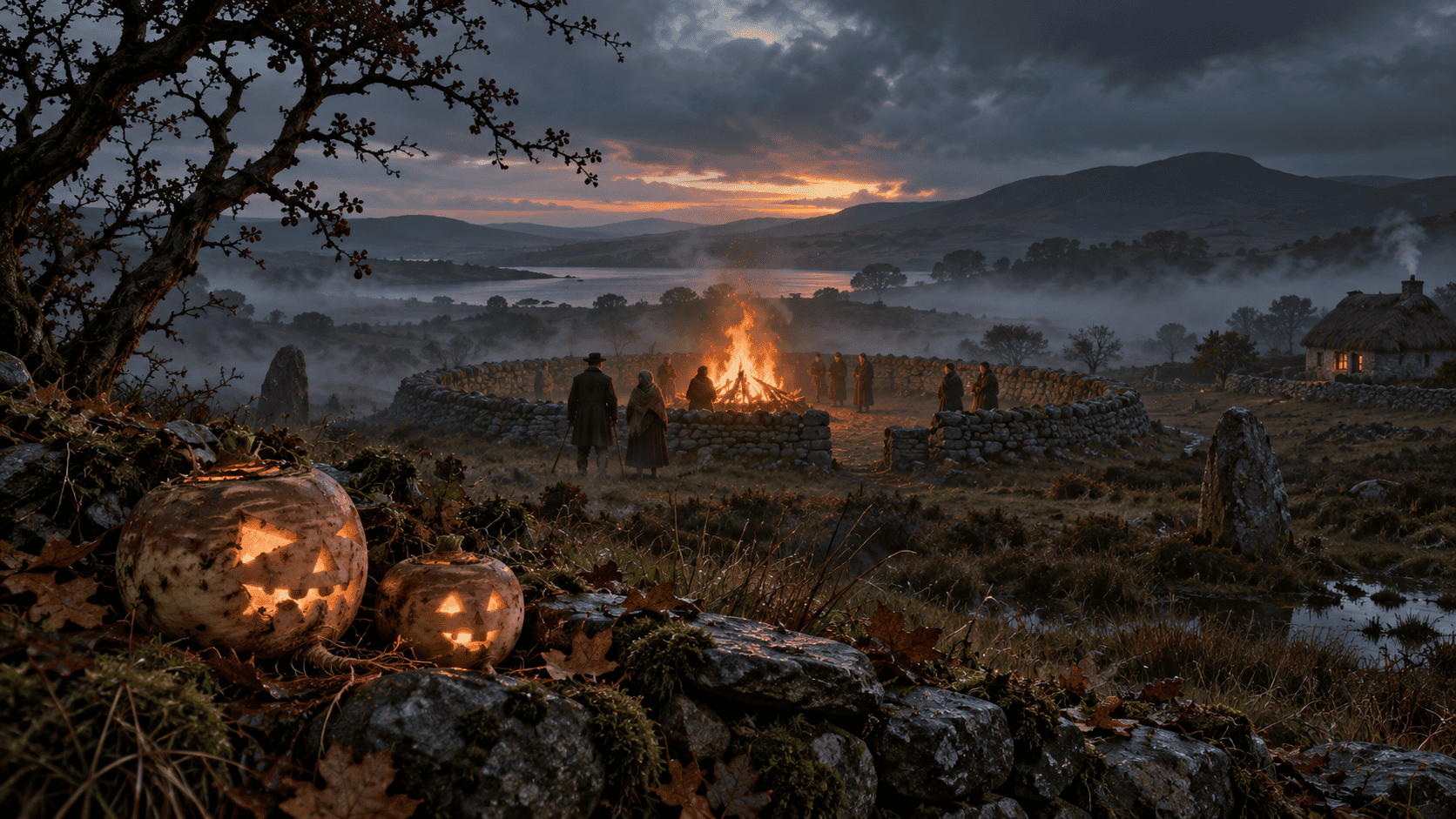
It is the last night of October in rural Ireland, a century or more ago. The potatoes are dug, the cattle are in from the summer pastures, and the evenings have turned dark and cold. In the kitchen, a hollowed-out turnip glows on the windowsill with a candle inside, carved into a face. Children bob for apples in a basin of water, and a cake is cut with a ring hidden somewhere inside it. Outside, nobody wants to be on the roads. Tonight, of all nights, the fairies are moving, and it is not wise to cross their path.
This was Oíche Shamhna, the eve of Samhain, the festival that opened the Irish winter. Its roots go back to the earliest Irish literature, where Samhain is the night when the doors of the Otherworld swing open. Its customs, carried across the Atlantic by Irish emigrants, became a large part of what the world now calls Halloween. But Samhain has also collected a great many modern myths, and this guide tries to separate what the sources say from what has been added since.
What Does the Word Samhain Mean?
Samhain is still the ordinary Irish word for the month of November, and Halloween night is Oíche Shamhna, “the night of Samhain.” The word comes from the Old Irish samain.
Its original meaning is debated. The explanation you will see most often is “summer’s end,” from the Irish words for summer and ending. That explanation is old, and it appears in medieval Irish texts themselves, but most language scholars now think it is a folk etymology, a guess made long after the word existed. They point instead to an old Celtic root meaning “assembly” or “gathering together,” which would fit Samhain’s role as a time when people gathered. A related word appears as the name of a month, SAMONI, on the Coligny calendar, a bronze calendar from Roman Gaul, which shows that a festival or month of this name existed on the continent too.
Samhain in the Early Sources
Samhain appears in some of the earliest Irish literature, from the ninth century onward, as one of the four great festivals of the year, alongside Imbolc, Bealtaine, and Lughnasadh. It was a time of great assemblies, when people gathered for feasting, games, and meetings. One tale, Serglige Con Culainn, “The Sickbed of Cú Chulainn,” says that the Ulstermen’s Samhain festival lasted a whole week: the day itself, and three days on either side.
Above all, Samhain is the night when the boundary between this world and the Otherworld grows thin. The great mounds of the Tuatha Dé Danann open, and their people come out. It is no surprise that so many of the old stories are set on it.
- The Dagda and the Morrígan. In Cath Maige Tuired, the Dagda meets the Morrígan at a river on Samhain, and she promises him help in the coming battle against the Fomorians.
- Óengus and the swan maiden. In Aislinge Óenguso, “The Dream of Óengus,” the young god can only win Caer, the woman of his dreams, on Samhain, when she takes the form of a swan. He becomes a swan himself to join her.
- Fionn and the burner of Tara. In the stories of the young Fionn mac Cumhaill, a being named Aillén comes out of the Otherworld every Samhain, lulls the court of Tara to sleep with music, and burns it down. Fionn stays awake and kills him.
- Nera and the cave of Cruachan. In Echtra Nerai, “The Adventure of Nera,” a young warrior accepts a dare on Samhain night at Cruachan, the royal seat of Connacht, and ends up following the people of the Otherworld into their mound, through the cave that tradition identifies as Oweynagat, near Cruachan.
The historian Ronald Hutton, one of the most careful scholars of the subject, sums up the medieval evidence this way: Samhain was a time when the supernatural was especially close, and when heroes and kings in the stories met their fated deaths or enchantments.
Was Samhain the Celtic New Year?
You will read almost everywhere that Samhain was the Celtic New Year. The idea is surprisingly recent. It was proposed in the late nineteenth century by the Welsh scholar John Rhys, who based it mainly on folklore he had collected in Wales and on the Isle of Man, where 31 October was sometimes called New Year’s Night. It was then popularized by the anthropologist James Frazer, in his enormously influential book The Golden Bough.
The medieval evidence is thin. One early text, Tochmarc Emire, lists the four festivals beginning with Samhain, which may mean the writer thought of it as the start of the year, or may simply be how he chose to list them. Hutton has concluded that the evidence for Samhain as a New Year festival is flimsy. It may be true, but it cannot be proved, and it should not be stated as fact.
Was Samhain a Festival of the Dead?
The same is true of the idea that Samhain was an ancient festival of the dead. This too was argued by Frazer, who believed the Church had turned it into the Christian feasts of All Saints and All Souls. The medieval Irish stories connect Samhain with the Otherworld and its inhabitants, the fairy people of the mounds, but they have little to say about the spirits of dead relatives returning home.
That belief does appear later. In the folklore of the nineteenth and twentieth centuries, some Irish families believed that the dead came back to their old homes on the night of Samhain, and some left food out or the door unlatched for them. Whether this was an ancient belief that the early writers never recorded, or one that grew up alongside the Christian feast of All Souls on 2 November, is still debated.
The Fires of Tlachtga
Another popular story says that on Samhain eve, the druids of Ireland gathered at Tlachtga, now the Hill of Ward near Athboy in County Meath, to light a sacred fire, and that every hearth in Ireland had to be relit from it. This story comes from a single source, the Foras Feasa ar Éirinn, a history of Ireland written by the priest Geoffrey Keating in the 1630s. It does not appear in any earlier text, and its origin is unknown. Scholars treat it with great caution. It has, however, inspired a modern revival, and a ceremonial fire is now lit on the Hill of Ward every October.
How Samhain Became Halloween
The name Halloween comes from “All Hallows’ Eve,” the evening before All Saints’ Day, or All Hallows, on 1 November. The following day, 2 November, is All Souls’ Day, when Christians pray for the dead.
It is often said that the Church placed All Saints’ Day on 1 November in order to replace Samhain. The evidence does not support this. Hutton points out that by around the year 800, churches in England and Germany were already celebrating All Saints on 1 November, having earlier kept a feast of martyrs in the spring, and that the Irish church at the time was still marking its feast of all saints in the spring. So the date seems to have spread from the continent and England, not from Ireland. What is clear is that in Ireland, the Christian feasts and the older festival fell on the same days, and over the centuries their customs blended together.
Irish Halloween Customs
Most of what we know about how Samhain was celebrated comes from folklore collected in the nineteenth and twentieth centuries. By then, it was usually called Halloween in English, but many of its customs were distinctly Irish.
Turnip Lanterns
Long before pumpkins, the Irish carved lanterns from turnips and other root vegetables, hollowing them out and cutting faces into them, then lighting them with a candle or an ember. The best-known story behind them is the tale of Jack, a blacksmith who tricked the Devil. When he died, he was barred from both heaven and hell and condemned to wander the earth, with only a coal inside a hollowed turnip to light his way. A frightening turnip lantern from around 1900, known as the Ghost Turnip, is on display at the National Museum of Ireland’s Country Life museum in Castlebar, County Mayo.
Barmbrack and Colcannon
Food on Halloween often came with a fortune inside it. The barmbrack, or bairín breac, a sweet bread studded with dried fruit, traditionally had small objects baked into it: a ring for a marriage within the year, a coin for wealth, a pea or a stick or a scrap of cloth for less happy fates. Colcannon, mashed potato with cabbage or kale, could also hide a ring. Shop-bought barmbracks in Ireland still include a toy ring every October.
Games and Fortune-Telling
Halloween was a night for games, and many of them were ways of seeing the future, especially who you would marry. Apple bobbing was one, and snap apple, in which players tried to bite an apple hanging from a string without using their hands, was another. The Irish painter Daniel Maclise captured a whole evening of these games in his painting Snap-Apple Night, completed in 1833 and inspired by a Halloween party he attended in Blarney, County Cork, the year before.
Fairies, Púcas, and Blackberries
Samhain was the night the fairy people moved from one fort to another, and people avoided lonely roads. It was also the night the púca was said to spoil the last of the blackberries, so that none could be eaten after it.
How Halloween Reached America
Irish and Scottish emigrants carried their Halloween customs to North America in the nineteenth century, especially during and after the Great Famine of the 1840s. In their new home, they found pumpkins, which were larger and far easier to carve than turnips, and the jack-o’-lantern took its familiar orange form. Over time, the customs of Irish and Scottish immigrants blended with those of other communities, and with a great deal of American commercial energy, into the Halloween now celebrated around the world.
Samhain in Popular Culture
Ireland has embraced its claim to be the home of Halloween. The Púca Festival, held around Trim and Athboy in County Meath, celebrates the Irish roots of the holiday, and includes a ceremonial fire on the Hill of Ward. Derry, in Northern Ireland, hosts a famous Halloween festival, often described as one of the largest in Europe. In modern paganism, including Wicca, Samhain is one of the eight festivals of the Wheel of the Year, and is often observed as a time to honor ancestors, a meaning shaped by the nineteenth-century theories of Rhys and Frazer as much as by the early Irish sources.
Is Samhain the Name of a God of the Dead?
No. You may come across claims, especially in older books and in some religious pamphlets, that Samhain was a “Lord of the Dead” worshipped by the druids. There is no such god in any early Irish or Celtic source. The idea goes back to Charles Vallancey, an eighteenth-century English military engineer and amateur antiquarian who made many imaginative claims about ancient Ireland, and it has been repeated ever since without evidence. Samhain is the name of a festival and a month, not a deity.
Sources and Further Reading
- Ronald Hutton, The Stations of the Sun: A History of the Ritual Year in Britain, Oxford University Press (1996).
- Ronald Hutton, “The Celtic New Year and Feast of the Dead,” Folklore (2023).
- Kevin Danaher, The Year in Ireland: Irish Calendar Customs, Mercier Press (1972).
- Geoffrey Keating, Foras Feasa ar Éirinn: The History of Ireland, trans. John O’Mahony (1857).
- Kuno Meyer, ed. and trans., “The Adventures of Nera,” Revue Celtique 10 (1889).