In Short
Fionn mac Cumhaill (pronounced fin mac COOL, often written Finn McCool) is the great hero of Irish legend and the leader of the Fianna, a band of hunter-warriors who roamed the wilds of Ireland. As a boy, he gained all the world’s knowledge by tasting the Salmon of Knowledge. As a young man, he saved Tara from a fire-breathing Otherworld musician and won the leadership of the Fianna. His stories, together with those of his son Oisín, his grandson Oscar, and the warrior Diarmuid, make up the Fenian Cycle, the most popular body of Irish legend for close to a thousand years. In later folklore, he became a giant, said to have built the Giant’s Causeway.
| Irish name | Fionn mac Cumhaill; Old Irish Finn mac Cumaill |
|---|---|
| Pronunciation | fin mac COOL |
| Meaning of Fionn | “Fair,” “bright,” or “white” |
| Childhood name | Demne |
| Parents | Cumhall, leader of the Fianna, and Muirne |
| Band | The Fianna |
| Family | Son Oisín, grandson Oscar; hounds Bran and Sceólang |
| Great rival | Goll mac Morna, who killed his father |
| Cycle | The Fenian Cycle, also called the Ossianic Cycle |
| Key texts | Macgnímartha Finn; Acallam na Senórach; Tóraigheacht Dhiarmada agus Ghráinne |
Who Was Fionn mac Cumhaill?
If the Ulster hero Cú Chulainn is Ireland’s Achilles, a young warrior who burns bright and dies early, Fionn mac Cumhaill is something closer to Robin Hood and King Arthur combined. He is a hunter, a warrior, a poet, and a seer. He leads a band of free-living fighters in the forests and mountains, and his stories are full of hunts, feasts, magic, love, and Otherworld adventures. He lives a long life, and his tales were told across Ireland and Gaelic Scotland for centuries, by storytellers at firesides as well as by poets in manuscripts.
His name means “fair” or “bright,” and his father’s name, Cumhall, is where the familiar English form “McCool” comes from. Irish tradition set his life in the third century, when he served the High King Cormac mac Airt at Tara.
Birth and Boyhood
Fionn’s story begins with a killing. His father, Cumhall, was the leader of the Fianna, until he was killed at the Battle of Cnucha by a rival clan, the sons of Morna, led by Goll mac Morna. Cumhall’s wife, Muirne, was pregnant. To protect the child from his father’s enemies, she gave him to two women to raise in secret in the forests of Sliabh Bladma, the Slieve Bloom Mountains: the druidess Bodhmall and the warrior woman Liath Luachra. They trained him in hunting and fighting, and he grew up under a false name, Demne.
These stories come from Macgnímartha Finn, “The Boyhood Deeds of Fionn,” a twelfth-century text. In it, the boy outruns wild deer, outswims other boys in a lake, and outplays the sons of chieftains at hurling. Each time, people ask who the fair boy is, and so he comes to be called Fionn, “the fair one.”
The Salmon of Knowledge
Fionn’s most famous childhood adventure took him to the River Boyne, where he studied with a poet, Finnéces, who had waited seven years to catch a magical salmon. Whoever ate it would gain all the knowledge in the world. When the salmon was caught, Fionn cooked it, burned his thumb on its skin, and put his thumb in his mouth. The knowledge went to him. From then on, whenever he put his thumb in his mouth, whatever he needed to know was revealed to him. Our article on the Salmon of Knowledge tells the full story.
The story explains one of Fionn’s defining traits. He was not only a warrior but a seer, and his “thumb of knowledge” gets him out of trouble again and again in later tales.
How Fionn Became Leader of the Fianna
When Fionn came of age, he went to Tara, the seat of the High King, on the great feast of Samhain. For twenty-three years, Tara had been burned every Samhain by Aillen mac Midgna, a being of the Tuatha Dé Danann, who came from his fairy mound playing music so sweet that every man who heard it fell asleep. While they slept, he breathed fire on the royal hall.
Fionn offered to guard Tara. An old follower of his father gave him a magical spear, and told him to press its point against his forehead when the music began, so that the pain would keep him awake. Fionn did so, stayed awake through the music, and when Aillen came to burn the hall, Fionn drove him off and killed him. In reward, the king made him leader of the Fianna, and even Goll mac Morna, his father’s killer, swore to follow him.
The Fianna
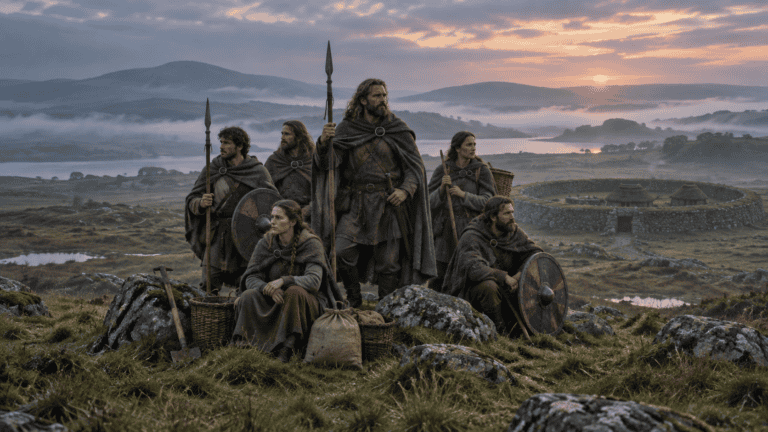
The Fianna were bands of warriors who lived outside ordinary society. In the stories, they spent the summer hunting and roaming the countryside and the winter quartered on the people, and they defended Ireland against invaders. Scholars believe the legend reflects a real institution: in early Ireland, young men who had not yet inherited land often lived for a time as a fian, a hunting and raiding band, before settling down.
The Tests of the Fianna
Later writers, especially the seventeenth-century historian Geoffrey Keating, described the tests a man had to pass to join the Fianna. He had to know the twelve books of poetry. He had to stand in a hole up to his waist, armed only with a shield and a hazel stick, while nine warriors threw spears at him, and come out unwounded. He had to run through a forest with warriors chasing him without being caught, without breaking a dry twig under his foot, and without a single braid of his hair coming loose. He had to leap over a branch as high as his forehead, stoop under one as low as his knee, and pull a thorn from his foot while running at full speed.
The tests explain what the Fianna were meant to be. They lived by hunting in the wild, so a member had to be silent, fast, and nimble in the forest. They had no land or family to protect them, so he had to be able to defend himself alone. And poetry was part of the warrior’s honor, because a great deed meant little unless it could be remembered in verse.
The Warriors of the Fianna
Fionn’s band included some of the most memorable characters in Irish legend.
- Oisín (pronounced uh-SHEEN), Fionn’s son, a warrior and poet, who later went to Tír na nÓg with Niamh of the Golden Hair.
- Oscar, Oisín’s son, the bravest of the young warriors.
- Diarmuid Ua Duibhne, the most handsome, with a magical love spot that made any woman who saw it fall in love with him.
- Caílte mac Rónáin, the fastest runner of the Fianna.
- Goll mac Morna, the one-eyed warrior who killed Fionn’s father, and later became one of his greatest fighters, though never quite his friend.
- Conán Maol, the bald, loud-mouthed troublemaker, the comic figure of the band.
Bran and Sceólang
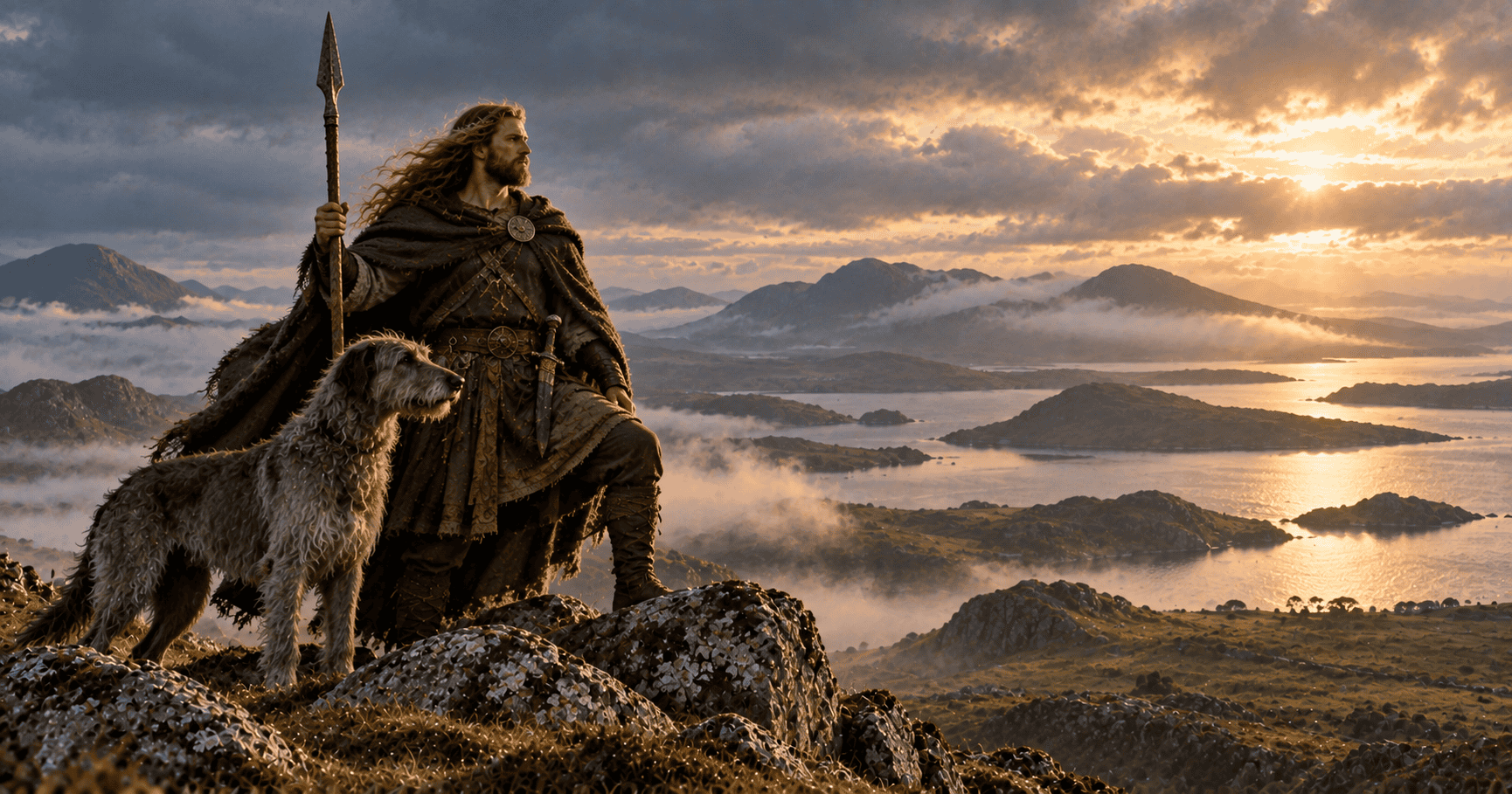
Fionn’s two great hounds, Bran and Sceólang, were no ordinary dogs. According to the stories, they were his cousins. His aunt Tuiren was turned into a hound by a jealous Otherworld woman while she was pregnant, and her two pups were born as dogs. That is why the hounds were so intelligent, and why Fionn loved them above all other animals.
Sadhbh and the Birth of Oisín
One day, while hunting, Fionn’s hounds cornered a fawn but refused to harm it, and it followed him home. That night, it became a beautiful woman, Sadhbh. A dark druid had turned her into a deer, and she could only become human on Fionn’s land. They married, and for a time Fionn gave up hunting and war to be with her. But while he was away fighting, the druid came in the form of Fionn himself, lured Sadhbh out, and turned her back into a deer. Fionn searched Ireland for her for seven years without success. At last, his hounds found a naked boy on a mountain, raised in the wild by a deer. Fionn named him Oisín, “little deer.”
Diarmuid and Gráinne
The most famous of all Fenian stories is a love story, and it shows Fionn at his worst. Tóraigheacht Dhiarmada agus Ghráinne, “The Pursuit of Diarmuid and Gráinne,” tells how the aging Fionn was betrothed to Gráinne (pronounced GRAWN-yuh), the young daughter of the High King Cormac mac Airt. At the wedding feast, Gráinne put a sleeping potion in everyone’s drink except a few, and then placed Diarmuid under a geis, a binding magical obligation, to run away with her. Diarmuid was loyal to Fionn, but he could not break a geis, and the two fled.
Fionn pursued them across Ireland for years. Many ancient stone tombs, the dolmens of the Irish countryside, are still called “Diarmuid and Gráinne’s beds,” after the places where the lovers were said to have slept. Eventually, peace was made. But years later, Diarmuid was gored by a magical boar on Ben Bulben, in County Sligo. Fionn had the power to heal any wound with water carried in his hands. Twice he fetched water, and twice, remembering Gráinne, he let it slip through his fingers. The third time, he brought it, but Diarmuid was already dead.
The Colloquy of the Ancients
The largest Fenian text is Acallam na Senórach, “The Colloquy of the Ancients,” written around 1200. It imagines that two old warriors of the Fianna, Caílte and Oisín, lived on for centuries after the Fianna fell, long enough to meet Saint Patrick. As they travel around Ireland together, the old warriors tell Patrick the stories behind every hill, well, and river they pass, and Patrick, charmed, has them written down. It is a clever way of joining the pagan past to the Christian present, and it gave later storytellers a frame for countless tales.
The End of the Fianna
In time, the Fianna grew too powerful. The High King Cairbre Lifechair, Cormac’s son, turned against them, and the two sides met at the Battle of Gabhra. It was the end of the Fianna. Oscar and Cairbre killed each other, and most of the band died with them.
The stories do not agree on how Fionn himself died. One medieval account says he was killed by a group of enemies at a ford on the Boyne. But folk tradition preferred a different ending: that Fionn and his warriors never died at all, but lie sleeping in a cave, and will wake when Ireland needs them, like King Arthur in British legend.
Fionn the Giant
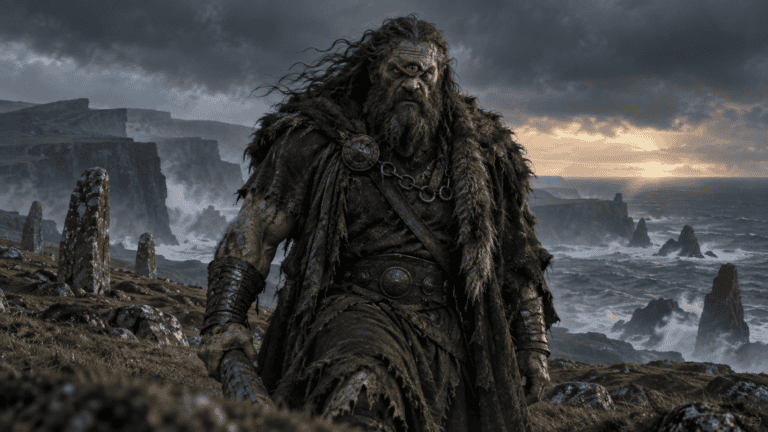
In later folklore, Fionn grew enormously, becoming a giant in countless local legends. The most famous is the story of the Giant’s Causeway, on the coast of County Antrim. Fionn built a causeway of stone across the sea to fight the Scottish giant Benandonner. When he saw how huge his rival was, Fionn fled home, and his clever wife, Oonagh, dressed him as a baby and put him in a cradle. When Benandonner arrived and saw the size of the “baby,” he fled in terror, tearing up the causeway behind him. All that remains are its ends: the Giant’s Causeway in Ireland and the similar columns of Fingal’s Cave on the Scottish island of Staffa. Another legend says Fionn scooped up a clod of earth to throw at a rival, leaving a hole that filled to become Lough Neagh, while the clod landed in the sea as the Isle of Man.
These stories are much later and more comic than the medieval tales, but they show how deeply Fionn became part of the landscape.
Was Fionn a Real Person?
Medieval Irish historians treated him as real, and set his life in the third century. Most modern scholars are doubtful. The folklorist Dáithí Ó hÓgáin argued that Fionn began as a divine figure, a god of wisdom and seeing, whose name relates to those of the Gaulish god Vindonnus and the Welsh Gwyn ap Nudd. Over time, the god became a hero, and the hero became the leader of an imagined golden age of the Fianna.
Fionn mac Cumhaill in Popular Culture
Fionn has had a remarkable afterlife. In the 1760s, the Scottish poet James Macpherson published Ossian, supposedly translated from ancient Gaelic poems by Oisín, in which Fionn appears as “Fingal.” The poems were largely Macpherson’s own work, and the critic Samuel Johnson denounced them as a fraud, but they were admired across Europe, including by Napoleon, and they helped spark the Romantic movement. In the twentieth century, Flann O’Brien made Finn Mac Cool a comic character in his 1939 novel At Swim-Two-Birds, and James Joyce built Finnegans Wake, published the same year, around echoes of his name. Fionn also appears in children’s books, fantasy novels, and games, and he remains the face of the Giant’s Causeway legend for visitors from around the world.
What Is the Best Music in the World?
In a well-loved retelling by the Irish writer James Stephens, the Fianna argue about the finest music in the world. One says the call of the cuckoo, another the ring of a spear on a shield, another the laughter of a girl. When Fionn is asked, he answers: the music of what happens. It is not a medieval line, but it has become the most quoted thing Fionn ever said, and it captures the hero perfectly: a man of action who was also a poet.
Sources and Further Reading
- Kuno Meyer, trans., “The Boyish Exploits of Finn,” Ériu 1 (1904).
- Ann Dooley and Harry Roe, trans., Tales of the Elders of Ireland (Acallam na Senórach), Oxford University Press (1999).
- Nessa Ní Shéaghdha, ed. and trans., Tóruigheacht Dhiarmada agus Ghráinne, Irish Texts Society (1967).
- Dáithí Ó hÓgáin, Fionn mac Cumhaill: Images of the Gaelic Hero, Gill and Macmillan (1988).
- Joseph Falaky Nagy, The Wisdom of the Outlaw: The Boyhood Deeds of Finn in Gaelic Narrative Tradition, University of California Press (1985).
- James Stephens, Irish Fairy Tales, Macmillan (1920).