In Short
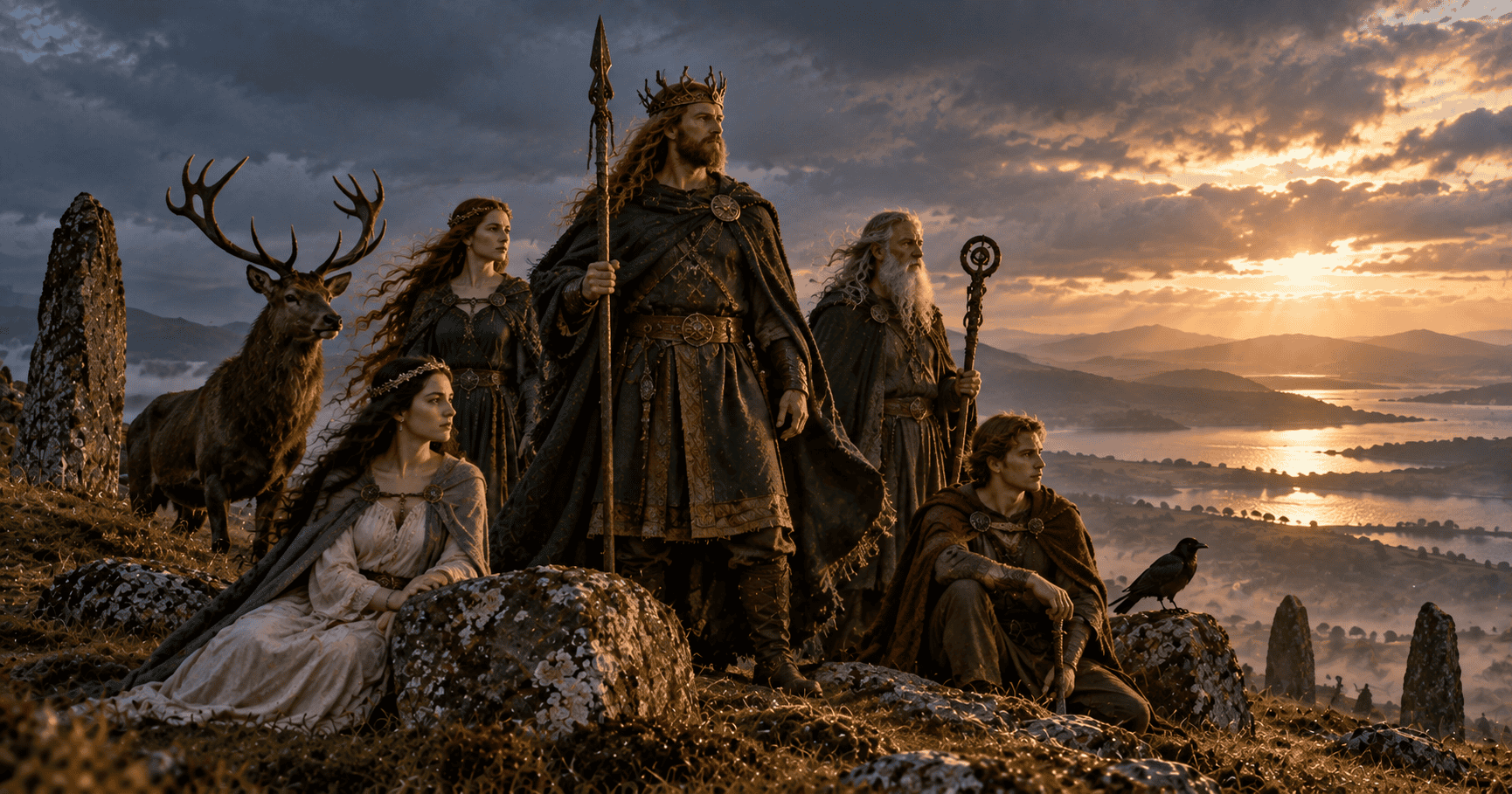
The Irish gods are the Tuatha Dé Danann (pronounced TOO-ah-ha day DAN-an), a people of great skill described in medieval Irish manuscripts. The best known are the Dagda, Lugh, the Morrígan, Brigid, Nuada and Manannán mac Lir. They are never presented as a formal pantheon, because the monks who wrote them down recorded them as early settlers of Ireland rather than as gods.
| Collective name | Tuatha Dé Danann, the people of the goddess Danann |
|---|---|
| Chief figure | The Dagda, the good god, meaning good at everything |
| Most skilled | Lugh Samildánach, master of every art |
| War goddess | The Morrígan, who appears as a crow |
| Enemy people | The Fomorians, led by Balor of the baleful eye |
| Great battles | The first and second battles of Mag Tuired |
| Main source | Lebor Gabála Érenn and Cath Maige Tuired |
| What became of them | They withdrew into the sídhe and became the fairy folk |
Why There Is No Irish Pantheon
Anyone arriving from Greek or Norse mythology expects a clear list: a sky god, a sea god, a war goddess, each with a fixed portfolio. Irish tradition does not provide one, and the reason is worth understanding before reading any further.
Everything we have was written by Christian scribes, some centuries after the beliefs themselves. Rather than record a rival religion, they presented the gods as an early race of skilled people who settled Ireland and were later defeated. This process is called euhemerism, and it runs right through Irish mythology.
What survives, then, is not theology. It is a set of characters with divine attributes, appearing in stories that treat them as history. Their functions overlap, their genealogies contradict each other, and the same figure can be a king in one text and a supernatural power in another.
The Tuatha Dé Danann
The Tuatha Dé Danann arrive in Ireland in a cloud of mist, take the island from the Fir Bolg at the first battle of Mag Tuired, and later defeat the Fomorians at the second. When the Gaels arrive in turn, the Tuatha Dé Danann are beaten and withdraw below ground, into the mounds, where they become the Aos Sí.
Their name is usually translated as the people of the goddess Danann, though Danu herself is close to invisible in the texts. She is inferred from the name rather than described. A related figure, Anu, is glossed in Cormac’s Glossary as the mother of the Irish gods, and the two hills in Kerry called the Paps of Anu carry her name.
The Dagda
The Dagda is the closest thing to a father figure among the Irish gods, and his epithet is regularly mistranslated. An Dagda means the good god in the sense of good at everything, not morally good. His other names, Eochaid Ollathair and Ruad Rofhessa, mean the great father and the lord of great knowledge.
He carries three possessions worth knowing. A club so large it is dragged on wheels, which kills with one end and revives with the other. A cauldron from which no one goes away unsatisfied. And a harp that orders the seasons and can play three strains: one that brings sorrow, one that brings laughter, and one that brings sleep.
The Dagda is also, notably, a figure of appetite and comedy. In Cath Maige Tuired he eats an enormous quantity of porridge from a pit in the ground, and the text finds this funny. Irish gods are not dignified in the classical sense.
Lugh
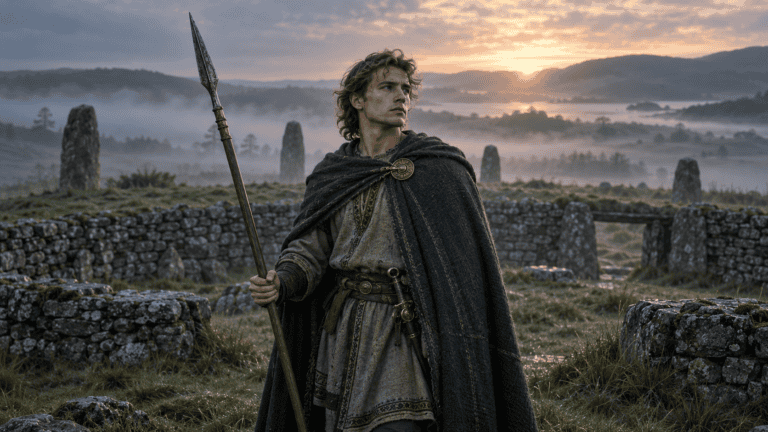
Lugh Lámhfhada, Lugh of the long arm, arrives at Tara and is refused entry until he can name a skill nobody inside possesses. He names one skill after another, each already held by someone within, until he asks whether any single man there has all of them at once. That is why he is called Samildánach, skilled in many arts together.
His central act is killing Balor of the Fomorians, his own grandfather, with a sling stone through the eye that destroys whatever it looks upon. The festival of Lughnasa at the start of August carries his name, and he founded it, in the tradition, as funeral games for his foster mother Tailtiu.
Lugh is not the god of anything in particular. He is the god of being better at it than you.
The sense of Samildánach in Cath Maige Tuired
The Morrígan
The Morrígan is the most misrepresented figure in the modern revival. She is a goddess of battle and sovereignty who appears as a crow over the field, incites conflict, prophesies outcomes, and washes the armor of men about to die.
She is sometimes one figure and sometimes three, grouped with Badb and Macha, and occasionally with Anann or Nemain instead. Her most famous appearances are in the Ulster Cycle, where she offers herself to Cú Chulainn, is refused, and torments him in a sequence of animal forms until she finally appears as a washer at the ford before his death.
What she is not, on the evidence, is a goddess of death in the general sense, nor a triple moon goddess. That last reading comes from twentieth-century neopaganism rather than from any Irish source.
Brigid
Brigid, daughter of the Dagda, holds poetry, smithcraft and healing, which the texts describe as three aspects of one figure. She is also the name of Ireland’s second patron saint, whose feast falls on 1 February, the day of the older festival of Imbolc.
Whether the saint absorbed the goddess is one of the genuinely open questions in Irish scholarship. The overlap of name, date, and associations with fire, livestock and healing is striking. The evidence for direct continuity is thinner than popular writing suggests, and careful scholars treat it as unresolved rather than settled.
Nuada, Manannán and the Rest
Nuada Airgetlám, Nuada of the silver arm, loses his hand at the first battle of Mag Tuired and with it his kingship, because a blemished man cannot rule. Dian Cécht makes him a silver replacement, and his son Miach later restores flesh and feeling to it, an act of skill his father repays with murder.
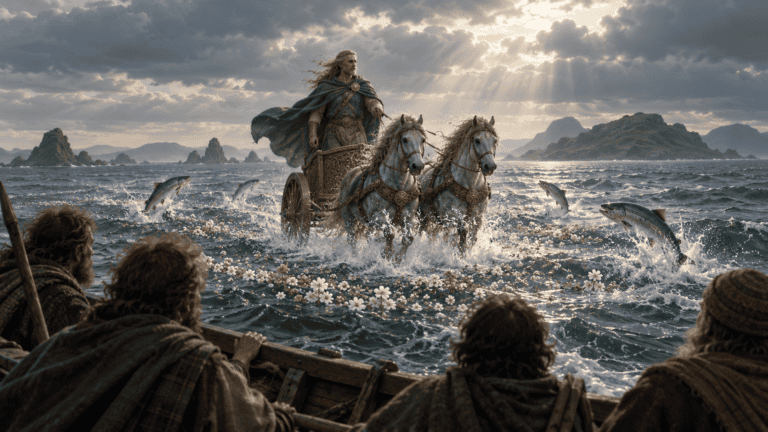
Manannán mac Lir is the sea, associated with the Isle of Man which carries his name. He owns a horse that runs on water, a boat that needs no sail, and a cloak of mist that he draws between two people so they never meet again. He is the usual guide to the Otherworld.
Aengus Óg, son of the Dagda and Boann, holds Brú na Bóinne, the great passage tomb at Newgrange, which he wins from his father by a trick of wording. His own story, Aislinge Óenguso, has him falling in love with a woman he has only seen in a dream.
Ogma is the champion and the eloquent one, credited in the tradition with inventing the ogham alphabet. Goibniu, Credne and Luchta, the smith, the metalworker and the wright, are the three gods of craft who arm the Tuatha Dé Danann for battle. Dian Cécht is the healer whose well restores the wounded.
The Fomorians
The Fomorians are the opposing power, usually described as coming from the sea and often depicted as misshapen. It would be a mistake to read them as simple monsters. They intermarry with the Tuatha Dé Danann repeatedly, and Lugh himself is half Fomorian through his mother Ethniu, Balor’s daughter.
The second battle of Mag Tuired, where the two sides meet, is less a war of good against evil than a struggle over tribute and rule, which is how the text itself frames it.
The Four Treasures
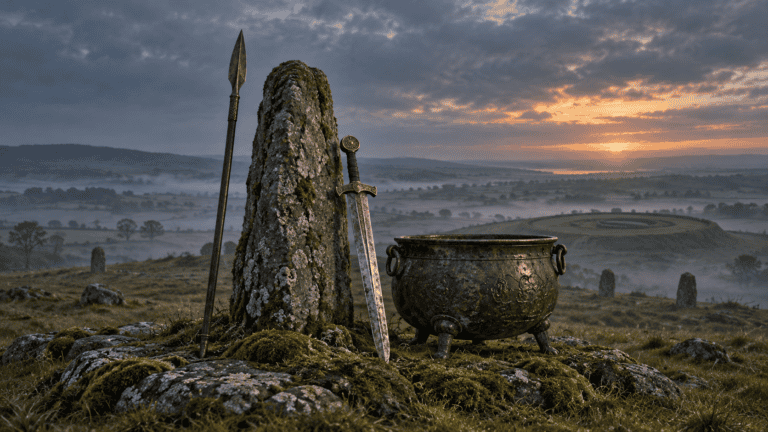
The Tuatha Dé Danann are said to have brought four objects from four cities. The Lia Fáil, the stone of destiny, which cries out under the rightful king. The sword of Nuada, from which none escaped. The spear of Lugh, which guaranteed victory. And the cauldron of the Dagda, which left no one unsatisfied.
Where to Start
Begin with the Tuatha Dé Danann for the people as a whole, then the four cycles for where each god appears. The Irish creation account covers how the island came to be settled, and the Aos Sí explains what became of the gods afterward.
Sources and Further Reading
- Cath Maige Tuired: The Second Battle of Mag Tuired, edited by Elizabeth A. Gray, Irish Texts Society (1982).
- Lebor Gabála Érenn, edited and translated by R. A. S. Macalister, Irish Texts Society (1938 to 1956).
- Sanas Cormaic (Cormac’s Glossary), ninth or tenth century, for Anu as mother of the Irish gods.
- James MacKillop, Dictionary of Celtic Mythology, Oxford University Press (1998).
- Mark Williams, Ireland’s Immortals: A History of the Gods of Irish Myth, Princeton University Press (2016).