In Short
The Fomorians (in Irish, Fomóire) are the great enemies of Irish mythology: a race of powerful beings from the sea who oppose every people that tries to settle Ireland. They fight the first settlers, enslave the people of Nemed from a tower on Tory Island, and force the Tuatha Dé Danann to pay them tribute until the gods rise up and defeat them at the Second Battle of Mag Tuired. Some are described as monsters with one eye, one arm, and one leg, or with the heads of goats. Others, like Elatha and his son Bres, are strikingly beautiful. The gods fought them, but they also married them: Lugh, the hero who defeated them, was half Fomorian himself.
| Irish name | Fomóire; modern Irish Fomhóraigh |
|---|---|
| Name’s meaning | Debated; perhaps “those from under the sea” or “phantoms from below” |
| Home | The sea and the islands, especially Tory Island |
| Appearance | Sometimes monstrous; sometimes beautiful |
| Famous Fomorians | Balor, Bres, Elatha, Indech, Tethra, Cethlenn |
| Enemies of | Partholón, Nemed, and the Tuatha Dé Danann |
| Final defeat | The Second Battle of Mag Tuired |
| Main sources | Lebor Gabála Érenn; Cath Maige Tuired |
Who Were the Fomorians?
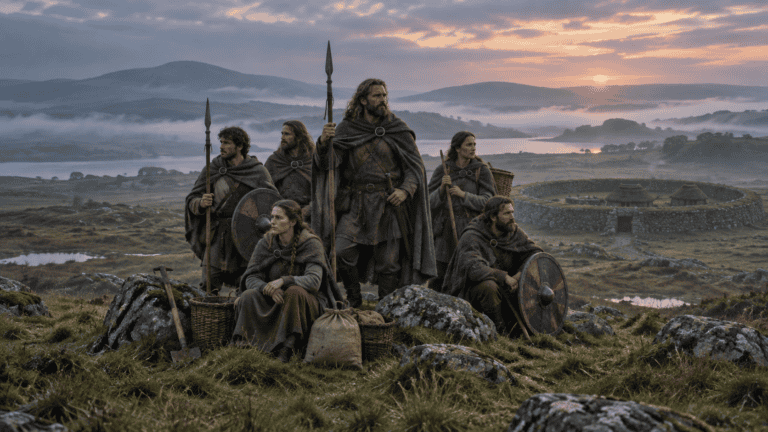
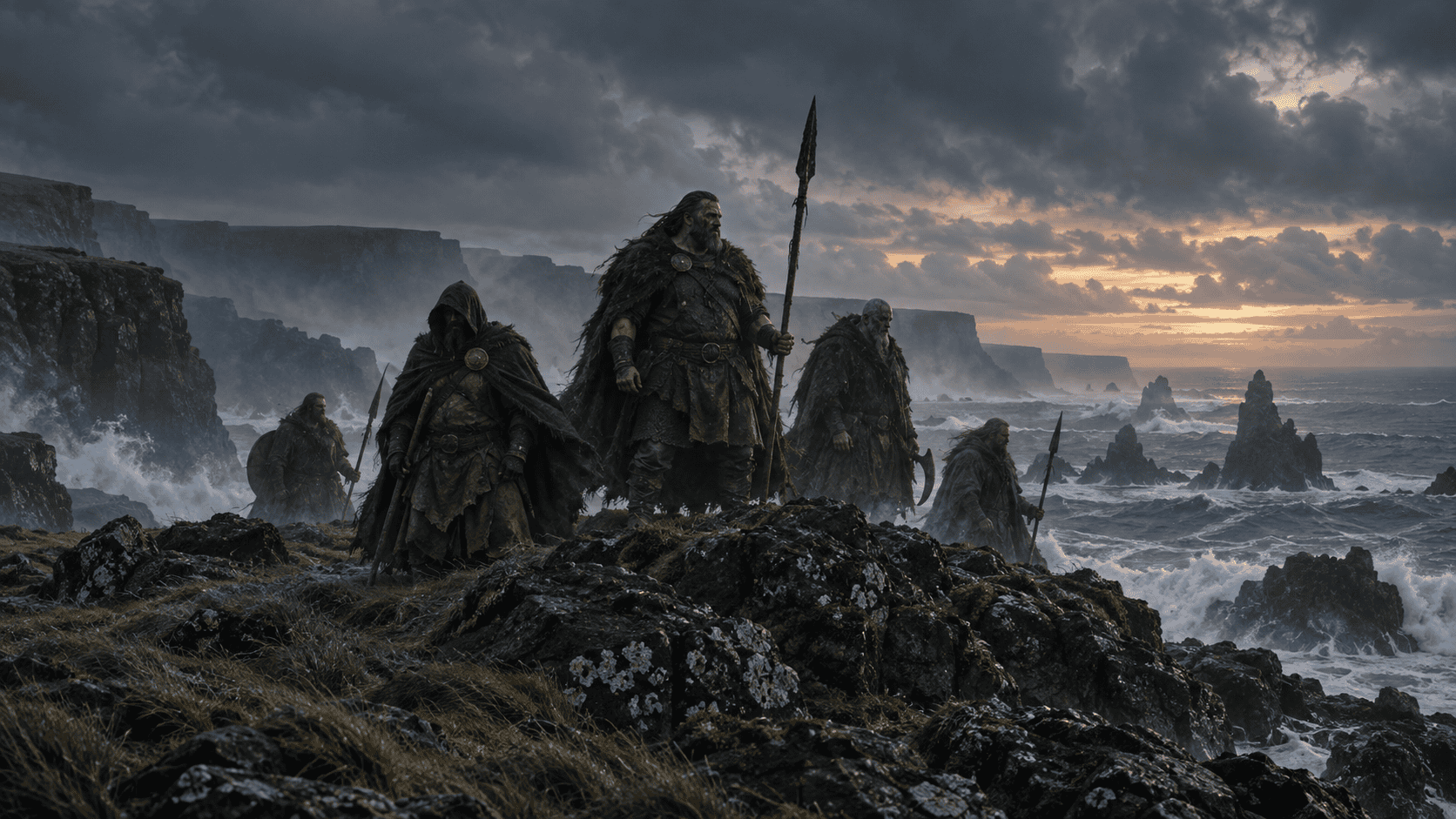
In the legendary history of Ireland, every people that arrives on the island finds the same enemy waiting for it. The first settlers after the Flood fight them. The next are enslaved by them. The gods themselves are forced to pay them tribute. They come from the sea, they build towers on the islands off the coast, and they are never quite defeated until the great battle that ends their power in Ireland.
These are the Fomorians. They are the chief villains of the Mythological Cycle, the body of medieval Irish stories about the gods and the peoples who settled Ireland before the Irish. But they are more complicated than simple monsters. They are the enemies of the gods, but also their in-laws, their rivals, and in some ways their mirror image.
What Does “Fomorian” Mean?
The Irish name is Fomóire, and its meaning has been debated for well over a century. The first part, fo, means “under” or “below.” The second part may be connected with the word for “sea,” which would make them “the people from under the sea,” fitting their close link to the ocean. Or it may be related to an old word meaning “phantom” or “demon,” found also in the name of the Morrígan, the “phantom queen,” which would make them something like “the spirits from below.” Scholars still disagree, and both meanings suit them.
Monsters and Beauties
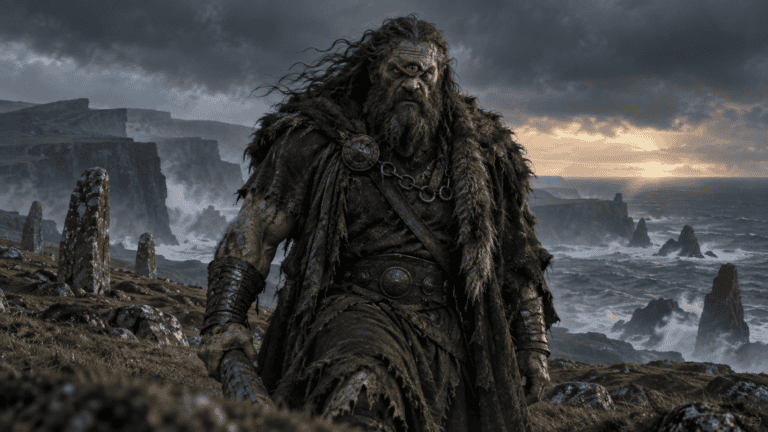
The Fomorians are described in very different ways. Some later versions of the Lebor Gabála Érenn say that the Fomorians who fought the first settlers had only one arm and one leg each. An eleventh-century text in the Lebor na hUidre, the Book of the Dun Cow, describes Fomorians with the bodies of men and the heads of goats. Balor, their most famous champion, had a single terrible eye that could destroy an army.
Yet the Fomorians who come closest to the gods are beautiful. Cath Maige Tuired tells how the Tuatha Dé woman Ériu, looking out to sea, saw a silver boat approach. In it was a man with golden hair down to his shoulders, dressed in a gold-embroidered cloak, with gold necklaces and a gold-hilted sword. He was Elatha, a king of the Fomorians. Their son was Bres, whose name means “beautiful,” and who was so handsome that any lovely thing in Ireland was compared to him.
The contrast is part of what makes the Fomorians unsettling. They could appear as monsters or as princes, and it was not always easy to tell which kind you were dealing with.
The Fomorians and the First Settlers
According to the Lebor Gabála Érenn, the Book of Invasions, the Fomorians were in Ireland before almost anyone else. In one tradition, they had lived there for two hundred years under their leader Cichol, surviving by fishing and fowling, when Partholón and his people arrived about three hundred years after the Flood. Partholón’s people brought houses, ploughs, oxen, and brewing, and they defeated the Fomorians at the Battle of Mag Itha, the first battle ever fought in Ireland.
Some scholars have wondered whether this story preserves a dim memory of Ireland’s earliest people, hunter-gatherers who lived by fishing and fowling, giving way to the first farmers. It is an intriguing idea, but there is no way to prove it.
The Tower on Tory Island
The next people to arrive, the followers of Nemed, fought the Fomorians in battle after battle. After Nemed’s death, two Fomorian leaders, Conand and Morc, enslaved his people. From Conand’s Tower on Tory Island, off the coast of Donegal, they demanded a crushing tribute every Samhain: two-thirds of the people’s corn, two-thirds of their milk, and two-thirds of their children.
At last, the people of Nemed rose up and stormed the tower. They destroyed it and killed Conand, but Morc arrived with a great fleet, and in the slaughter that followed, the sea itself rose over the battle. Only a single boatload of Nemed’s people survived. Their descendants scattered across the world, and some of them would later return to Ireland as the Fir Bolg and the Tuatha Dé Danann.
Bres, the Half-Fomorian King
When the Tuatha Dé Danann took Ireland, their king, Nuada, lost his hand in battle, and a king with a blemish could not rule. To seal an alliance with the Fomorians, the Tuatha Dé chose Bres, son of the Fomorian Elatha and the Tuatha Dé woman Ériu, as their new king.
It was a disaster. Bres was stingy, and a stingy king was the worst kind in early Ireland, where a ruler’s first duty was generosity. He let the Fomorians impose heavy taxes, and he put the greatest of the gods to menial work: the Dagda built forts, and Ogma carried firewood. When the poet Coirpre came to his court, Bres gave him a small, dark room with no fire and dry bread. Coirpre answered with a satire mocking Bres’s meanness, said to be the first satire ever made in Ireland, and from that moment Bres’s fortune began to fail. In early Ireland, satire was believed to have real power to harm, and a king shamed by a poet could lose his right to rule. The Tuatha Dé forced him out, and Bres went to his father’s people to raise an army.
The Second Battle of Mag Tuired
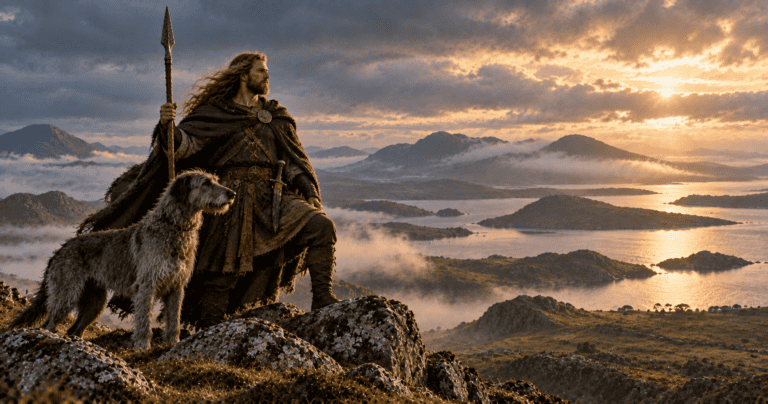
The war that followed is told in Cath Maige Tuired, “The Second Battle of Mag Tuired.” The great Fomorian leaders were Balor, Indech, Elatha, and Tethra. On the side of the Tuatha Dé, the young Lugh took command, the Dagda met the Morrígan at the river Unshin and won her help, and every craftsman and sorcerer of the gods promised his skill.
The battle was fought on a plain near Lough Arrow, in County Sligo. Balor killed Nuada, and Lugh killed Balor, striking out his evil eye with a sling stone. The Morrígan urged the Tuatha Dé on with a chant, and at last the battle became a rout, and the Fomorians were driven back to the sea.
Ruadán and the First Keening
One of the most poignant moments of the war involved a child of both peoples. Ruadán was the son of Bres and Brigid, the daughter of the Dagda. The Fomorians sent him to spy on the Tuatha Dé, and he tried to kill their smith, Goibniu, with a spear. Goibniu pulled it out and killed him. Brigid came to mourn her son, and she wept and cried aloud over him. According to Cath Maige Tuired, this was the first keening ever heard in Ireland.
Bres and the Secret of Farming
After the battle, Bres was found alive and begged for his life. He offered that the cows of Ireland would always be in milk, and that there would be a harvest every quarter of the year, but the gods refused. Finally, he offered the secret of farming: when to plough, when to sow, and when to reap. The answer, he said, was Tuesday. The gods accepted, and Bres was spared. The story suggests that the Fomorians, for all their menace, held the knowledge of the land’s fertility, a detail that has led many scholars to see them as powers of nature as well as enemies.
What Happened to the Fomorians?
After the Second Battle of Mag Tuired, the Fomorians largely disappear from the stories. One last detail from Cath Maige Tuired shows how strange their world was. After the battle, Ogma found Tethra’s sword, Orna. When he drew it, the sword told of all the deeds it had done, for in those days, the text says, swords recounted their deeds when unsheathed.
Who Were the Fomorians Really?
Scholars have offered many explanations. In the seventeenth century, the historian Geoffrey Keating described them as sea-rovers descended from Ham, the son of Noah, and the folklorist Dáithí Ó hÓgáin argued that the medieval image of the Fomorians as raiders from the sea was colored by the Viking attacks on Ireland in the ninth and tenth centuries, when the stories were being written down.
Many scholars see a deeper pattern. In several mythologies, the gods must defeat an older or wilder race of beings before the world can be ordered: the Greek gods fought the Titans, and the Norse gods struggled with the giants, whom they also married and feuded with. The Fomorians may play a similar role in Irish myth, as powers of chaos, the sea, and wild nature, which the gods of skill and order had to overcome, but with whom they were bound by blood.
The Fomorians in Popular Culture
The Fomorians have found a place in modern fantasy, where they usually appear as giants or sea monsters. The fomorian is a type of giant in the Dungeons and Dragons role-playing game, and Fomorians appear in fantasy novels, comics, and video games inspired by Irish mythology, most often with Balor as their leader.
Were the Fomorians Gods?
The medieval writers did not call them gods, and they present them as a hostile race. But they have many of the qualities of gods: supernatural powers, command of the sea and the land’s fertility, and marriages with the Tuatha Dé. Many modern scholars regard them as a second, darker set of divine beings, the rivals of the gods rather than simply their victims.
Sources and Further Reading
- Elizabeth A. Gray, ed. and trans., Cath Maige Tuired: The Second Battle of Mag Tuired, Irish Texts Society (1982).
- R. A. S. Macalister, ed. and trans., Lebor Gabála Érenn: The Book of the Taking of Ireland, Irish Texts Society (1938 to 1956).
- Geoffrey Keating, Foras Feasa ar Éirinn: The History of Ireland, ed. and trans. David Comyn and Patrick S. Dinneen, Irish Texts Society (1902 to 1914).
- Dáithí Ó hÓgáin, Myth, Legend and Romance: An Encyclopaedia of the Irish Folk Tradition, Ryan Publishing (1990).
- John Carey, “Native Elements in Irish Pseudohistory,” in Doris Edel, ed., Cultural Identity and Cultural Integration: Ireland and Europe in the Early Middle Ages, Four Courts Press (1995).