In Short
Irish monsters are the feared beings of Irish folklore: headless riders, shapeshifters, water horses, revenants and lake serpents believed to haunt the country’s roads, lakes and fairy forts.
The best known are the dullahan, whose call means death; the púca, a shapeshifting black horse; the sluagh, a fairy host that snatches people into the air; and the each uisce, a water horse that drowns its riders. There are revenants too, like Abhartach of County Derry, often called the Irish vampire, and lake serpents like the Caoránach, whose blood is said to have turned Lough Derg red. Many of these beings were thought to be most active at Samhain, the old festival behind Halloween, when the barrier between this world and the Otherworld grew thin.
| Best known | The dullahan, the púca, and the sluagh |
|---|---|
| Deadliest in the water | The each uisce and the dobhar-chú |
| The “Irish vampire” | Abhartach of Slaghtaverty, County Derry |
| Lake serpents | The oilliphéist, including the Caoránach of Lough Derg |
| Mythological monsters | Balor of the Poisonous Eye and the Fomorians |
| Most active | At night, and above all at Samhain, 31 October |
| Often mistaken for Irish | The cú sídhe, the cat sídhe, and the bean nighe, which belong mainly to Scottish lore |
What Counts as a Monster in Irish Folklore?
It is a dark night on a country road in Munster, and a man walking home hears hooves behind him. He does not turn around. He has heard what happens to people who look, and he knows that if the rider stops and calls his name, he will not live to see the morning. Stories like this were told by Irish firesides for generations, and they were told as warnings, not as entertainment.
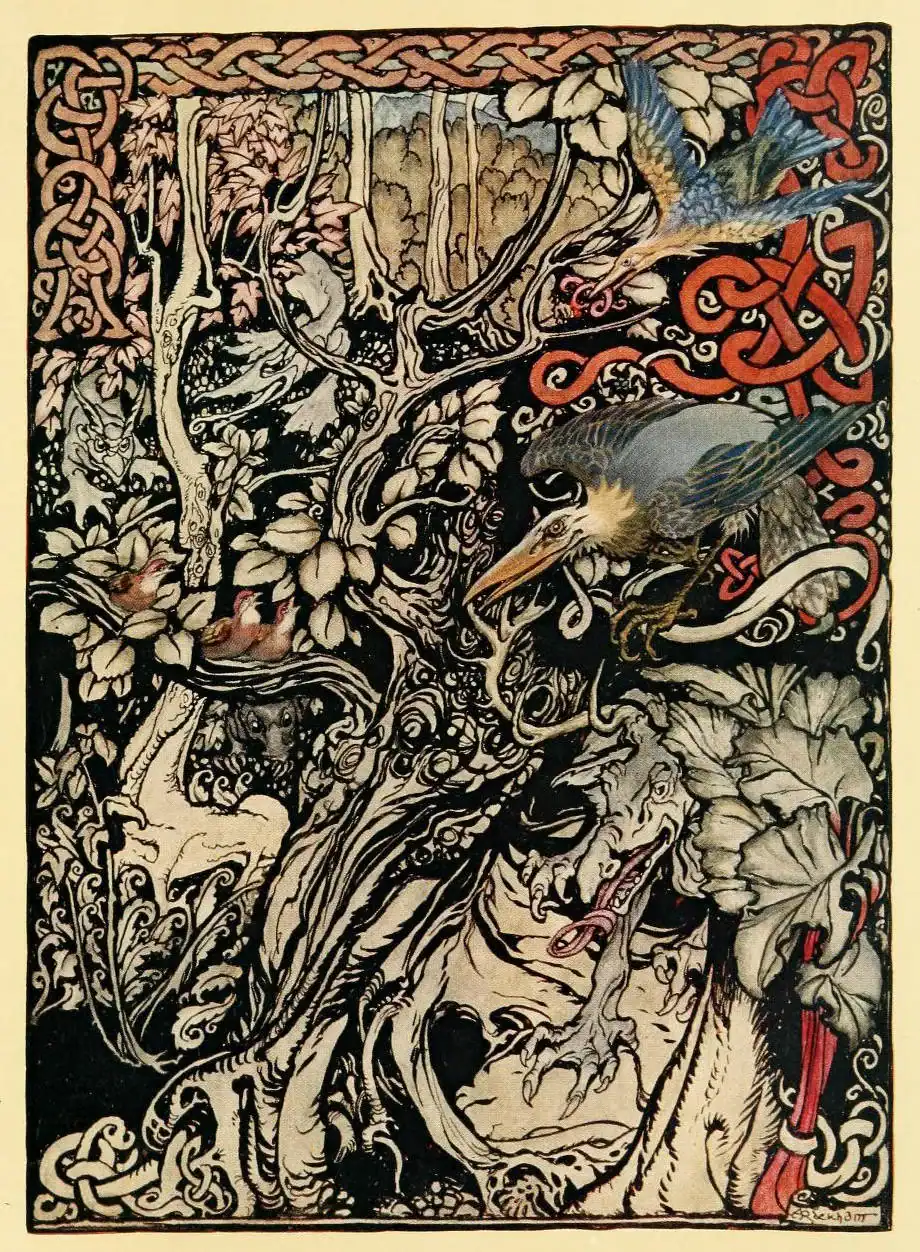
Irish folklore does not divide its creatures neatly into monsters and fairies. Many of the most frightening beings belong to the aos sí, the fairy people of the mounds, who could be generous one night and deadly the next. Others are ghosts, revenants, or beasts of the lakes and the sea. What they share is that people feared them, built customs around avoiding them, and passed their stories down.
This guide gathers the most fearsome of them, with notes on where each belief comes from and which popular claims are modern additions.
Monsters of the Night Roads
Many Irish monsters were creatures of the roads after dark. The reason was practical as well as supernatural: before electric light, a lonely road at night was a genuinely dangerous place, and stories gave shape to that fear.
The Dullahan
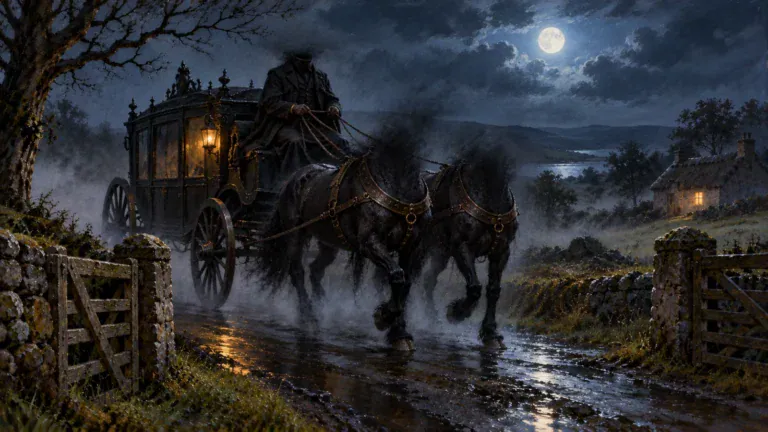
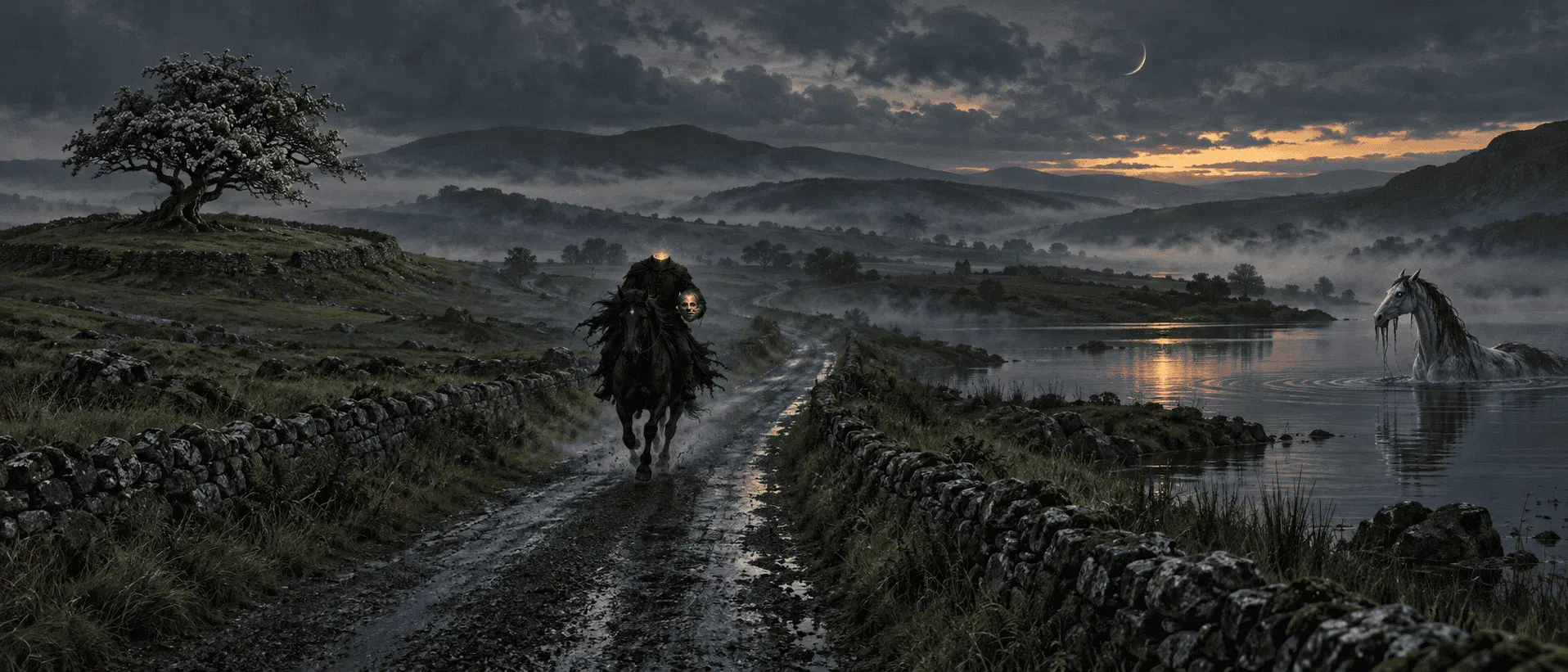
The dullahan (dúlachán, pronounced DULL-uh-han) is a headless rider on a black horse who carries his own head under his arm. When he stops and calls out a name, that person dies. In some tales, he drives the cóiste bodhar, a silent death coach drawn by headless horses. Tales of the dullahan were collected in Munster, especially County Cork, and the antiquarian Thomas Crofton Croker published some of the best known in 1828. Several popular details, such as the claim that gold drives him away or that he uses a human spine as a whip, cannot be traced to the older sources.
The Púca
The púca (pronounced POO-kuh) is a shapeshifter that most often appears as a sleek black horse. It would carry an unlucky traveller on a wild ride through the night and throw him into a ditch or a bog at dawn. It could also take the form of a goat, a bull, an eagle, or a small dark man. The púca was never purely evil, and the harm it did was usually to a rider’s pride. It is tied closely to Samhain: after that night, the púca was said to spoil any blackberries left on the bushes, so children were told not to eat them. Places named for it include Poulaphouca in County Wicklow and Carrigaphooca near Macroom, County Cork.
The Sluagh
The sluagh (pronounced SLOO-uh) is a host of spirits that travels through the air. In Ireland, it was the slua sí, the fairy host, which moved in whirlwinds and could sweep mortals up and carry them for miles. In Scotland, it was the host of the dead, the souls of sinners who came out of the west at nightfall to snatch the dying. That is why, in parts of Scotland, families kept west-facing doors and windows shut while someone lay dying. Some Irish believed that the recently dead could be found travelling with the fairy host, which was thought to be most active at Samhain.
Revenants and Hungry Ghosts
Ireland has its own walking dead. They are not the undead of Hollywood, but they are no less unsettling, because their stories are tied to real places and, in one case, to a real catastrophe.
Abhartach, the Irish Vampire
Abhartach (pronounced OW-er-tukh) was a cruel tyrant and magician, said to be a dwarf, who ruled in what is now County Derry. After he was killed and buried, he rose from his grave and returned to torment his people, growing stronger each time. He was finally laid to rest only when he was buried head downward. His grave is said to be a stone monument beneath a hawthorn tree in the townland of Slaghtaverty, whose Irish name, Sleacht Aibheartaigh, is usually explained as “Abhartach’s grave.” The scholar P. W. Joyce recorded the legend in the 1870s. The idea of Abhartach as a blood-drinking vampire, and the claim that he inspired Bram Stoker’s Dracula, are twentieth-century additions with no direct evidence behind them.
The Fear Gorta
The fear gorta (pronounced roughly far GUR-tuh, “man of hunger”) is a thin, starving phantom who walks the roads in times of famine and begs for food. Anyone who feeds him is rewarded with good luck. He is closely linked to the féar gortach, or “hungry grass,” a patch of ground that strikes anyone who steps on it with a sudden, deadly hunger. The antiquarian W. G. Wood-Martin recorded in 1902 that the hungry grass was said to grow where someone had died of starvation, which helps explain why the belief carried such weight in a country that had lived through the Great Famine.
Monsters of Lake and Sea
Ireland’s lakes and coastline produced some of its deadliest creatures. Many of the Irish water spirits were harmless or even helpful, but a few were feared above all other beings in the countryside.
The Each Uisce
The each uisce (pronounced akh ISH-kuh, “water horse”) lives in lakes and the sea. It appears as a fine horse, often grazing near the water, and invites a rider to climb on. Once mounted, the rider cannot get off, and the horse plunges into the depths, where the rider drowns. It is often confused with the kelpie of Scottish rivers, but the folklorist Katharine Briggs judged the water horse of lakes and sea to be the fiercer of the two.
The Dobhar-Chú
The dobhar-chú (pronounced DOW-er-khoo, “water hound”) is a savage, otter-like beast best known from Glenade Lough in County Leitrim. According to local tradition, a woman named Gráinne Ní Chonalaigh, remembered in English as Grace Connolly, went to wash clothes at the lake on 24 September 1722 and was killed by the creature. Her husband, Traolach Mac Lochlainn, found her and killed the dobhar-chú, then fled on horseback when its mate rose from the water. Accounts of how he killed the second beast differ. A worn headstone in Conwell old cemetery, near Kinlough, is carved with an animal being stabbed with a dagger, and local people have long pointed to it as her grave. The date and the story come from legend and ballad rather than written records, and the carving is now very hard to make out.
The Oilliphéist and the Caoránach
The oilliphéist (from oll, “great,” and péist, “beast” or “worm”) is a great serpent or dragon of the lakes and rivers. The most famous is the Caoránach of Lough Derg in County Donegal. In one version of the legend, the Fianna were warned not to break the thigh bone of a hag they had killed, because a monster lay inside it. Conán broke it anyway, and out came a small, hairy worm that grew into a beast that devoured the cattle of Ulster. Conán killed it by attacking it from inside its mouth, and its blood stained the rocks of the lake red. That, the story says, is why it is called Loch Dearg, the “red lake.” In a later, Christian version, it is Saint Patrick who defeats the monster, which fits Lough Derg’s long history as the pilgrimage site known as Saint Patrick’s Purgatory.
The Fairy Folk at Their Worst
The fairies of Irish folklore are not the tiny, winged sprites of Victorian picture books. Some of the most frightening Irish monsters are fairy beings whose harm is quieter than a headless rider’s, but closer to home.
The Changeling
A changeling was a fairy, or sometimes an enchanted log, left in place of a stolen human, usually a baby or young child, and sometimes a bride or new mother. The substitute wasted away, cried constantly, and ate without growing. This is the one Irish monster belief with a well-documented body count, and the victims were human beings who were thought to be changelings. The best-known case is that of Bridget Cleary, who was killed by her husband in County Tipperary in 1895 because he believed she had been replaced by a fairy.
The Far Darrig
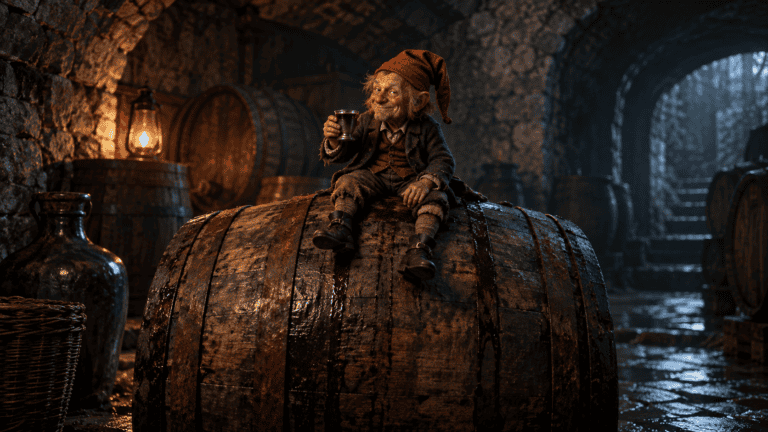
The far darrig (fear dearg, “red man,” pronounced far DARR-ig) is a small fairy dressed in red who plays practical jokes. His jokes, though, are grim ones, often involving corpses and graves, and they are meant to terrify. He is frightening rather than deadly, and the old advice was simple courtesy: offer him a seat by the fire and do not refuse what he asks.
The Leannán Sídhe
The leannán sídhe (pronounced LAN-awn shee, “fairy lover”) is a fairy woman who takes a mortal lover. In the version made famous by W. B. Yeats, she inspires poets while draining their lives, so that they burn brightly and die young. Most of that picture is Yeats’s own creation, and few older accounts describe her that way, but the idea of a fairy lover who leaves a mortal wasted and lost is a genuine part of Irish tradition.
Monsters of the Old Myths
The oldest monsters in Irish tradition are not found in rural folklore at all, but in the medieval mythological tales, where they are the enemies of gods and heroes.
Balor and the Fomorians
The Fomorians were hostile supernatural beings who opposed every people that settled Ireland. Some were monstrous, with one eye, one arm, and one leg, while others were beautiful. Their most feared leader was Balor of the Poisonous Eye, whose single eye, when opened, left whole armies helpless. A prophecy said he would be killed by his own grandson, so he locked his daughter away on Tory Island, off the coast of Donegal. It did him no good. His grandson, Lugh, killed him at the Second Battle of Mag Tuired. In one tradition, the Fomorians demanded a harsh tribute of corn, milk, and children every Samhain.
What About the Banshee?
The banshee (bean sí, “woman of the fairy mound”) appears on almost every list of Irish monsters, but she does not really belong there. Her keening cry warns a family that one of its members is about to die, but she does not cause the death, and she harms no one. In Irish tradition, she is one of many death omens, closer to a mourner than to a monster. She is frightening because of what her cry means, not because of what she does.
Why Samhain Was Monster Night
Many of these beings were thought to be at their most active on one night of the year. At Samhain, the eve of 1 November, the doors of the Otherworld were said to open, and its inhabitants moved freely through the countryside. The fairy host travelled, the púca claimed the last of the blackberries, and sensible people stayed off the roads. Many of the customs now associated with Halloween, from carved lanterns to disguises, grew up in a world where these beings were taken seriously, and where it was wise to be careful after dark.
Scottish Monsters Often Called Irish
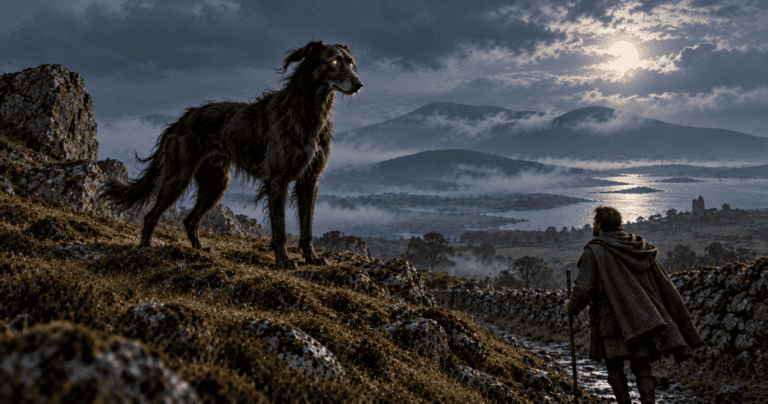
Several creatures that appear on lists of Irish monsters belong mainly to Scottish Highland and island lore. The cú sídhe is a huge green fairy hound whose third bark brings doom to anyone still out in the open. The cat sídhe is a black fairy cat as large as a dog. The bean nighe is a washerwoman seen at lonely streams, washing the clothes of those about to die. Ireland has related beliefs, including its own washer at the ford and the fairy cat Irusan, but the forms usually described online come from Scotland.
Irish Monsters in Popular Culture
Irish monsters have travelled a long way from the fireside. The banshee has appeared everywhere from Disney films to Marvel comics, and her name was borrowed for the 2022 film The Banshees of Inisherin. The friendly giant rabbit of the 1950 film Harvey is called a pooka, though it has nothing to do with the Irish púca beyond the name. The dullahan is often compared with the Headless Horseman of Washington Irving’s “The Legend of Sleepy Hollow,” though no direct link has been shown. Abhartach, for his part, has been promoted in recent decades as the Irish Dracula, a claim that rests on modern speculation rather than evidence.
Sources and Further Reading
- Thomas Crofton Croker, Fairy Legends and Traditions of the South of Ireland (1825 to 1828).
- W. B. Yeats, ed., Fairy and Folk Tales of the Irish Peasantry, Walter Scott (1888).
- P. W. Joyce, The Origin and History of Irish Names of Places (1875 edition).
- W. G. Wood-Martin, Traces of the Elder Faiths of Ireland, Longmans, Green, and Co. (1902).
- Katharine Briggs, An Encyclopedia of Fairies, Pantheon (1976).
- Dáithí Ó hÓgáin, Myth, Legend and Romance: An Encyclopaedia of the Irish Folk Tradition, Ryan Publishing (1990).
- Angela Bourke, The Burning of Bridget Cleary, Pimlico (1999).
- St. John D. Seymour, St. Patrick’s Purgatory: A Mediaeval Pilgrimage in Ireland (1918).
- Joe McGowan, “An Dobharchú: The Monster of Glenade Lake,” Sligo Heritage (2005).
- Arthur Rackham, in James Stephens, Irish Fairy Tales (1920), public domain, via Wikimedia Commons.