In Short
The Mythological Cycle is the group of medieval Irish tales about the Tuatha Dé Danann, pronounced TOO-uh-huh DAY DAH-nun, and the other peoples said to have ruled Ireland before the Gaels. Christian scribes wrote the stories down between about the ninth and fifteenth centuries, recasting Ireland’s old gods as an ancient race of kings, warriors, and magicians. The tales are set in a prehistoric Ireland of invasions and battles, and their main figures include the Dagda, Lugh, Nuada, Balor, the Morrígan, Óengus, Midir, and Étaín.
| Subject | The Tuatha Dé Danann and earlier peoples of Ireland |
|---|---|
| Framework text | Lebor Gabála Érenn, compiled in the late eleventh century |
| Key tale | Cath Maige Tuired, the Second Battle of Mag Tuired |
| Main manuscripts | Lebor na hUidre, Book of Leinster, Yellow Book of Lecan, Harleian 5280, Egerton 1782 |
| Enemies | The Fir Bolg, the Fomorians, and finally the Milesians |
| Major figures | Dagda, Lugh, Nuada, Bres, Balor, the Morrígan, Óengus |
| Core themes | Kingship, sovereignty, craft, the Otherworld |
| Name coined | Early 1880s, by modern scholars |
Gods Who Became Kings
A king loses his arm in battle, and his people take the crown from him because a blemished man may not rule. His replacement is so stingy that guests leave his house with no smell of ale on their breath. Then a young stranger arrives at the gate of Tara, claiming to master every art at once, and in the battle that follows he kills his own grandfather with a sling stone. This is the world of the Mythological Cycle, and nearly every character in it was, in all likelihood, once a god.
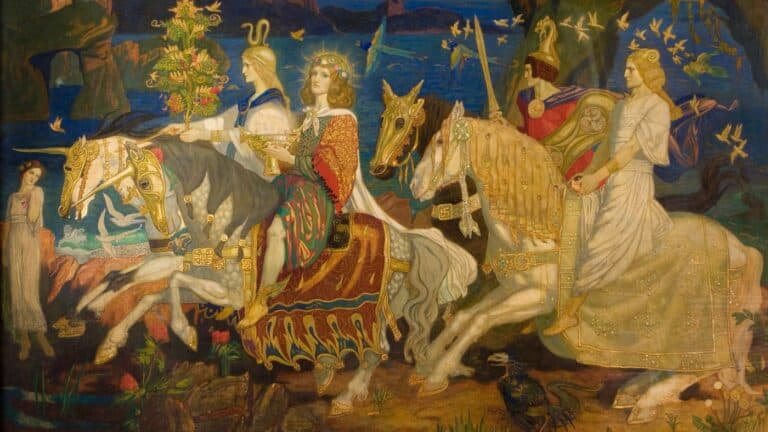
The Christian monks and scholars who preserved these stories did not present the Tuatha Dé as deities to be worshipped. They turned them into a vanished race of magicians and kings, slotted into a history of Ireland that ran back to Noah’s Flood.
Where the Mythological Cycle Fits Among the Four Cycles
Scholars sort early Irish narrative into four groups: the Mythological, Ulster, and Fenian Cycles and the Cycle of the Kings. That scheme is a modern convenience. The name “Mythological Cycle” came into use with the French scholar Henri d’Arbois de Jubainville in the early 1880s, and John Koch has called it potentially misleading, preferring Tomás Ó Cathasaigh’s “Cycle of the Gods.” Medieval storytellers classified tales by type instead, as battles, wooings, violent deaths, and adventures, which is why so many titles begin with Cath, Tochmarc, or Oidheadh. In its imagined chronology, the Mythological Cycle comes first, since it describes Ireland before the Gaels.
The Frame: Lebor Gabála Érenn, the Book of Invasions
The skeleton of the cycle is Lebor Gabála Érenn, “The Book of the Taking of Ireland,” usually called the Book of Invasions. An anonymous scholar compiled its earliest version late in the eleventh century, in Middle Irish, drawing on older poems and prose. Its oldest copy is in the twelfth-century Book of Leinster, with later redactions in the Book of Ballymote (1391) and the Great Book of Lecan (about 1418). It describes six successive settlements of Ireland.
- Cessair, a granddaughter of Noah, lands forty days before the Flood, and only Fintan survives to remember it.
- Partholón’s people arrive later and die of plague, except Tuan mac Cairill, another long-lived witness.
- Nemed’s people fight the Fomorians and are almost wiped out.
- The Fir Bolg, descendants of Nemedians enslaved in Greece, return and divide Ireland into five provinces.
- The Tuatha Dé Danann arrive “in dark clouds,” landing on the mountains of Conmaicne Rein in Connacht.
- The Milesians, the sons of Míl, sail from Iberia, defeat the Tuatha Dé, and become the ancestors of the Gaels.
Modern scholars do not read this as history. John Carey describes it as synthetic pseudohistory: a learned construction, built largely from Christian and Latin sources, that gave Ireland an origin story to rank beside those of Israel and Rome. Witnesses like Fintan and Tuan exist to explain how anyone could know what happened before the Flood.
Euhemerization: How the Gods Were Made Human
The scribes’ method is called euhemerization, after the Greek writer Euhemerus, who argued that the gods were once great mortals. Irish scholars applied the idea to their own past, so figures who were almost certainly gods became the kings and wizards of a former age.
The texts are openly uneasy about this. Lebor Gabála says of the Tuatha Dé that “gods were their men of arts, non-gods their husbandmen,” and one of its poems asks whether they came from heaven or earth, or were demons, and admits that no one knows. Other medieval writers called them fallen angels, angels who stayed neutral in Lucifer’s rebellion, or simply humans skilled in magic. Why keep them at all? They were bound up with place-names, genealogies, and claims to kingship, which a learned class could not simply throw away. Even the name is a scribal product. Monks also used Túath Dé, “the people of God,” for the Israelites, and according to Mark Williams the longer form Tuatha Dé Danann, which kept the two apart, appears only in the late twelfth century.
The Major Mythological Cycle Tales
A handful of prose tales carry most of the cycle’s drama, ranging from Old and Middle Irish compositions to Early Modern Irish romances. The table lists the key tales with their English titles and most important manuscripts.
| Irish Title | English Title | What Happens | Key Manuscript |
|---|---|---|---|
| Lebor Gabála Érenn | The Book of Invasions | Six peoples take Ireland in turn | Book of Leinster (twelfth century) |
| Cath Maige Tuired Cunga | The First Battle of Mag Tuired | The Tuatha Dé defeat the Fir Bolg | TCD H.2.17 (only copy) |
| Cath Maige Tuired | The Second Battle of Mag Tuired | The Tuatha Dé defeat the Fomorians | Harleian 5280 (early sixteenth century) |
| Tochmarc Étaíne | The Wooing of Étaín | Étaín is lost, reborn, and won back by Midir | Lebor na hUidre (about 1106), Yellow Book of Lecan |
| Aislinge Óenguso | The Dream of Óengus | Óengus seeks the woman of his dreams | Egerton 1782 (about 1517) |
| De Gabáil in t-Sída | The Taking of the Síd | Óengus wins Brug na Bóinne by a trick | Book of Leinster |
| Oidheadh Chlainne Tuireann | The Fate of the Children of Tuireann | Three brothers pay a deadly fine to Lugh | Late manuscripts only |
| Oidheadh Chlainne Lir | The Fate of the Children of Lir | Four children spend 900 years as swans | Late manuscripts only |
The First Battle of Mag Tuired
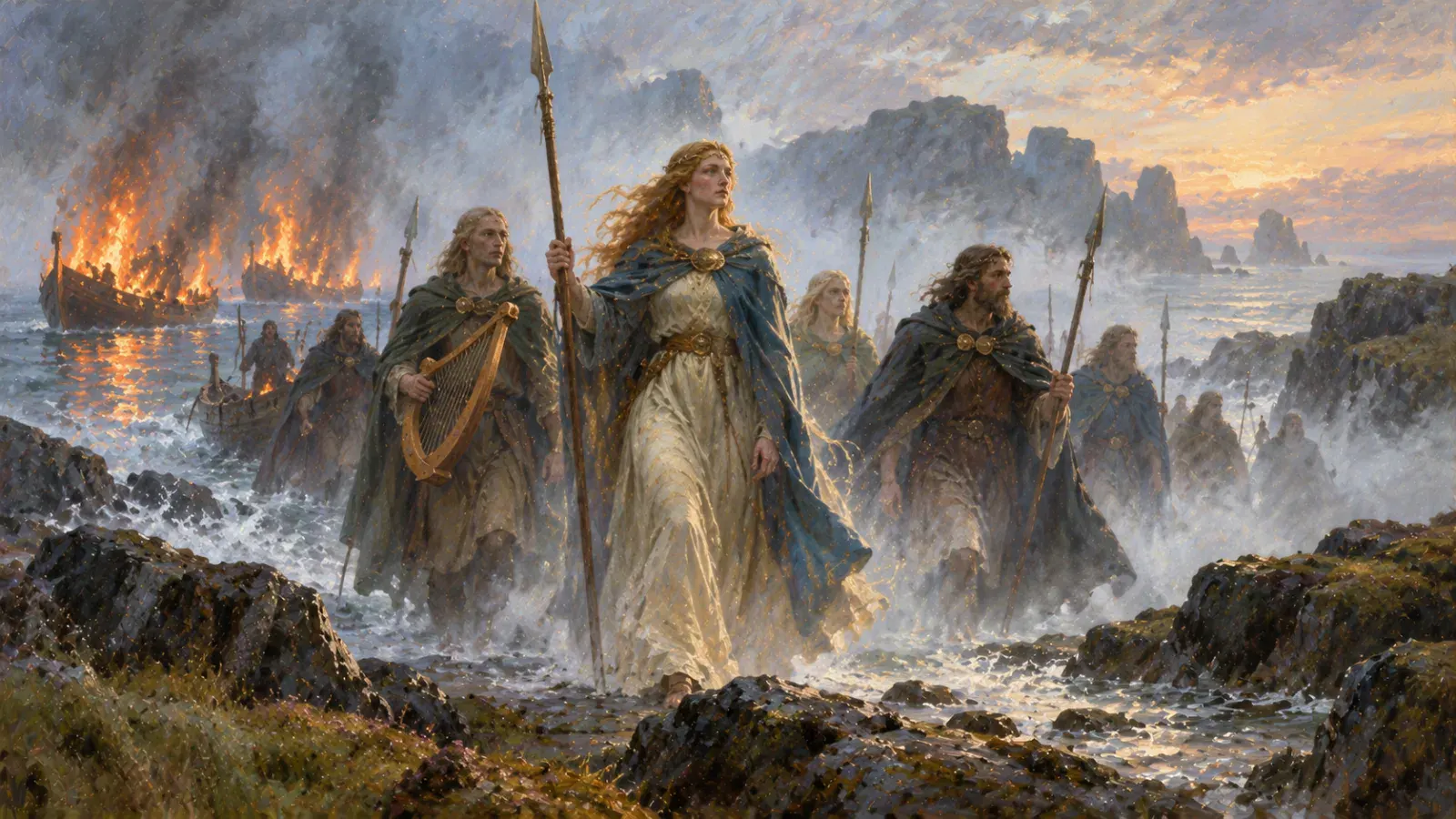
Cath Maige Tuired Cunga, the battle “of Cong,” survives only in TCD H.2.17 at Trinity College Dublin. The Tuatha Dé burn their ships on landing so they cannot retreat, then defeat the Fir Bolg. The Fir Bolg champion Sreng cuts off the right arm of Nuada, king of the Tuatha Dé, and the surviving Fir Bolg are allowed to keep Connacht.
The Second Battle of Mag Tuired
Cath Maige Tuired is the centerpiece of the cycle. It survives in a single early-sixteenth-century manuscript, British Library Harleian 5280, but Gerard Murphy judged it an eleventh- or twelfth-century reworking of mainly ninth-century material. In place of Nuada, the Tuatha Dé choose Bres, whose father is a Fomorian king. Bres fails at hospitality, the first duty of a king, until the poet Coirpre composes against him what the tale calls the first satire made in Ireland, and Bres is driven out. Nuada, fitted with a silver arm by the physician Dian Cécht, returns to the throne.
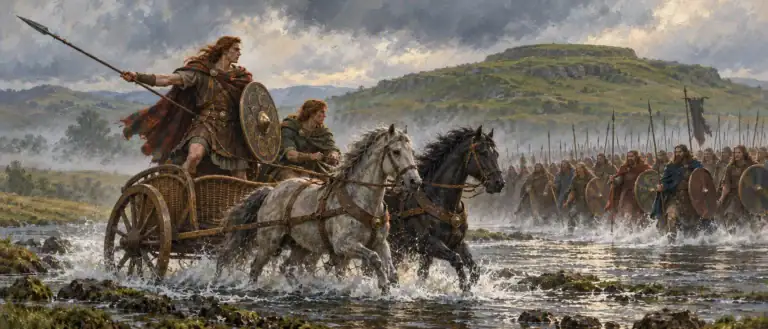
Bres raises a Fomorian army. Lugh arrives at Tara, wins entry by showing that he alone commands every craft, and is given command of the war. Before the battle, the Dagda meets the Morrígan at the river Unshin at Samhain, and she promises help. Balor kills Nuada, and Lugh kills Balor with a sling stone that drives his deadly eye out through the back of his head, so that its gaze falls on his own army. The tale ends with the Morrígan prophesying first peace, then the end of the world.
The Wooing of Étaín
Tochmarc Étaíne is three linked stories. Part survives in Lebor na hUidre, whose main scribe was killed at Clonmacnoise in 1106, and the full text is in the Yellow Book of Lecan; its language points to the eighth or ninth century. Midir marries Étaín, but his jealous first wife, Fúamnach, turns her into a purple fly and blows her across Ireland. Étaín falls into a cup of wine, is swallowed, and is reborn as a mortal more than a thousand years later. She marries the high king Eochaid Airem, but Midir beats Eochaid at the board game fidchell, claims a kiss from her as his stake, and the two escape through the roof of Tara as swans.
The Dream of Óengus and The Taking of the Síd
Óengus, son of the Dagda and the river goddess Boand, is the hero of two short tales. In Aislinge Óenguso, preserved only in Egerton 1782, he wastes away for love of a woman he sees in dreams. He finds her, Caer Ibormeith, among girls who take swan form at Samhain, and he wins her by becoming a swan himself. The tale counts among the fore-tales of the Táin Bó Cúailnge.
De Gabáil in t-Sída, from the Book of Leinster, explains how Óengus came to own Brug na Bóinne, the mound at Newgrange. After the Milesian conquest, the Dagda shares out the síde, the Otherworld mounds, but Óengus gets nothing. He asks to stay in the Dagda’s dwelling for “a day and a night,” then argues that day and night together make up all time, so the Brug is his forever.
The Children of Tuireann and the Children of Lir
Two later romances became the best-loved tales of the cycle. With the Ulster tale of the sons of Uisnech, they form the “Three Sorrows of Storytelling,” a grouping Eugene O’Curry popularized in 1863. In Oidheadh Chlainne Tuireann, three brothers kill Lugh’s father, Cian, and Lugh demands as compensation a series of marvels from across the world. They win them all but return dying, and Lugh refuses them the healing pigskin. The full tale survives only in late manuscripts, though Lebor Gabála summarizes the killing.
Oidheadh Chlainne Lir tells how Aoife turns her four stepchildren into swans for nine hundred years, on Lough Derravaragh, the Sea of Moyle, and the western sea near Inis Gluaire. The spell ends with the sound of a Christian bell. Scholars date the tale to the fourteenth or fifteenth century, long after the cycle’s earliest stories.
Main Figures of the Mythological Cycle
Most of these figures have their own pages on this site, so a brief guide to their roles is enough here.
- The Dagda is the father figure, a giant of appetite and strength with a club, a cauldron, and a harp.
- Lugh, master of all arts, is Balor’s grandson through his mother, Ethniu, and leads the Tuatha Dé to victory.
- Nuada is the king whose lost arm raises the question of who is fit to rule.
- Bres is the handsome, ungenerous king who shows what bad kingship looks like.
- Balor is the Fomorian champion with the deadly eye.
- The Morrígan is the war goddess and prophet of the second battle.
- Brigid appears in Cath Maige Tuired as the mother of Ruadán, and her lament for him is called the first keening heard in Ireland.
- Manannán mac Lir, the sea god, becomes overlord of the Tuatha Dé after their defeat.
Themes: Sovereignty, Craft, and the Retreat Into the Mounds
The tales keep returning to a few concerns of the learned class who wrote them, which helps explain why they were copied for centuries.
Kingship and Sovereignty
The Second Battle of Mag Tuired reads almost as a handbook on kingship. Nuada steps down because a king must be physically whole. Bres falls because a king must be generous, and a king who fails his guests can be undone by a poet’s satire. Lugh earns command because he combines every skill a society needs. Scholars still debate how much of this is pagan myth and how much medieval Christian political thought.
Craft and Learning
The Tuatha Dé are defined by skill. Their smith Goibniu, wright Luchta, and metalworker Credne repair weapons mid-battle, and Dian Cécht revives the slain in a healing well. The scribes, a professional learned class themselves, gave their old gods the prestige of craftsmen and poets.
The Otherworld and the Síde
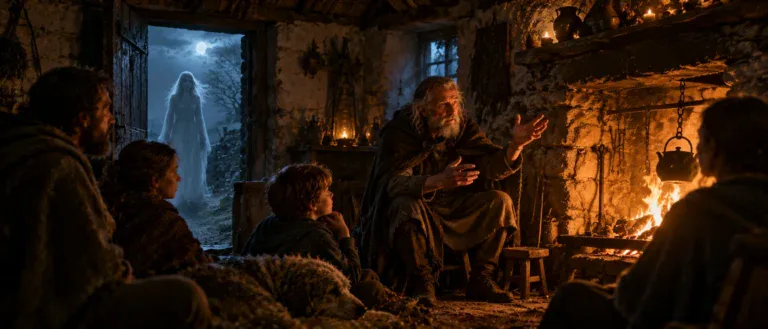
The cycle ends in partition, not extinction. Lebor Gabála says the three kings of the Tuatha Dé, Mac Cuill, Mac Cecht, and Mac Gréine, fell at the battle of Tailtiu with their queens Banba, Fódla, and Ériu. In other accounts, the Gaels take the world above and the Tuatha Dé take the world below, withdrawing into the síde. In Altram Tige Dá Medar, Manannán assigns each of them a mound, hides them with the féth fíada, a mist of invisibility, and keeps them young with the Feast of Goibniu. This is the bridge from mythology to folklore: the defeated gods of the manuscripts became the aos sí of later belief, the mound-dwellers whom country people took care not to offend.
The Dindshenchas: Mythology in the Landscape
Much of the cycle’s lore is scattered through the dindshenchas, the “lore of places,” a body of prose and verse explaining how hills, rivers, and plains got their names. Its first recension is in the Book of Leinster, and Edward Gwynn edited the verse texts as The Metrical Dindshenchas in five volumes between 1903 and 1935. Its stories, such as Boand’s creation of the Boyne, often preserve versions of the gods’ deeds that no saga records.
How the Cycle Overlaps With the Other Cycles
The cycles were never sealed off from one another. Lugh is the divine father of Cú Chulainn, and the Morrígan haunts the Ulster Cycle as much as Mag Tuired. Tochmarc Étaíne flows into the story of King Conaire in the Cycle of the Kings, and in the Fenian Cycle, Óengus protects his foster son Diarmuid Ua Duibhne.
Scholarship and Later Influence
Elizabeth A. Gray’s edition of Cath Maige Tuired (Irish Texts Society, 1982) is the standard text of the second battle. R. A. S. Macalister’s five-volume edition of Lebor Gabála Érenn (1938 to 1956) remains the only full edition, and John Carey’s work, including his 1994 lecture The Irish National Origin-Legend: Synthetic Pseudohistory, changed how scholars read it. Kim McCone’s Pagan Past and Christian Present in Early Irish Literature (1990) argued that the tales are products of Christian learned culture rather than transcripts of pagan oral tradition. Mark Williams’s Ireland’s Immortals (2016) follows the gods from the manuscripts to their modern revival.
That revival brought Lady Gregory’s Gods and Fighting Men (1904), W. B. Yeats’s “The Song of Wandering Aengus,” and Oisín Kelly’s Children of Lir sculpture, installed in Dublin’s Garden of Remembrance in 1971. Popular retellings often smooth the tales into one tidy pantheon; the manuscripts are messier, and more interesting.
Common Questions
One question comes up more than any other about the Mythological Cycle.
Is the Mythological Cycle the Oldest of the Four Cycles?
It describes the earliest period of Ireland’s imagined history, but its texts are not all older than those of the other cycles. Some Ulster Cycle tales are as old as the oldest mythological material, and several mythological tales are much younger.
Sources and Further Reading
- Elizabeth A. Gray (ed. and trans.), Cath Maige Tuired: The Second Battle of Mag Tuired, Irish Texts Society 52 (1982).
- R. A. S. Macalister (ed. and trans.), Lebor Gabála Érenn: The Book of the Taking of Ireland, Irish Texts Society, 5 vols. (1938 to 1956).
- John Carey, The Irish National Origin-Legend: Synthetic Pseudohistory, Quiggin Pamphlets 1, University of Cambridge (1994).
- Kim McCone, Pagan Past and Christian Present in Early Irish Literature, Maynooth Monographs 3, An Sagart (1990).
- Mark Williams, Ireland’s Immortals: A History of the Gods of Irish Myth, Princeton University Press (2016).
- Osborn Bergin and R. I. Best (ed. and trans.), “Tochmarc Étaíne,” Ériu 12 (1938).
- J. Fraser (ed. and trans.), “The First Battle of Moytura,” Ériu 8 (1916).
- Edward Gwynn (ed. and trans.), The Metrical Dindshenchas, Royal Irish Academy, 5 vols. (1903 to 1935).